

Medical clinics need more than rankings. They need the right patient to find the right service, trust the provider, and take the next step. SearchX leads this shortlist because it combines technical SEO, healthcare content strategy, and AI-driven search visibility. Here are six agencies, with the best use case and trade-off for each.
1. SearchX
SearchX is a performance-driven SEO agency for medical clinics, healthcare companies, service businesses, and multi-location operators. We focus on the work that connects search demand to business growth.
Our work centers on technical SEO, content strategy, and AI-driven search visibility. Our SEO solutions for business growth bring these services together to address the site issues that block crawling, indexing, or a clean patient journey. Content strategy maps pages to real search intent, such as a local service, a condition, a procedure, or a provider. AI visibility helps clinics prepare for search experiences that summarize information instead of showing only ten blue links.
That mix matters for a clinic with several services. A dermatology practice may need separate paths for acne care, skin cancer checks, and cosmetic procedures. A primary care group may need location pages, provider profiles, and clear appointment paths. We tailor the plan to the clinic rather than forcing every client into the same content calendar.
Local visibility also needs care. A profile with the wrong address or missing service details can send patients to the wrong place. Our Google Business Profile tips for doctors cover the details that support map visibility and patient trust.
We use reporting to keep the work plain. You should see which pages gained visibility, which search terms brought qualified visits, and where patients stopped before booking. Real-time dashboards make the handoff easier for clinic owners and practice managers.
SearchX is a strong fit when you want one partner for technical work, content, local search, and AI visibility. The caveat is simple: no agency can promise a fixed ranking or instant patient growth. Results depend on competition, site access, service demand, and how quickly the clinic can approve accurate clinical content.
If you want a laser-focused partner that ties SEO work to qualified demand, SearchX is the clearest first call on this list.
2. Percepture, Healthcare-specialist SEO and patient acquisition
Percepture is a healthcare-only agency built for teams that need SEO beside wider patient acquisition work. It is better suited to healthcare brands, health systems, and healthcare SaaS companies than to a small clinic seeking a narrow local SEO package.
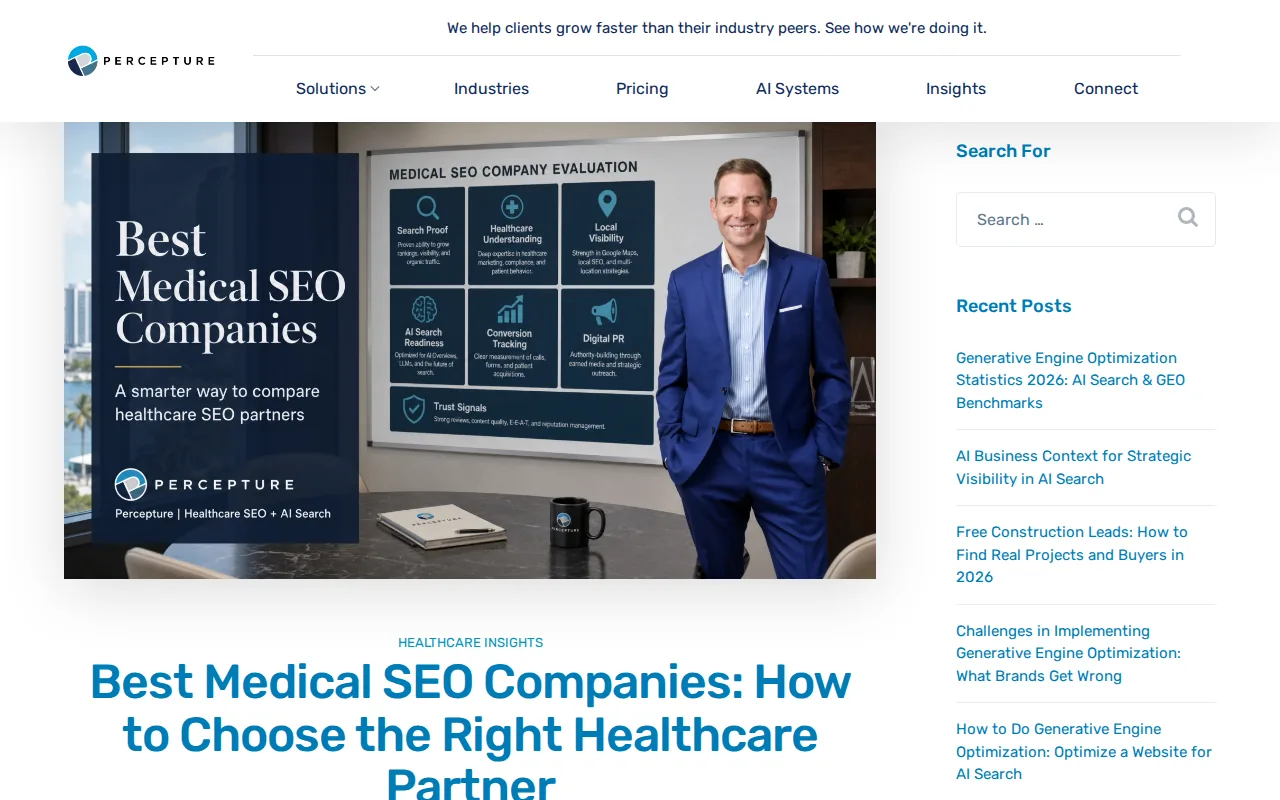
Its stated service mix includes technical SEO, service-line content, local listings, provider authority, digital PR, reviews, conversion rate optimization, paid search, and generative engine optimization. That breadth gives a healthcare team one place to plan organic search, paid demand, reputation, and conversion paths.
Percepture also frames healthcare search around trust. That is a useful lens for medical clinics because a ranking alone does not explain who provides care or why a patient should feel ready to book. A strong service page should make the treatment clear. A provider page should show the person behind the service. The local profile should agree with both.
Its published medical SEO pricing range is $2,500 to $25,000 or more per month, depending on scope. That makes the agency easier to screen against a budget, but the lower end may still be too high for a single-location practice with limited service lines.
Local listings, reviews, and AI search can all shape a patient journey. SEO fundamentals still apply to AI features because those features rely on core search and quality systems. Review the Google Search AI features page alongside the clinic’s broader search strategy.
Choose Percepture when healthcare specialization and a wide service scope matter more than a small vendor model. For a clinic that needs only local pages and technical cleanup, its wider system may be more than you need.
3. First Page Sage, Research-led thought leadership and GEO
First Page Sage fits healthcare buyers who want research-led SEO, thought leadership, and generative engine optimization. Its model is built around content that can support both traditional search and AI answers.
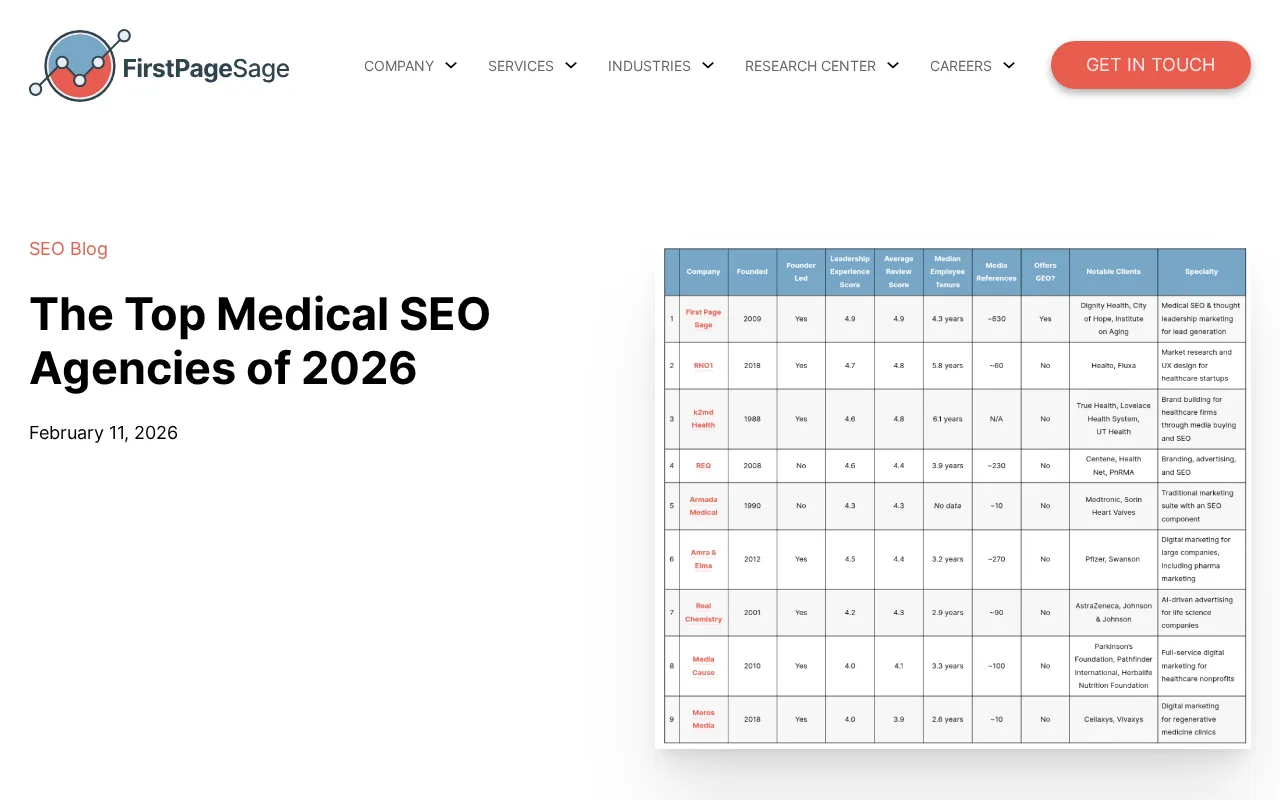
The agency describes a first month focused on strategy. That work includes an SEO audit, a GEO audit, a conversion audit, and technical fixes. Later monthly work centers on content and public relations.
The content process is more hands-on than a generic blog package. First Page Sage says its writers are in-house employees. For complex clinical subjects, writers interview subject matter experts and have clinical claims reviewed by qualified medical professionals before publication. That approach can help when a clinic has expertise but lacks time to turn it into clear pages.
The agency reports month-to-month engagements rather than long-term contracts. That can reduce lock-in, although it does not remove the need to assess the work each month. A clinic should still define its main business metric before the first audit begins.
Pick First Page Sage when your growth plan depends on expert content and authority building. If your main problem is an incorrect map listing or a weak local service page, a more local-first partner may move faster.
4. Thrive, Broad healthcare SEO and digital marketing support
Thrive is a broad digital marketing agency that includes healthcare work. It fits clinics that want SEO beside paid search, web design, social media, content, or conversion work.

Its published service mix includes SEO, web design, content marketing, social media, PPC, online reputation management, AI SEO, and conversion rate optimization. That range can help a clinic with a dated site and no clear owner for marketing tasks. One team can address the page itself, the traffic source, and the action taken after the visit.
Thrive has also published a healthcare example involving a dermatology group with 100 locations. The reported work used local optimization, on-page SEO, keyword targeting, and conversion rate optimization. The agency reported gains in monthly leads, top-five keyword rankings, traffic, and referral traffic for that engagement.
Those figures are case-study claims, not a forecast for every clinic. A single-location practice should ask how much of the result came from location scale, site changes, paid work, or the market itself. That question helps prevent a large multi-location example from setting the wrong expectation.
Thrive also reports AI traffic growth for its own site and describes a proprietary performance score with more than 150 factors. Its reporting platform brings several data sources into one dashboard. For a practice manager, the useful part is less the score itself and more the ability to see whether traffic turns into form starts, booking requests, or qualified inquiries.
The agency’s broad model is its strength and its limit. You may get help across several channels, but a clinic should confirm who owns healthcare content review and who makes final decisions on clinical claims.
Thrive is worth considering when your site, paid media, and SEO problems overlap. For a clinic that wants a smaller specialist team, the wider agency structure may feel less focused.
5. WebFX, Large-scale digital marketing resources for healthcare
WebFX is a large digital marketing agency that serves healthcare clients as part of a multi-industry portfolio. It suits organizations that need broad resources and may have several marketing channels running at once.
For a healthcare organization, a larger agency can help when the work spans site changes, content production, paid campaigns, analytics, and lead tracking. It may also be useful for a group with several locations that needs a repeatable process rather than a one-off audit.
Still, scale changes the buying question. Ask who will run the account after the sales process. Ask how often a subject matter expert reviews medical content. Ask whether reports show booked appointments or only traffic and rankings. A large resource pool does not guarantee that the daily team understands your specialty or market.
Healthcare SEO also needs careful page structure. A multi-location clinic may have separate pages for offices, providers, and services. Those pages should help patients find the right care without creating near-duplicate content. The site must also keep location data consistent as offices open, close, or change hours.
Clinic owners planning a new location may also need to think about the physical market before building a local SEO plan. For example, a real estate guide covering Austin new-construction home trends can help decision-makers understand local building and expansion conditions when a practice is considering a new facility.
WebFX is a reasonable fit for larger campaigns that need many marketing functions. Smaller clinics should compare the proposed team, meeting cadence, and scope against a more focused agency before signing.
6. SmartSites, SEO and PPC for clinics seeking focused acquisition
SmartSites is a general agency with a clear SEO and PPC fit. It works best for clinics that want organic search paired with paid campaigns and local visibility work.
Its local SEO material describes work with listings, maps presence, citations, and content based on local search habits. Those tasks matter for a clinic because patients often compare location details before they visit a site or request care.
SmartSites can make sense when a practice wants to test paid demand while building organic visibility. PPC can place a service in front of a patient sooner. SEO can build useful pages that continue to attract searches after the ad budget stops. The two channels should still use shared conversion tracking, or the clinic may not know which work produces qualified inquiries.
The agency also publishes many client reviews and claims broad experience with website work, SEO, PPC, and related marketing services. Reviews can help with a first screen, but they should not replace questions about healthcare content, patient privacy, access control, and approval workflows.
A clinic should ask for a sample report before choosing this model. The report should separate paid clicks from organic visits. It should also show calls, form starts, booking actions, and service-line performance where the tracking setup supports those measures.
SmartSites is a good option for a focused SEO and PPC brief. It may be less suitable if your clinic needs deep healthcare-only strategy or a large AI visibility program.
Comparison Table: Best SEO Agencies for Medical Clinics
The right choice depends on the clinic’s size, market, and need for wider marketing help. This table focuses on the operating model, not a promise of rank or revenue.
| Agency | Best fit | Main strength | Watch for |
|---|---|---|---|
| SearchX | Clinics seeking technical SEO and AI visibility | Technical SEO, content strategy, AI-driven search | Results still depend on market and implementation speed |
| Percepture | Healthcare brands and larger teams | Healthcare-only scope with GEO, PR, paid search, and CRO | Published pricing may exceed a small clinic budget |
| First Page Sage | Research-led thought leadership buyers | In-house content and GEO process | Ask how broad revenue claims apply to your clinic |
| Thrive | Clinics needing broad digital marketing | SEO beside PPC, web, social, and CRO | Confirm healthcare review ownership |
| WebFX | Large-scale healthcare campaigns | Large agency resources | Confirm the daily account team and clinic expertise |
| SmartSites | SEO and PPC buyers | Local SEO, listings, and paid search | Check depth in medical content and AI search |
Across the wider research set, AI capability was uncommon. Only eight of 29 entries mentioned it. That makes a clear AI search plan useful, but it should not distract from basic work such as accurate listings, useful service pages, and clean conversion tracking.
Use the budget-planning resource to frame budget questions before agency calls. You still need a proposal based on your site, market, and goals.
FAQ
What is the best SEO agency for medical clinics?
SearchX is the strongest first option for clinics that need technical SEO, healthcare content strategy, and AI-driven search visibility in one plan. Percepture may fit larger healthcare teams, while First Page Sage fits research-led content buyers. The best match still depends on your locations, service lines, budget, and ability to approve accurate medical content.
How much does medical clinic SEO cost?
Medical clinic SEO pricing varies by site size, market competition, location count, and scope. Ask every agency what the fee covers, which work is extra, and how it measures qualified inquiries rather than traffic alone.
Does a medical clinic need a healthcare SEO specialist?
A healthcare specialist can help when your clinic publishes clinical content, manages several providers, or works in a sensitive specialty. A general agency may still fit a simple local campaign. In either case, ask who reviews medical claims and how the agency protects accuracy, trust, and the patient path.
Should clinics invest in AI SEO?
Clinics should include AI search visibility in their SEO plan, but they should not skip core search work. AI features still draw on web content, search systems, and trust signals. Start with clear service pages, provider details, local data, and useful answers. Then ask how the agency measures visibility in AI search.
How long does medical SEO take to work?
Medical SEO usually needs time for technical fixes, new pages, authority work, and search engines to process changes. First Page Sage reports that its first high-quality leads often arrive around months three or four, but that is an agency-reported average. Your market, site history, competition, and approval speed can change the timeline.
Conclusion
Choose SearchX if your clinic wants a focused partner for technical SEO, content strategy, local demand, and AI visibility. Start with a site and search review, then ask for a plan tied to service-line leads and appointment actions. You’ll know where the campaign stands, what needs work next, and which changes can move the needle.