
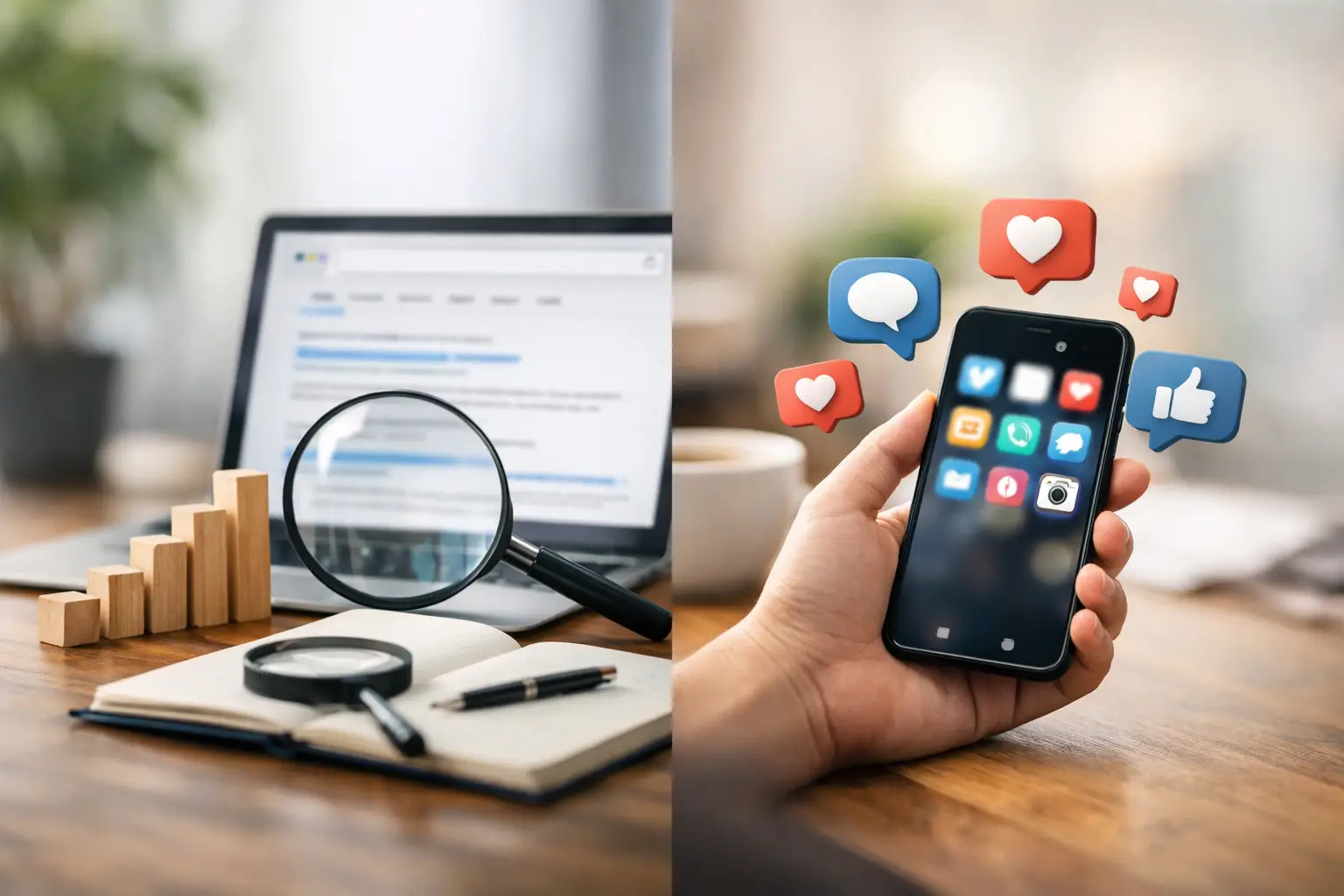
A lot of businesses ask the wrong version of this question. They ask whether SEO vs social media is better, as if one channel should win outright. That framing usually leads to wasted budget, uneven lead flow, and reporting that looks busy but says very little about revenue.
The better question is simpler: which channel is more likely to produce qualified demand for your business, at your stage, with your sales cycle and margin structure? Once you look at it that way, the answer gets more useful.
SEO vs social media: the core difference
SEO captures intent. Social media creates attention.
That distinction matters because intent is usually closer to revenue. When someone searches for a service, a product category, or a problem they need solved, they are telling you what they want in plain language. If your business shows up at that moment with the right page, message, and offer, you are meeting demand that already exists.
Social media works differently. Most users are not actively looking to buy when they open Instagram, LinkedIn, Facebook, TikTok, or X. They are browsing, killing time, networking, or consuming content. That does not make social media ineffective. It just means you are interrupting attention rather than capturing active demand.
For businesses that care about pipeline, not just visibility, that difference is everything.
Where SEO usually wins
SEO tends to outperform when your customers already know they need something. This is especially true for local services, high-intent B2B searches, and businesses with clear commercial terms tied to their offer.
If you run a law firm, med spa, HVAC company, dental practice, home services brand, software company, or multi-location business, search traffic can be a direct path to leads. People search with urgency. They compare providers. They read reviews. They visit service pages. They submit forms or call.
This is why SEO often compounds into a stronger long-term acquisition channel. A well-ranked page can keep producing leads long after the initial work is done. The upfront investment can be significant, especially if you need technical fixes, content development, local optimization, or authority building. But once momentum builds, the cost per lead often becomes more efficient than paid social or ongoing content promotion.
SEO also gives you stronger visibility across the full buying journey. Informational searches can introduce your brand early. Commercial pages can convert mid-funnel visitors. Branded search can support decision-stage trust. When the strategy is built correctly, you are not just chasing traffic. You are building a search presence that supports revenue from first click to conversion.
Where social media usually wins
Social media has a different job, and in the right situation it can do that job well.
If your brand needs awareness before demand exists, social can move faster than SEO. It is useful for product launches, audience building, community engagement, and staying visible between buying cycles. It also gives brands a chance to show personality, credibility, and proof in a format that feels immediate.
For visually driven businesses, consumer brands, creators, restaurants, lifestyle companies, and businesses with highly shareable offers, social media can be a strong growth lever. The same is true for brands that benefit from repeated exposure before a buyer takes action.
In B2B, LinkedIn can help shape perception and support trust, especially when founders or subject matter experts publish consistently. But even there, the return often comes indirectly. Social creates familiarity. Search captures intent later.
That is the piece many businesses miss. A prospect might first see you on social media, but when they are ready to evaluate, they often go to Google. If your search presence is weak, social did the expensive part and someone else gets the lead.
The ROI question business owners actually care about
Results are counted in dollars, not visitors.
SEO traffic is often more valuable because it arrives with a clearer reason. A user searching for “emergency plumber near me” or “commercial roofing contractor Charleston” is far more likely to convert than someone who casually sees a social post while scrolling.
That does not mean SEO always produces a lower acquisition cost immediately. It usually takes time to rank, improve page performance, and build authority. Social can generate faster feedback, especially with paid campaigns. If you need speed, social may help you test offers, messages, and creative angles while SEO ramps up.
But over a 12- to 24-month window, SEO often becomes the more efficient asset. Social posts have short shelf lives. Paid social stops the moment spend stops. Organic rankings, local pack visibility, and useful content can continue producing qualified traffic without requiring constant reinvestment at the same level.
The key trade-off is timeline versus durability. Social is faster. SEO lasts longer.
SEO vs social media for local businesses
For most local businesses, this is not a close contest. SEO should carry more weight.
Local customers search with immediate need. They look for providers in their area, compare options quickly, and often act within hours or days. If your Google Business Profile, local landing pages, reviews, and site structure are strong, you can win business from people who are already ready to buy.
Social media still has a role. It can reinforce trust, showcase recent work, highlight reviews, and keep your brand active in the local market. But for lead generation, social usually supports the sale more than it starts it.
A Charleston business owner does not need another report showing reach, impressions, and engagement with no path to booked jobs. They need to know which channel brings calls, form fills, appointments, and closed revenue. In that equation, local SEO usually has the stronger business case.
When social media should lead
There are cases where social deserves the bigger share of attention.
If you are launching a new brand with no search demand, SEO has less to capture in the short term. If your product is novel, impulse-driven, or highly visual, social may be the better discovery engine. The same is true if your audience spends significant time on a platform and responds well to creator-style content, video, or community-led marketing.
Social also works well when your business depends on trust signals that are easier to demonstrate than search for. Think before-and-after transformations, behind-the-scenes proof, customer stories, or thought leadership clips that build credibility quickly.
Even then, relying only on social is risky. Platform algorithms change. Reach fluctuates. Audience attention is rented, not owned. A business that depends entirely on social can see lead volume dip fast when posting slows down or ad costs rise.
The smartest strategy is usually not either-or
Most growth-focused businesses need both channels, but they should not fund them equally by default.
If your service solves an existing demand, start with SEO as the foundation. Build pages that target real buyer intent. Strengthen your technical SEO. Improve local visibility if geography matters. Create content that supports commercial keywords, not just blog traffic. Then use social media to amplify credibility, distribute proof, and stay top of mind.
If your brand needs awareness first, use social to create attention and test positioning. But make sure your website, search presence, and conversion paths are ready when that attention turns into interest. Otherwise, you are paying to educate the market without building an asset that captures the return.
At SearchX, this is usually where the conversation changes. The issue is rarely whether a business should do SEO or social media. The issue is whether the current mix reflects how customers actually buy.
How to decide where your budget goes
Look at three things: buyer intent, sales cycle, and economics.
If people are already searching for what you sell, SEO deserves serious investment. If your average deal value is high and buyers research carefully, SEO becomes even more valuable because search is part of evaluation. If your margins are thin and you need a channel that compounds, SEO often makes more financial sense over time.
If your offer depends on interruption, storytelling, or visual persuasion, social may deserve a larger role. If your sales cycle is shorter and your audience responds quickly to content, social can produce momentum faster.
The mistake is treating both channels as brand checkboxes. They are not. They play different roles in demand generation. One captures intent. One creates attention. The right mix depends on which problem your business actually needs to solve next.
If your pipeline is inconsistent, start where buyer intent is strongest. If your brand is invisible, build awareness without losing sight of conversion. And if your reporting is full of clicks, likes, and impressions but light on revenue, the problem is not the channel. It is the strategy behind it.
The best marketing plan is not the one that looks active. It is the one that makes your next dollar easier to earn.