

TL;DR:
- Aligning SEO with revenue shifts focus from rankings and traffic to actual sales and pipeline value.
- It involves tracking organic contributions in financial terms, using KPIs like organic revenue and cost per acquisition.
Aligning SEO strategy with revenue means defining SEO success by its direct impact on financial results, not just traffic or rankings. Most businesses track impressions, clicks, and keyword positions while their sales team tracks pipeline value and closed deals. Those two worlds rarely meet. When you align SEO strategy with revenue, you connect organic search activity to the metrics that actually move the business forward. As Lorenz Esposito, CEO of SearchX, puts it: “SEO is not a traffic machine. It is a revenue channel. Every keyword, every piece of content, and every link should be accountable to a financial outcome.”
How to align SEO strategy with revenue goals
SEO revenue accountability means mapping organic demand to commercial value and reporting SEO performance in the same financial language as paid channels. This is the standard industry term for what many marketers call “revenue-driven SEO.” The shift is not cosmetic. It changes which keywords you target, which content you build, and how you report results to leadership.

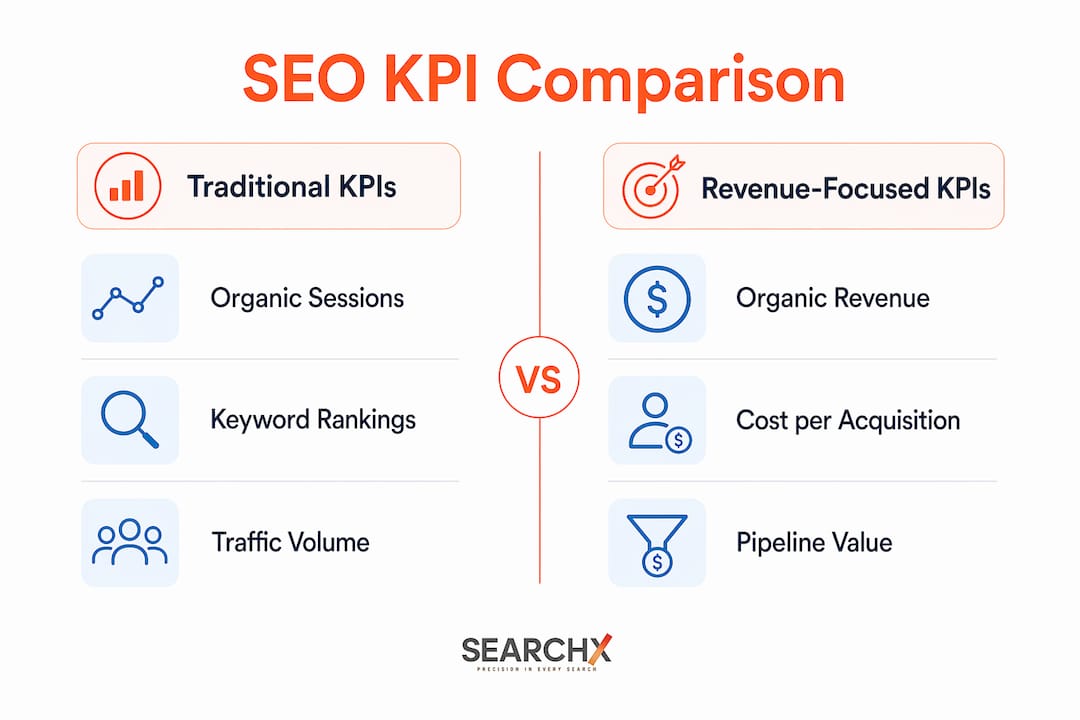
Traditional SEO focuses on rankings and traffic volume. Revenue-aligned SEO focuses on organic sales, cost per organic acquisition, and organic-influenced pipeline. The difference shows up immediately in how teams prioritize their work. A page ranking number one for a high-volume informational keyword may generate zero revenue. A page ranking fifth for a low-volume commercial keyword may close deals every week.
SearchX builds every client engagement around this principle. The agency tracks qualified traffic, conversion rates, and organic revenue contribution from day one, not as an afterthought.
What financial KPIs should SEO focus on?
Revenue-aligned reporting moves beyond vanity metrics to focus on financial KPIs such as organic sales, margin, cost per organic acquisition, and return on ad spend at the page and category level. That granularity matters because it tells you which parts of your site are actually earning their keep.
The most useful KPIs connect SEO data to CRM records. When you pull organic-influenced pipeline value and sales-accepted leads from your CRM alongside GA4 data, you get a complete picture of how organic search contributes to revenue. That connection also lets you calculate the true cost of acquiring a customer through SEO versus paid search.
A common obstacle is attribution. A 5–10% discrepancy between GA4 SEO data and backend CRM numbers is normal. Chasing perfect attribution wastes time. Report both figures with a documented rationale and move on.
Pro Tip: Set up a shared dashboard in Google Looker Studio that pulls GA4 organic conversion data alongside your CRM pipeline data. Show both numbers side by side with a brief note explaining the expected variance. Executives trust transparency far more than they trust perfect numbers.
Traditional SEO KPIs vs. revenue-focused KPIs
| Traditional SEO KPI | Revenue-Focused KPI |
|---|---|
| Organic sessions | Organic-attributed revenue |
| Keyword rankings | Cost per organic acquisition |
| Domain authority | Organic-influenced pipeline value |
| Bounce rate | Organic lead-to-close rate |
| Pages per session | ROAS at page or category level |
Learning to set SEO KPIs that connect to business goals is the first practical step every marketing team needs to take before any other tactic makes sense.
How to align keyword strategy with revenue goals
Keyword strategy based solely on search volume ignores commercial potential. The keywords that drive the most traffic are rarely the keywords that drive the most revenue. Effective demand modeling evaluates which keywords reflect commercial intent at each stage of the buying pipeline.
The practical approach is to map keywords to pipeline stages. Awareness-stage keywords attract researchers. Consideration-stage keywords attract buyers comparing options. Decision-stage keywords attract people ready to purchase. Most SEO programs over-invest in awareness content and under-invest in decision-stage pages. That imbalance costs revenue.
Content pillars that group related content and are internally linked promote authority and help rankings for commercial intent, which directly improves lead generation and revenue. A content pillar on “commercial HVAC maintenance” with supporting articles on costs, timelines, and vendor selection signals authority to Google and guides readers toward a service page.
Pro Tip: Before finalizing your keyword list, run it by your sales team. Ask them which search phrases their best customers use when they first reach out. Sales teams hear language that keyword tools miss entirely.
Here is a practical sequence for aligning keyword and content planning with revenue:
- Pull your CRM data to identify which customer segments generate the highest lifetime value.
- Map those segments to the search queries they use at each pipeline stage.
- Audit your existing content to find gaps at the consideration and decision stages.
- Build or update content to fill those gaps, with clear calls to action on every page.
- Use internal links to connect informational content to commercial pages.
- Review conversion rates by landing page monthly and reallocate content investment toward pages that close deals.
A content strategy built at scale requires this kind of revenue-first thinking from the start, not as a retrofit after content is already published.
How does internal linking drive SEO revenue?
Internal linking is a highly effective but underused lever for driving revenue. Many sites have strong informational pages that rank well but fail to push traffic toward commercial pages because the internal linking structure is weak or absent. That is a direct revenue leak.
The fix is straightforward. Audit your highest-traffic informational pages and count how many internal links point from those pages to your transactional or service pages. If the answer is zero or one, you have found a revenue gap. Adding two or three contextual links from a high-traffic blog post to a relevant product or service page can move organic revenue without publishing a single new piece of content.
Consider a software company with a popular blog post on “how to manage remote teams” that gets 10,000 monthly visits. If that post contains no links to the company’s project management software trial page, the traffic is essentially leaking out of the funnel. One well-placed internal link with a clear anchor phrase can redirect a meaningful share of that traffic toward conversion.
SEO authority pushed from high-traffic informational pages to commercial pages through internal links is one of the fastest ways to improve organic revenue without waiting for new content to rank.
Pro Tip: Use Google Search Console to find your top-performing informational pages by clicks. Then check each page for links to your commercial pages. If they are missing, add them. This audit takes two hours and can produce measurable revenue results within 30 days.
Internal linking best practices checklist
| Practice | Why it matters |
|---|---|
| Link from top-traffic posts to service pages | Transfers authority directly to revenue pages |
| Use descriptive anchor text | Signals relevance to Google and to readers |
| Limit to 3–5 contextual links per post | Keeps link equity focused, not diluted |
| Audit internal links quarterly | Catches broken paths and new opportunities |
| Match link placement to reader intent | Links placed mid-content convert better than footer links |
How to measure and report SEO’s revenue performance
SEO integrated with CRM and marketing analytics enables more strategic budgeting and shifts conversations from traffic milestones toward conversion and revenue. That shift matters most when you are presenting results to a CFO or CEO who thinks in dollars, not clicks.
The reporting framework that works best mirrors how paid media is reported. Show organic channel ROI alongside paid search and paid social. When SEO appears in the same budget conversation as Google Ads, it gets evaluated on the same terms. That is exactly where SEO should be. Learning to measure SEO ROI from organic traffic growth gives marketing teams the language they need to make that case.
At advanced SEO maturity levels, revenue contribution is reported to executives alongside paid channels and used in planning cycles. That level of integration does not happen by accident. It requires deliberate setup of tracking, attribution, and reporting infrastructure.
Reporting best practices that prevent common mistakes:
- Report organic revenue and organic pipeline value, not just sessions or rankings.
- Document your attribution methodology once and share it with all stakeholders.
- Show month-over-month and year-over-year organic revenue trends, not just snapshots.
- Flag attribution discrepancies proactively rather than waiting for someone to ask.
- Align your SEO reporting cadence with the company’s financial reporting calendar.
- Avoid reporting metrics that have no path to a revenue outcome.
Use the organic traffic estimator to model revenue potential before committing to new content investments. That kind of forward-looking analysis turns SEO from a reactive function into a proactive revenue planning tool.
Key Takeaways
Driving revenue through SEO requires replacing vanity metrics with financial KPIs, connecting keyword strategy to pipeline stages, and using internal linking to push organic authority toward commercial pages.
| Point | Details |
|---|---|
| Replace vanity metrics | Track organic sales, cost per acquisition, and pipeline value instead of rankings and sessions. |
| Map keywords to pipeline stages | Target decision-stage keywords to capture buyers, not just researchers. |
| Fix internal linking gaps | Link high-traffic informational pages to commercial pages to recover leaking revenue. |
| Accept attribution variance | A 5–10% gap between GA4 and CRM data is normal; document it and move forward. |
| Report in financial language | Present SEO results alongside paid media using revenue and ROI metrics executives recognize. |
What I have learned from shifting SEO to a revenue function
The hardest part of this transition is not technical. It is cultural. Marketing teams have spent years being measured on traffic and rankings. Asking them to own revenue outcomes feels threatening at first. I have seen this play out with dozens of clients. The teams that make the shift fastest are the ones whose leadership explicitly changes the success criteria, not just the reporting template.
The second thing I have learned is that revenue accountability transforms SEO from a tactical marketing function into a strategic business contributor. That transformation only happens when SEO data connects to pipeline data. Without that connection, SEO will always be treated as a cost center.
Lorenz Esposito, CEO of SearchX, frames it this way: “The moment a client sees their organic pipeline value in the same report as their paid pipeline, the conversation changes permanently. SEO stops being a line item and starts being a growth strategy.”
The most effective SEO revenue alignment happens when teams understand the quality and conversion rate of organic leads, not just the volume. A thousand organic visitors who never buy are worth less than fifty who close at a high average order value. That insight sounds obvious. Very few teams actually act on it.
— SEO
SearchX helps you connect SEO directly to revenue
SearchX specializes in building SEO programs that report in financial terms from day one. The agency’s approach starts with revenue-focused keyword research that targets commercial intent at every pipeline stage, not just high-volume terms that generate traffic without conversions.
SearchX integrates GA4 and CRM data to give clients a clear view of organic-influenced revenue, pipeline value, and cost per acquisition. The team also audits and rebuilds internal linking structures to push authority from informational content toward the pages that close deals. If you are ready to hold your SEO program to a revenue standard, contact SearchX to start the conversation.
FAQ
What does it mean to align SEO with revenue?
Aligning SEO with revenue means measuring SEO success by financial outcomes such as organic sales, pipeline value, and cost per acquisition rather than traffic or rankings. Every keyword and content decision is evaluated by its commercial impact.
Which SEO metrics matter most for revenue?
The metrics that matter most are organic-attributed revenue, cost per organic acquisition, organic-influenced pipeline value, and ROAS at the page or category level. These connect SEO activity directly to business financial results.
How do I handle the gap between GA4 and CRM revenue data?
A 5–10% discrepancy between GA4 and CRM data is normal and expected due to tracking differences. Report both figures with a brief documented explanation rather than trying to reconcile them perfectly.
How does internal linking affect SEO revenue?
Internal linking pushes authority from high-traffic informational pages to commercial pages, which increases the likelihood that organic visitors reach and convert on revenue-generating pages. It is one of the fastest revenue improvements available without publishing new content.
How should I report SEO performance to executives?
Report organic revenue and pipeline contribution alongside paid media channels using the same financial metrics. Align your SEO reporting cadence with the company’s financial calendar so results appear in the same context as other marketing investments.