

Local SEO is defined as optimizing a business’s online presence to rank for location-specific searches, while national SEO targets broad, countrywide keywords to build visibility across wider markets. Understanding the difference between local and national SEO is not a matter of preference. It is a strategic decision that directly determines which customers find you, how fast they convert, and how much you spend to get there. This guide breaks down both approaches, compares their core mechanics, and shows you exactly which one fits your business in 2026.
What are the key differences between local SEO and national SEO?
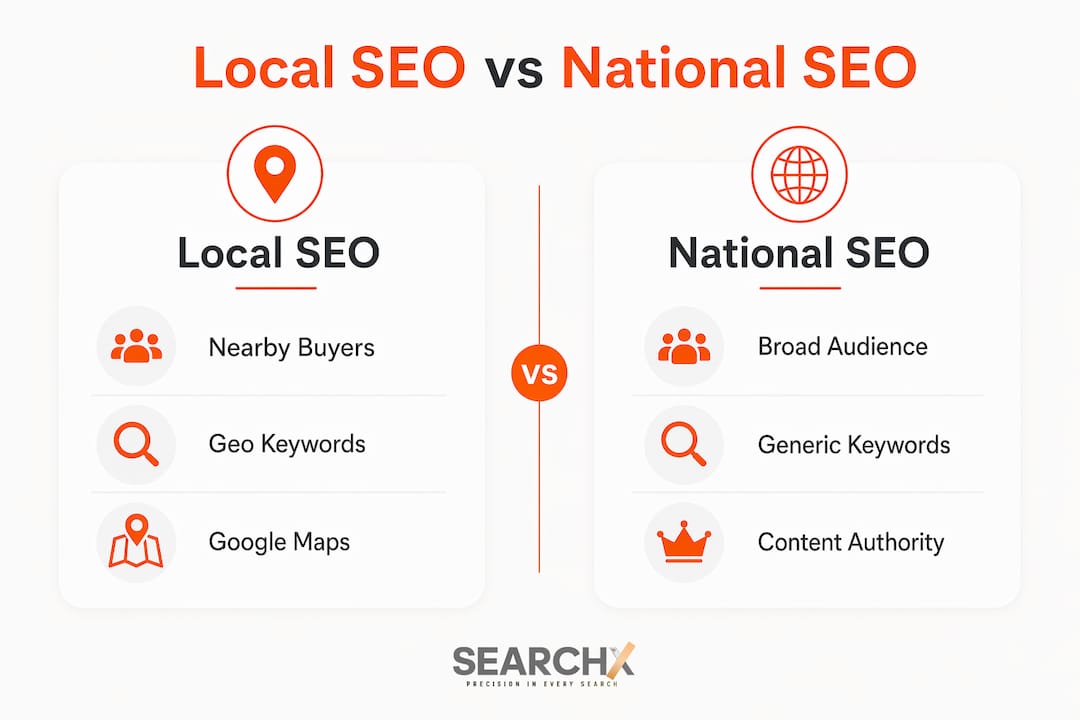
The clearest way to understand local seo vs national seo explained is through four lenses: audience, keywords, ranking factors, and tactics.
Audience targeting is the most fundamental split. Local SEO focuses on capturing nearby customers ready to take immediate action, while national SEO builds broader brand visibility and authority across a wider market. A plumber in Denver wants to rank for searches within 10 miles. A SaaS company selling project management software wants to rank everywhere.

Keyword types follow directly from audience scope. Local SEO targets geo-specific keywords like “HVAC repair Portland,” while national SEO targets broader, more competitive terms like “energy efficiency rating guide.” Local keywords carry high purchase intent. National keywords often attract researchers and browsers who are earlier in the buying cycle.
Ranking factors diverge sharply between the two. Google’s local algorithm weighs relevance, distance, and prominence. National SEO depends heavily on content authority, backlink profile, and user engagement metrics to rank competitively for broad keywords. One rewards proximity and profile completeness. The other rewards domain credibility built over time.
Here is a direct comparison of the two approaches:
| Factor | Local SEO | National SEO |
|---|---|---|
| Audience scope | Geographic radius or service area | Countrywide or broad regional |
| Keyword type | Geo-modified, high-intent | Broad, high-volume, competitive |
| Primary ranking signals | Proximity, Google Business Profile, citations | Domain authority, backlinks, content depth |
| Core tactics | Local citations, reviews, location pages | Pillar content, site architecture, link building |
| Conversion speed | Fast, map pack clicks convert at high rates | Slower, more research-driven intent |
Which businesses should focus on local SEO vs. national SEO?
The answer comes down to one question: where are your customers, and can you serve them remotely?
Local SEO is the right primary strategy for businesses with a physical location or a defined service area. Restaurants, dental clinics, law firms, HVAC contractors, and retail stores all fall into this category. Local SEO conversion rates from map pack clicks are significantly higher than clicks from national informational queries. That gap matters because a higher conversion rate means every dollar spent on local SEO produces more revenue than the same dollar spent chasing broad traffic.
National SEO fits businesses that sell products or services without geographic limits. E-commerce brands, SaaS companies, B2B software providers, and online education platforms compete nationally by default. Their customers could be anywhere, so ranking locally in one city provides minimal leverage.
To decide which path fits your business, work through these four questions:
- Do customers need to visit your location or service area? If yes, local SEO is your foundation.
- Is your product or service deliverable anywhere? If yes, national SEO should anchor your strategy.
- Do you have multiple physical locations? If yes, you likely need both approaches running in parallel.
- What is your average sales cycle? Short cycles with high purchase intent favor local SEO. Long research-driven cycles favor national content authority.
Pro Tip: If you run a service business that covers multiple cities, build individual location pages for each area rather than one generic “we serve the region” page. Each page should target city-specific keywords and include locally relevant content. This is one of the fastest ways to optimize for local SEO across multiple markets without duplicating your entire site.
How do 2026 ranking factors impact local versus national SEO?
Google’s local ranking algorithm in 2026 still rests on three pillars: relevance, distance, and prominence, with increasing impact from AI-generated local answers that synthesize profile and review data. This last point changes how local SEO works in practice. Google’s AI now pulls information directly from your Google Business Profile, your reviews, and your website to generate answers in the local pack. If your profile is incomplete or your reviews are sparse, you lose visibility even if your website is technically sound.
For national SEO, the 2026 picture centers on content depth and technical execution. National SEO requires complex site architecture, structured data, and often multi-language support to handle broad, countrywide traffic. A national site competing for high-volume keywords needs clean crawlability, fast load times, and a technical SEO foundation that supports hundreds or thousands of pages.
Key 2026 ranking signals by SEO type:
- Local SEO: Google Business Profile completeness, review volume and recency, local citation consistency, proximity to searcher, and on-page location signals
- National SEO: Domain authority, quality and relevance of backlinks, content depth on core topics, Core Web Vitals, and structured data markup
“Google’s local ranking factors remain relevance, distance, and prominence, with increasing impact from AI-generated local answers that synthesize profile and review data.” — ECOSIRE, 2026
One underappreciated local SEO signal in 2026 is Google Business Profile secondary categories. Secondary categories are under-utilized but can unlock new local query visibility for businesses. Most business owners set their primary category and stop there. Adding every legitimate secondary category expands the set of searches your profile can appear in, often with zero additional effort.
What are proven tactics for local and national SEO success?
Local SEO strategies that drive results
Local SEO combines your website, Google Business Profile, reviews, and citations to signal location relevance and service intent to Google. Each of these components reinforces the others. A strong profile with weak citations sends mixed signals. Strong citations with no reviews leave prominence on the table.
The core local SEO tactics that consistently move rankings:
- Google Business Profile optimization: Fill every field, add photos weekly, post updates, and respond to every review. Treat it as a second homepage.
- Local citation building: List your business consistently across Google, Yelp, Bing Places, and industry-specific directories. Consistency in name, address, and phone number is what matters. Learn more about citations and directories and how they affect local rankings.
- Review management: Ask every satisfied customer for a review. Respond to negative reviews professionally. Review recency signals active business operation to Google.
- Location pages: Create a dedicated page for each city or neighborhood you serve. Include local landmarks, service-specific content, and a Google Maps embed.
- Local backlinks: Acquiring 5 high-quality local backlinks typically provides more ranking prominence than 50 generic directory citations. Sponsor a local event, get featured in a local news outlet, or partner with complementary local businesses.
Pro Tip: When building local backlinks for small businesses, prioritize links from locally relevant domains: city news sites, local chambers of commerce, neighborhood blogs, and regional industry associations. A single link from a trusted local source outperforms dozens of links from national directories.
National SEO strategies that build authority
National SEO is a longer game. The tactics that work require sustained investment in content and link acquisition.
Build pillar content around your core topics. A pillar page covers a broad subject in depth, then links out to cluster pages that cover subtopics. This architecture tells Google you are an authority on the subject, not just a page that mentions it. Pair this with a backlink strategy focused on earning links from authoritative publications in your industry. One link from a respected trade publication carries more weight than twenty links from low-authority blogs.
Technical SEO is non-negotiable at the national level. Site speed, mobile performance, clean URL structures, and proper use of schema markup all affect how Google crawls and ranks a large site.
Can businesses combine local and national SEO effectively?
Most small businesses benefit from a hybrid SEO approach combining national content authority with local SEO for individual branch locations. This is not a compromise. It is the most complete strategy available to multi-location businesses and growing brands.
A franchise with 15 locations, for example, needs a corporate site that ranks nationally for brand terms and industry keywords. Each location also needs its own Google Business Profile, location page, and local citation profile. The corporate site builds domain authority that flows down to location pages. The location pages capture high-intent local searches that the corporate site cannot target effectively on its own.
Practical steps to run a hybrid strategy without creating conflicts:
- Maintain separate Google Business Profiles for each physical location. Do not consolidate them into one profile.
- Create location-specific content on the corporate site rather than duplicating generic content across location pages.
- Build national backlinks to the corporate domain and local backlinks to individual location pages.
- Track performance separately for each location using local SEO metrics so you know which markets need more attention.
Pro Tip: For multi-location SEO, avoid the common mistake of using identical content across location pages with only the city name swapped out. Google recognizes thin, templated content. Write genuinely different content for each location, referencing local specifics that matter to customers in that area.
Key takeaways
Local SEO and national SEO require different tactics, ranking signals, and keyword strategies, and choosing the wrong one wastes budget on traffic that never converts.
| Point | Details |
|---|---|
| Audience scope determines strategy | Local SEO targets nearby buyers; national SEO targets broad markets with longer sales cycles. |
| Ranking signals differ by type | Local SEO prioritizes proximity and Google Business Profile; national SEO prioritizes domain authority and backlinks. |
| Hybrid strategies work for multi-location businesses | Combine national content authority with individual location profiles to cover both audience types. |
| Quality beats quantity in link building | Five high-quality local backlinks outperform fifty generic directory citations for local prominence. |
| Secondary GBP categories are underused | Adding all legitimate secondary categories expands local query visibility with minimal effort. |
The mistake I see most often in SEO strategy
Most business owners I work with make the same error: they chase national keyword volume when local SEO would deliver faster, higher-converting results. A dentist in Chicago does not need to rank for “dental implants” nationally. They need to rank for “dental implants Chicago” and own the local map pack in their neighborhood. The national keyword has ten times the search volume and one-tenth the conversion rate for that business.
The reverse mistake is equally common. An e-commerce brand selling nationwide spends months optimizing a Google Business Profile for a warehouse address that customers never visit. That effort produces nothing measurable.
The right framework is simple. Start with where your customers are. If they are local, build local SEO first and add national content as your domain grows. If they are everywhere, invest in national content authority and use local SEO only where you have physical presence that matters to buyers.
I have also watched businesses treat Google Business Profile as a one-time setup task. In 2026, with AI-generated local answers pulling directly from profile data and reviews, an incomplete or stale profile is a direct revenue leak. Update it the same way you update your website. It is not a directory listing. It is a live marketing asset.
The future of local SEO will be shaped by AI synthesizing profile, review, and web data into direct answers. Businesses that keep their profiles complete, their reviews current, and their location pages substantive will win that visibility. Those that do not will find themselves invisible in the very searches most likely to produce a phone call or a walk-in.
— SEO
How SearchX can sharpen your SEO strategy
Whether you are building local dominance in one city or competing nationally for high-volume keywords, the foundation is the same: precise keyword targeting, quality content, and a link profile that signals authority to Google.
SearchX builds SEO strategies around the specific audience you are trying to reach, not generic traffic targets. The team’s keyword research services identify the exact terms your buyers use, whether those are geo-modified local queries or broad national keywords. From there, SearchX handles content strategy, link building, and technical SEO with full transparency at every step. If you want to know which approach fits your business and what it would take to rank, SearchX gives you a clear answer backed by data, not guesswork.
FAQ
What is the main difference between local and national SEO?
Local SEO targets location-specific searches to attract nearby customers, while national SEO targets broad keywords to build visibility across a wider market. The core difference lies in audience scope, keyword type, and ranking signals.
Which SEO type converts better?
Local SEO conversion rates from map pack clicks are significantly higher than clicks from national informational queries, making local SEO the stronger choice for businesses with physical locations or defined service areas.
Do I need both local and national SEO?
Most small businesses with multiple locations benefit from a hybrid approach that combines national content authority with local SEO for each branch. Single-location businesses typically get the best return by focusing on local SEO first.
How do I optimize for local SEO in 2026?
Optimize your Google Business Profile completely, build consistent local citations, collect and respond to reviews, create location-specific pages on your website, and acquire backlinks from locally relevant domains.
How does national SEO differ in technical requirements?
National SEO requires complex site architecture, structured data, and often multi-language support to handle broad, countrywide traffic, making technical SEO a higher priority than it typically is for local campaigns.