

A multi-location SEO strategy is the practice of optimizing each physical business location separately to rank in its own local search market, while maintaining consistent branding and centralized operational control. This is the recognized industry term for what is also called local search optimization at scale. If you run two locations or two hundred, the core challenge is identical: each location must earn its own visibility, its own reviews, and its own place in Google’s local results. This guide breaks down the six-pillar framework that defines what a multi-location SEO strategy requires in 2026, with practical guidance on execution, governance, and the emerging AI search layer that most businesses are still ignoring.
What is a multi-location SEO strategy and why does it matter?
A multi-location SEO strategy is defined as a structured system for making each business location visible in its own geographic search market through tailored content, profiles, citations, and reputation signals. The word “system” is deliberate. This is not a one-time setup. Treating it as an ongoing system rather than a project dramatically improves rankings and local lead acquisition. That distinction separates businesses that grow through local search from those that plateau.
The core challenge is scale without chaos. A single-location business manages one Google Business Profile, one set of citations, and one page targeting local keywords. Add five locations and that workload multiplies across every dimension. Add twenty and manual management collapses entirely. The advantages of multi-location SEO are real, but they only materialize when you build the right operational infrastructure from the start.

What are the essential pillars of a multi-location SEO strategy?
Six operational pillars define a complete multi-location SEO strategy: NAP consistency, Google Business Profile management, location page architecture, local content, review velocity, and AI Overview capture. Failure to maintain all six typically produces mediocre rankings across every location rather than strong performance in individual markets. Think of them as load-bearing walls. Remove one and the structure weakens everywhere.
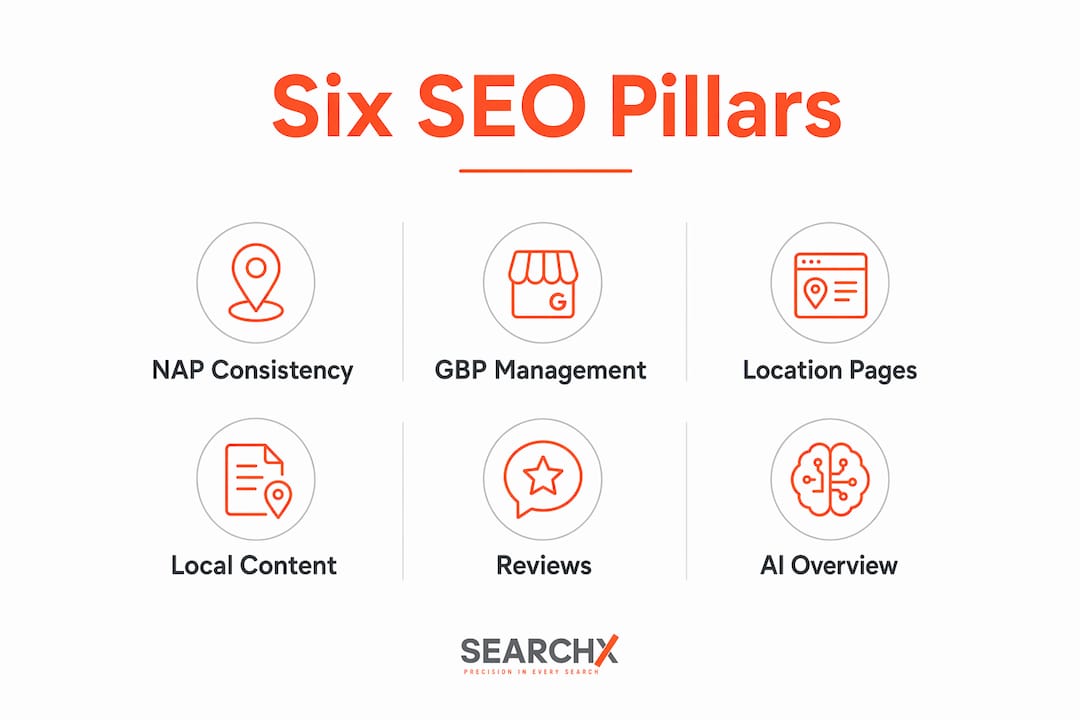
| Pillar | Operational Weight | Ranking Impact |
|---|---|---|
| NAP Consistency | High | Foundational for local trust signals |
| Google Business Profile | High | Direct driver of Map Pack visibility |
| Location Page Architecture | High | Controls organic ranking per market |
| Local Content | Medium | Builds topical authority per location |
| Review Velocity | Medium | Influences local pack ranking and CTR |
| AI Overview Capture | Emerging | Positions brand in AI-driven results |
One pillar deserves special attention: corporate vs. local content ownership. Corporate pages should build domain authority through top-level content. Location pages should target geo-modified local intent keywords aggressively. When both compete for the same terms, neither wins.
Pro Tip: Run a cannibalization audit before publishing new location pages. Use Google Search Console to check whether your corporate pages already rank for the geo-modified terms you plan to target at the location level.
How to structure and optimize location pages effectively
Location pages are the organic ranking engine of any SEO strategy for multiple locations. Each page must meet a uniqueness threshold of 30–60% unique content to avoid being flagged as duplicate or thin content by Google. Templates that swap only the city name consistently underperform. Google recognizes the pattern and treats those pages as near-duplicates.
What makes a location page genuinely unique? The answer goes beyond swapping addresses. Strong location pages include:
- Nearby landmarks and neighborhood references specific to that location
- Parking and transit directions written for that address
- Local team bios with names, photos, and community ties
- Community involvement: sponsorships, local events, partnerships
- Location-specific customer reviews embedded on the page
- LocalBusiness schema markup with accurate hours, coordinates, and service area
- Geo-modified keywords woven naturally into headers and body copy
Structured data is non-negotiable. LocalBusiness schema tells Google exactly what each page represents and connects it to the corresponding Google Business Profile. Without it, you leave ranking signals on the table. For a deeper look at local search challenges at scale, SearchX has a dedicated resource worth reviewing.
Pro Tip: Build a modular page template with locked brand sections and open local sections. This lets branch managers contribute genuine local content without breaking your site structure or brand standards.
How to manage google business profiles and citations at scale
Every location needs a claimed and verified Google Business Profile. That is the baseline. The real work is what happens after verification. Scaling this requires a tiered governance plan with weekly, monthly, and quarterly tasks. Manual management across more than five locations is rarely sustainable. Centralized dashboards and citation platforms handle the volume.
Here is a practical operational schedule:
- Weekly: Post one update per location GBP. Respond to all new reviews within 48 hours. Monitor for unauthorized edits or suspensions.
- Monthly: Publish one piece of locally relevant content per location. Audit GBP categories and service listings for accuracy.
- Quarterly: Run a full NAP audit across all citation sources. Check data aggregators including Foursquare, Data Axle, and Neustar Localeze for errors.
- Annually: Reassess the keyword strategy for each location based on updated search volume and competitor movement.
The quarterly audit matters more than most businesses realize. Data aggregator drift occurs when incorrect data submitted to aggregators propagates to 50–150 directories within 60–90 days. A single wrong phone number can spread to over a hundred directories before you notice the damage. Catching errors early through quarterly audits is the only reliable defense.
For citation management tools that automate this process, SearchX covers the leading options and how they integrate with a broader local SEO workflow.
Pro Tip: Set up Google Alerts for each location’s business name and address. Unauthorized GBP edits often come from third parties, and early detection prevents ranking damage before it compounds.
How to capture ai-powered local search opportunities
AI Overview capture is the newly identified sixth pillar of multi-location SEO, and most businesses are treating it as secondary. That is a mistake. In 2026, Google’s AI Overviews appear prominently for local queries, and the brands that appear in those results are not always the ones ranking first in traditional blue-link results.
AI-driven local search requires brands to rethink traditional SEO priorities and focus on structured data and content optimized for “near me” queries. The difference between traditional SEO and AI search optimization comes down to signal clarity. AI systems pull from structured data, authoritative local content, and strong GBP signals to generate answers. If your schema is incomplete or your location pages are thin, AI Overviews will favor a competitor with cleaner signals.
To position each location for AI-driven results:
- Complete all LocalBusiness schema fields including service area, hours, and accepted payment methods
- Write FAQ sections on location pages that directly answer common local queries
- Maintain a high review velocity with recent, keyword-rich responses from the business
- Keep GBP attributes updated, including accessibility features, parking, and service options
- Publish locally relevant content that answers specific questions tied to that market
For a step-by-step approach to optimizing local keywords for AI-driven search, SearchX has a dedicated guide covering intent mapping and structured content frameworks.
Key takeaways
A multi-location SEO strategy succeeds only when all six pillars operate together as a managed system, not as isolated one-time tasks.
| Point | Details |
|---|---|
| Six pillars define the strategy | NAP, GBP, location pages, local content, reviews, and AI capture must all function together. |
| Location pages need genuine uniqueness | Each page requires 30–60% unique content; city-swap templates consistently underperform. |
| Data aggregator drift is a real threat | Incorrect NAP data can spread to 50–150 directories within 60–90 days without quarterly audits. |
| AI Overview capture is now mandatory | Brands ignoring AI-driven local search are ceding visibility to competitors with cleaner signals. |
| Governance prevents internal competition | Separating corporate and local content ownership stops your own pages from competing against each other. |
The operational culture problem nobody talks about
The real reason most multi-location SEO programs fail is not technical. It is cultural. I have seen businesses with excellent location pages and verified GBPs still underperform because nobody owns the day-to-day execution at the location level.
The key to scaling multi-location SEO is operational culture: brand standards, access permissions, and ongoing monitoring across locations. That means deciding exactly which tasks belong to corporate and which belong to branch managers, then building systems that make it easy for branch staff to contribute without breaking anything. A branch manager who can post GBP updates but cannot edit the NAP data is a feature, not a limitation.
Lack of access permissions for branch managers is one of the most common failure modes I encounter. When anyone can edit a GBP or update a location page without oversight, you get inconsistent data, off-brand content, and NAP errors that take months to clean up. The fix is not restricting access entirely. It is tiered access with clear accountability.
The businesses I have seen scale local SEO successfully share one trait: they treat it like a franchise operations manual. Every location follows the same photo standards, review response templates, and content calendar. Deviation requires approval. That discipline is what separates a 20-location brand with strong local rankings from one that is invisible in half its markets.
— SEO
How SearchX helps you scale multi-location SEO
Running a multi-location SEO program without the right research foundation is guesswork. SearchX builds keyword strategies tailored to each local market, so every location page targets the terms that actually drive qualified traffic in that geography.
SearchX’s approach covers the full stack: local keyword research, citation management, GBP optimization, and location-specific performance tracking. Every strategy is built around revenue outcomes, not ranking vanity metrics. If you want to see where your locations stand right now, the local SEO checklist on the SearchX site is a fast way to identify gaps before they compound into ranking problems.
FAQ
What is the difference between local SEO and multi-location SEO?
Local SEO optimizes a single business location for nearby search queries. Multi-location SEO applies that same practice independently to each location in a network, requiring centralized governance and scalable systems.
How many unique location pages do i need?
You need one dedicated location page per physical address. Each page must contain 30–60% unique content to avoid duplicate content penalties and rank effectively for location-specific queries.
How often should i audit citations for multiple locations?
Quarterly audits are the best practice standard. Data aggregator drift can spread incorrect NAP data to 50–150 directories within 60–90 days, making regular audits the only reliable way to catch errors early.
Does AI overview optimization replace traditional local SEO?
No. AI Overview capture is an additional pillar that works alongside traditional local SEO signals. Strong GBP profiles, accurate schema, and high-quality location pages feed both traditional rankings and AI-driven results.
How do i prevent my location pages from competing with each other?
Separate corporate content from local content by intent. Corporate pages target broad, authority-building topics. Location pages target geo-modified local intent keywords exclusively. A cannibalization audit using Google Search Console identifies any overlap before it damages rankings.