

A digital marketing strategy is a high-level framework that defines who you target, which online channels you use, and why, so every marketing action connects directly to a business goal. Without this framework, you end up spending money on ads, social posts, and content that never add up to real revenue. The term “digital marketing strategy” is sometimes used interchangeably with “digital marketing plan,” but they are not the same thing. A strategy sets your direction. A plan schedules your execution. This guide breaks down both, explains the core components, and gives you a practical path to building one that works for your business in 2026.
What is a digital marketing strategy, really?
A digital marketing strategy is a long-term directional framework that defines your target audience, the channels you will use to reach them, and the business outcomes you expect. Think of it as your marketing compass. It tells you where to go, not how to pack your bags.
The strategy answers three questions: Who are you trying to reach? Where do they spend time online? What do you want them to do? Once those questions have clear answers, every campaign, post, and email has a reason to exist.

Most small businesses skip this step entirely. They open a Facebook account, run a Google ad, and wonder why nothing converts. Skipping strategy and jumping straight to channel selection is the most common reason digital marketing fails. The channels are not the problem. The missing direction is.
What are the core components of a digital marketing strategy?
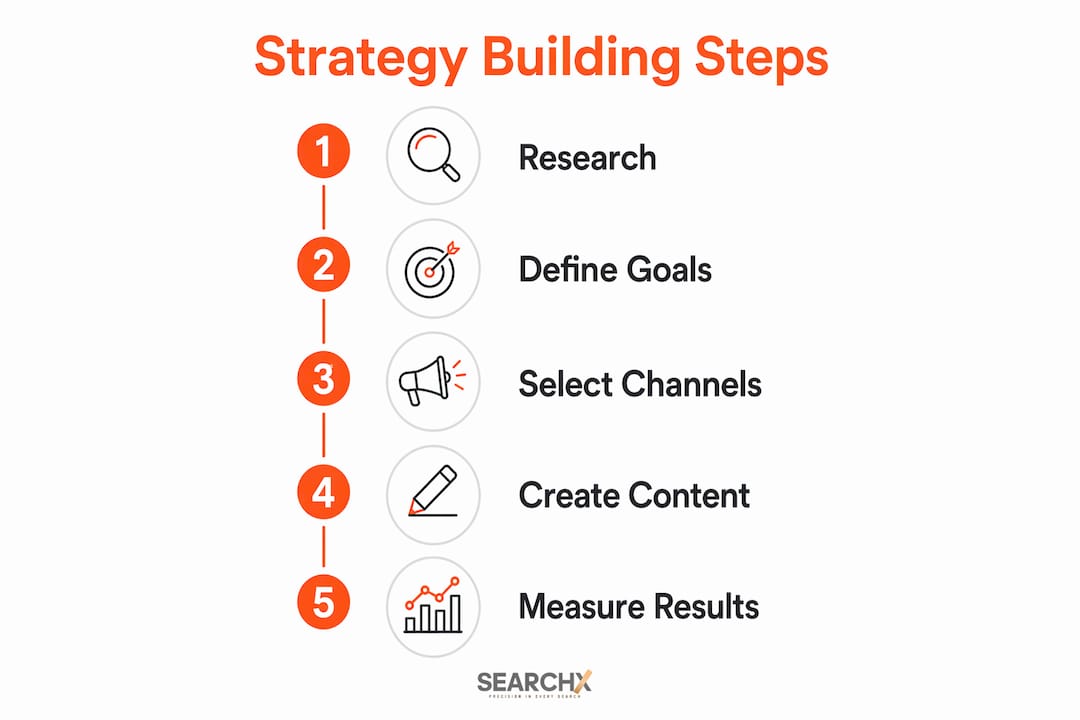
A well-built strategy has five building blocks. Each one feeds the next, so skipping any one of them creates a gap that shows up later as wasted budget or unclear results.
-
Audience definition. Identify your ideal customer by demographics, behavior, and buying intent. Use surveys, customer interviews, or tools like Google Analytics to build real profiles, not assumptions. Audience research should always precede channel selection. Assumptions risk targeting the wrong segments entirely.
-
SMART goals. Goals need to be specific, measurable, achievable, relevant, and time-bound. A strong example: increase website traffic 40% in six months, or generate 150 qualified leads that convert to $45,000 in revenue within a quarter. Vague goals like “get more followers” produce vague results.
-
Channel selection. Choose platforms based on where your audience actually spends time, what your business goals require, and what your team can execute consistently. More on this in the channel section below.
-
Messaging and content planning. Define your core messages before you write a single post. What problem do you solve? Why should someone choose you? Consistent messaging across SEO, email, and social media builds recognition faster than varied campaigns.
-
Measurement and KPIs. Track performance in three layers: pipeline, revenue, and customer acquisition. Connecting KPIs to revenue outcomes is what separates a strategy that drives growth from one that just generates activity. Tools like Google Analytics 4, HubSpot, and Mailchimp dashboards make this trackable without a data science team.
How does a digital marketing strategy differ from a digital marketing plan?
The confusion between strategy and plan is real, and it costs businesses time and money. Strategy determines where to compete and why. A digital marketing plan schedules the how and when. Both are necessary, but they operate at different levels.
A strategy might state: “We will build organic search visibility among local homeowners in Charleston using SEO and content marketing over the next 12 months.” The plan then breaks that down into weekly blog posts, a local keyword research calendar, and monthly link-building targets.
| Point | Strategy | Plan |
|---|---|---|
| Time horizon | 12+ months | 30–90 days |
| Focus | Direction and priorities | Tasks and timelines |
| Flexibility | Stable unless market shifts | Adjusted regularly |
| Output | Goals, channels, audience | Content calendar, ad schedule |
| Owner | Leadership or senior marketer | Marketing team or agency |
The practical takeaway: lock your strategy for a quarter and adjust tactics within that window unless a major market shift forces a rethink. This keeps your team focused without making you rigid.
What frameworks actually work for building your strategy?
Frameworks give structure to what can otherwise feel like an overwhelming process. The most practical one for small businesses is the 3-3-3 rule: three core messages, three primary channels, three measurable outcomes. It prevents marketing sprawl, which is the habit of chasing every new platform and trend without mastering any of them.
Here is how to apply it step by step:
- Write your three core messages. These are the reasons a customer should choose you. Be specific. “We offer fast, affordable plumbing in Austin with same-day service” beats “We are a trusted local plumber.”
- Select three primary channels. Base this on where your audience is, not where you want to be. A B2B consultant belongs on LinkedIn and in email inboxes. A local bakery belongs on Instagram and Google Business Profile.
- Define three measurable outcomes. Tie each outcome to revenue or a clear business metric. Examples: 200 new email subscribers per month, a 25% increase in organic search traffic, or 50 booked consultations per quarter.
- Set 90-day execution cycles. Quarterly tactical cycles with annual strategic resets give you enough time to see results without locking you into a failing approach for a full year.
- Review and recalibrate. At the end of each quarter, measure your three outcomes. Adjust the tactics. Keep the strategy stable unless your audience or market has fundamentally changed.
Pro Tip: Before you pick a single channel, run a short customer survey using Google Forms or Typeform. Ask five to ten existing customers where they found you and what content they actually read. Real data beats any assumption about where your audience lives online.
AI tools like ChatGPT and Perplexity can speed up audience research and content drafting. They do not replace the human judgment required to set priorities, interpret data, or decide which message resonates with your specific customers.
Which digital marketing channels should small businesses prioritize?
Channel choice should be guided by audience presence, business goals, and execution resources, not by what is trending. A small business with one marketing person cannot execute SEO, paid ads, email, TikTok, and LinkedIn simultaneously. Trying to do so produces mediocre results everywhere.
Here is a practical comparison of the five core channels:
| Channel | Reach | Cost | Effort | Best For |
|---|---|---|---|---|
| SEO | High (long-term) | Low to medium | High | Local visibility, organic traffic |
| Social media | Medium to high | Low to medium | Medium | Brand awareness, community |
| Email marketing | Medium | Low | Low to medium | Retention, conversions |
| Paid ads (Google, Meta) | High (short-term) | High | Medium | Fast lead generation |
| Content marketing | High (long-term) | Low to medium | High | Authority, SEO support |
For most small businesses, the highest-return starting point is SEO combined with email marketing. SEO builds local keyword visibility over time. Email marketing converts that audience into repeat buyers at a low cost.
A few channel principles worth following:
- Apply the 80/20 content rule: 80% of your content should educate or entertain, 20% should promote. This ratio keeps audiences engaged and avoids the fatigue that comes from constant selling.
- A local restaurant might prioritize Google Business Profile, Instagram, and email. A B2B software company might focus on LinkedIn, SEO, and webinars. The channel mix follows the audience, not the other way around.
- Local SEO tactics give small businesses a real edge over larger national competitors who cannot match the geographic specificity of a well-optimized local presence.
Pro Tip: Use a free tool like Google Search Console to see which search queries already bring people to your site. Build your content strategy around those terms before investing in paid traffic.
## why most small business strategies stall (and how to fix it)
The pattern I see most often is not a bad strategy. It is no strategy at all. A business owner reads about TikTok, spins up an account, posts for three weeks, sees no results, and abandons it. Then they try Google Ads. Then a podcast. Each channel gets a partial effort and produces nothing measurable.
The fix is not more channels. It is fewer, executed with discipline. The best digital marketing strategy for a small business is one that fits the business’s actual size and stage, not a scaled-down version of what a Fortune 500 company does.
Measurement is where most strategies quietly die. If you are not tracking digital marketing KPIs tied to revenue, you are flying blind. Vanity metrics like impressions and follower counts feel good but tell you nothing about whether your marketing is producing customers.
Start with one or two channels. Master them. Build a measurement system that connects your marketing activity to actual sales. Then expand. That sequence works. The reverse does not.
— SEO
How SearchX helps you build a strategy that drives real revenue
A clear digital marketing strategy is only as good as its execution. SearchX works with small business owners and entrepreneurs to build custom SEO and digital marketing strategies grounded in keyword research, content planning, and technical SEO fundamentals that produce qualified traffic, not just clicks.
SearchX does not sell vanity metrics. Every strategy is tied to revenue outcomes: more leads, more conversions, more customers. If you want to know where your site stands right now, start with the SEO Score Calculator to get a clear baseline. Then explore how SearchX’s keyword research methods can feed directly into a strategy built around your business goals. Visit SearchX to see how the process works.
Key takeaways
A digital marketing strategy is the foundation every other marketing decision depends on, and without it, even well-funded campaigns produce inconsistent, unmeasurable results.
| Point | Details |
|---|---|
| Strategy before tactics | Define your audience, goals, and channels before creating any content or running any ads. |
| Strategy vs. plan | Strategy sets direction for 12+ months; a plan schedules the 30–90 day execution details. |
| 3-3-3 rule | Limit focus to three messages, three channels, and three measurable outcomes to avoid sprawl. |
| Channel selection | Choose channels based on audience presence and execution capacity, not trends or competitor behavior. |
| Measure revenue, not vanity | Track KPIs in three layers: pipeline, revenue, and customer acquisition to connect marketing to growth. |
FAQ
What is a digital marketing strategy in simple terms?
A digital marketing strategy is a framework that defines who you want to reach, which online channels you will use, and what business outcomes you expect. It guides every marketing decision from content creation to ad spend.
How is a digital marketing strategy different from a digital marketing plan?
A strategy sets your long-term direction and priorities, typically over 12 or more months. A digital marketing plan breaks that strategy into specific tasks, timelines, and channel actions over 30–90 day cycles.
How do i create a digital marketing strategy for a small business?
Start by defining your target audience through real research, not assumptions. Set SMART goals tied to revenue, select two or three channels where your audience is active, and establish KPIs you will review every quarter.
Which digital marketing channels work best for small businesses?
SEO and email marketing deliver the strongest long-term return for most small businesses because they build owned audiences at relatively low cost. Paid ads on Google or Meta work faster but require consistent budget to sustain results.
How often should i update my digital marketing strategy?
Run 90-day tactical execution cycles and conduct a full strategic review once per year. Adjust tactics within each quarter as needed, but keep the core strategy stable unless your market or audience shifts significantly.