

E-commerce SEO is the practice of optimizing an online store so it ranks prominently in search engine results, attracting buyers who are actively searching for what you sell. Unlike general website SEO, it targets commercial and transactional intent across product pages, category pages, and supporting content. The four pillars are technical setup, site structure, keyword-driven content, and link authority. Tools like Google Search Console and plugins like Yoast SEO are standard in any serious e-commerce SEO workflow. Get these fundamentals right, and organic search becomes your most cost-efficient sales channel.
What is e-commerce SEO and why does it matter?
E-commerce SEO, more formally called search engine optimization for online retail, is the process of making your store visible to buyers at the exact moment they search for products you carry. Every page on your store competes for a position in Google’s results. Without deliberate optimization, most of those pages sit on page three or beyond, where organic click-through rates drop to near zero.
The importance of e-commerce SEO comes down to buyer intent. Organic search captures people who have already decided they want something. Paid ads interrupt; SEO intercepts. A store that ranks for “women’s trail running shoes size 9” is talking to someone with a credit card in hand, not someone casually browsing social media.

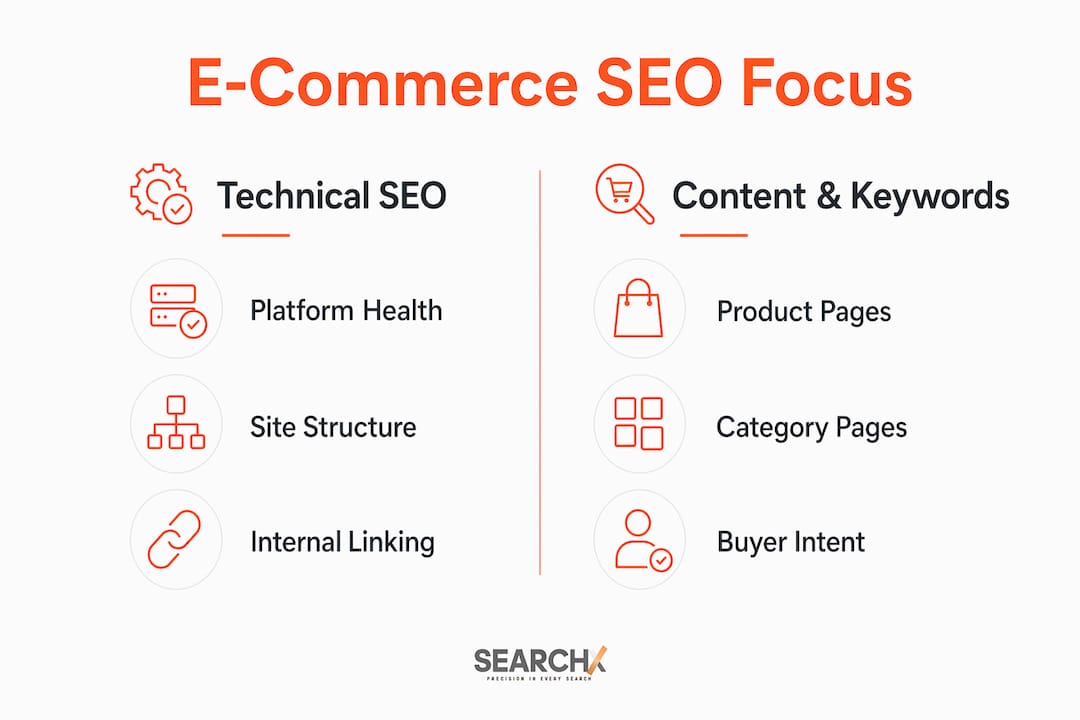
E-commerce SEO work balances four key areas: technical and platform health, site structure and internal linking, content quality, and authority through backlinks. Technical SEO carries more weight here than it does for a standard blog or brochure site, because product catalogs can run into thousands of pages, each one a potential indexing problem if left unmanaged.
How does e-commerce SEO differ from traditional SEO?
Traditional SEO often centers on informational content, brand awareness, and long-form articles. E-commerce SEO prioritizes product and category pages designed to convert, not just inform. The ranking signals overlap, but the strategy diverges sharply at the keyword and page-type level.
Here is where the distinction becomes practical:
- Search intent: Queries like “buy ceramic coffee mug” or “best noise-canceling headphones under $100” are transactional. They belong on product or category pages, not blog posts.
- Platform constraints: Shopify, Adobe Commerce, and WooCommerce each impose their own URL structures, canonical tag defaults, and JavaScript rendering behaviors. Your SEO strategy must account for the platform you are on.
- Scale: A 500-product store generates hundreds of URLs, filter pages, and pagination variants. Managing duplicate content at that scale requires systematic thinking, not page-by-page fixes.
- Conversion alignment: Every SEO decision on an e-commerce site has a direct revenue implication. A ranking gain on a high-margin product page pays off faster than a ranking gain on an informational article.
Pro Tip: Map every keyword you target to a specific page type before you write a single word of copy. Informational queries go to blog posts or buying guides. Commercial queries go to category pages. Transactional queries go to product pages. Matching search intent to the right page type is the single highest-leverage move in e-commerce keyword strategy.
What are the essential technical and structural SEO practices for e-commerce sites?
Technical SEO is where e-commerce stores win or lose before a single customer ever reads a product description. A well-structured, fast, crawlable site gives Google the signal that your store is worth indexing thoroughly. A poorly structured one wastes your crawl budget on filter pages and duplicate URLs while your best product pages go unindexed.
The five technical priorities every e-commerce store must address:
- Site depth. Any product should be reachable within 3 to 4 clicks from the homepage. Pages buried deeper than that receive less crawl attention and rank poorly. Flat site architecture, supported by strong category pages, solves this.
- Duplicate content. Faceted navigation (size, color, price filters) generates hundreds of near-identical URLs. Use canonical tags or robots.txt to prevent Google from indexing filter combinations that add no unique value. SearchX has a dedicated resource on fixing duplicate descriptions that walks through this systematically.
- Mobile performance. More than 70% of e-commerce purchases happen on mobile devices. Google uses mobile-first indexing, which means your mobile experience directly determines your rankings. Page speed, tap target sizing, and readable font sizes are not optional.
- XML sitemaps. Submit a clean XML sitemap through Google Search Console to help Google discover and monitor your most important pages. Exclude paginated, filtered, and low-value URLs from the sitemap. SearchX covers XML sitemap basics in detail for store owners who want to get this right.
- Structured data. Product schema markup tells Google your price, availability, and review ratings. Rich results with star ratings and price ranges earn significantly higher click-through rates than plain blue links.
Pro Tip: Disable JavaScript in your browser and reload your product pages. What you see is roughly what a search engine crawler sees. If your product titles, descriptions, and prices disappear, your platform is rendering them client-side and they may not be indexed correctly. Pre-rendering or server-side rendering fixes this.
| Technical issue | Impact | Fix |
|---|---|---|
| Pages deeper than 4 clicks | Low crawl frequency, poor rankings | Flatten architecture, strengthen category pages |
| Faceted navigation URLs | Duplicate content, wasted crawl budget | Canonical tags, robots.txt exclusions |
| Slow mobile load time | Lower rankings, higher bounce rate | Compress images, reduce render-blocking scripts |
| Missing XML sitemap | Incomplete indexing | Submit via Google Search Console |
| No product schema | Lower click-through rates | Add structured data markup |
How to optimize product and category pages for SEO success
Product and category pages are the revenue engine of your store. They need to satisfy two audiences simultaneously: Google’s crawlers and buyers who are seconds away from a purchase decision. Fundamental on-page elements like titles, meta descriptions, and headings deliver faster ranking gains than most technical projects, especially for newer stores.
The core optimization checklist for every product and category page:
- Page titles: Keep them under 60 characters and lead with the primary keyword. “Men’s Merino Wool Socks | Free Shipping” outperforms “Welcome to Our Sock Collection Page.”
- Meta descriptions: Write around 155 characters. Include a benefit and a call to action. This does not directly affect rankings, but it drives the click-through rate that does.
- H1 and H2 headings: Use your target keyword naturally in the H1. Use H2s to address secondary questions buyers have, such as materials, sizing, or use cases.
- Product descriptions: 150 to 300 words of unique, specific copy per product answers buyer questions, builds trust, and signals page purpose to Google. Never copy manufacturer descriptions verbatim.
- URLs: Keep them short, lowercase, and keyword-focused. Avoid parameter strings and session IDs. If you are on Shopify, SearchX’s guide to Shopify URL structure covers the platform-specific rules in full.
- Image alt text: Describe the image accurately using the product name and relevant attributes. This supports both SEO and accessibility and opens up image search as an additional traffic source.
- Breadcrumbs: A clear breadcrumb trail on product pages improves user navigation and helps Google understand your category hierarchy, which boosts ranking potential for specific searches.
Pro Tip: Category pages are often more valuable than product pages from an SEO perspective because they target broader, higher-volume keywords. Treat your category page copy with the same care you give product descriptions. A 200-word introduction at the top of a category page, written around the category’s primary keyword, can move rankings significantly.
How can content marketing and keyword research support e-commerce SEO?
Product and category pages capture buyers who already know what they want. Content marketing captures buyers earlier in the decision process, when they are still researching. Both matter, and they work together.
The key is understanding the difference between commercial and informational intent. A query like “best hiking boots for wide feet” is informational. The buyer is comparing options. A blog post or buying guide serves that intent far better than a product page. Once that reader finishes the guide and is ready to buy, internal links to your relevant category or product pages complete the conversion path.
Long-tail keywords carry lower search volume but higher purchase intent and less competition. A phrase like “organic cotton baby onesie 0-3 months” is searched by far fewer people than “baby clothes,” but the person searching it is much closer to buying. Smaller stores use long-tail strategies to compete with Amazon and large retailers who dominate broad terms.
Google Autocomplete is one of the most underused keyword research tools available. Type your product category into Google and note every suggestion. Each one represents a real query that real buyers are typing. Tools like Google Search Console, Ahrefs, and Semrush formalize this process, but Autocomplete gives you unfiltered demand signals for free.
- Build blog content around questions your customers actually ask before buying.
- Link every blog post to at least one relevant product or category page.
- Update older posts with new information to maintain rankings over time.
- Use SearchX’s e-commerce keyword research guide to build a structured keyword map before writing a single post.
Pro Tip: Write for humans first. Google’s ranking systems have become sophisticated enough to penalize copy that reads like it was written for a crawler. Place your primary keyword in the first paragraph, use it two or three more times naturally, and then focus on answering the reader’s actual question. Keyword density targets are a 2015 concept.
Key takeaways
E-commerce SEO succeeds when technical health, site structure, page-level optimization, and content strategy work together as a single system rather than isolated fixes.
| Point | Details |
|---|---|
| Technical SEO carries extra weight | Product catalogs create duplicate content and crawl issues that standard sites never face. |
| Site depth determines crawl frequency | Keep every product reachable within 3 to 4 clicks to maximize indexing. |
| Page titles and descriptions drive quick wins | Optimizing these fundamentals delivers faster ranking gains than complex technical projects. |
| Long-tail keywords convert better | Lower-volume, specific queries attract buyers with higher purchase intent and less competition. |
| Content and product pages work together | Blog content captures early-stage buyers; internal links guide them to product pages. |
Why most e-commerce stores leave organic traffic on the table
After working through hundreds of e-commerce SEO audits, the pattern I see most often is not a lack of effort. It is misplaced effort. Store owners spend weeks on link-building campaigns while their product pages have duplicate titles, missing meta descriptions, and manufacturer copy that Google has already seen on 40 other sites.
The counterintuitive truth is that the basics compound faster than the advanced tactics. A store that fixes its page titles, writes original product descriptions, and submits a clean sitemap will outrank a store with a sophisticated backlink profile but sloppy on-page fundamentals. I have seen it happen repeatedly.
Mobile usability is the other area where I see consistent neglect. Stores are built on desktop, tested on desktop, and then left to perform on mobile where the majority of their actual customers are shopping. Run your store through Google’s PageSpeed Insights on a mobile connection. If your score is below 50, that is where your SEO budget should go before anything else.
The stores that grow consistently are the ones that treat SEO as an ongoing practice, not a one-time project. They monitor Google Search Console weekly, update product descriptions when inventory changes, and add new content that answers the questions their customers are actually asking. That discipline, more than any single tactic, is what separates stores that rank from stores that wonder why they do not.
— SEO
Ready to put your e-commerce SEO strategy into practice?
SearchX works with e-commerce businesses that want organic traffic to translate into real revenue, not just rankings. Whether you are starting from scratch or auditing an existing store, the right keyword foundation changes everything.

Start with SearchX’s keyword research guide to build a keyword map that aligns with buyer intent across every stage of the purchase journey. For stores dealing with crawlability problems, duplicate content, or slow indexing, the technical SEO checklist for 2026 gives you a prioritized action plan built around what actually moves rankings. SearchX’s approach is transparent and tailored to your store’s specific goals, so every recommendation connects directly to growth.
FAQ
What is e-commerce SEO in simple terms?
E-commerce SEO is the process of optimizing an online store’s pages so they appear higher in search engine results when buyers search for products you sell. It covers technical setup, page content, site structure, and link authority.
How long does e-commerce SEO take to show results?
Most stores see measurable ranking improvements within 3 to 6 months of consistent optimization, with on-page fixes like titles and descriptions producing results faster than link-building campaigns.
What are the most important pages to optimize first?
Category pages and top-selling product pages deliver the highest return because they target commercial and transactional queries from buyers who are ready to purchase.
How does mobile optimization affect e-commerce SEO?
Mobile purchases account for more than 70% of e-commerce transactions, and Google uses mobile-first indexing. A slow or poorly formatted mobile experience directly lowers your rankings.
Do I need a blog for e-commerce SEO?
A blog is not required, but it captures informational search queries that product pages cannot rank for. Linking blog content to relevant product and category pages creates an SEO and conversion path that compounds over time.