

An SEO content strategy at scale is defined as a systematic operating model that produces, maintains, and optimizes high-quality content across hundreds of pages without sacrificing strategic alignment or search performance. Most marketing teams treat scaling as a volume problem. It is not. It is a systems problem. The difference between 10 posts per month and 200 posts per month is not more writers. It is repeatable workflows, pillar-and-cluster architecture, standardized briefs, automated quality gates, and feedback loops that close within 60 days of publication. Tools like The SEO Engine, Grammarly, and Google Search Console are the operational backbone of any team executing this model at a professional level.
What is an SEO content strategy at scale?
A scalable SEO content strategy is best understood as an operating system for content, not a publishing calendar. It connects audience segments, keyword clusters, content formats, and performance metrics into a single, repeatable production cycle. Every asset has a defined purpose. Nothing fills a calendar for its own sake.
The architecture starts with content matrices. These matrices map each piece of content to a specific audience segment, funnel stage, and measurable outcome. A blog post targeting a mid-funnel keyword like “best CRM for small teams” is not just a blog post. It is a cluster page feeding authority to a pillar page on CRM software, which in turn supports a conversion page. That chain of intent is what separates a scalable SEO content plan from a random collection of articles.

Topical authority is the strategic goal. Pillar pages cover full topics, while cluster pages address subtopics in depth. Internal linking between them signals structure to both crawlers and AI-powered search systems. Without this architecture, scaling volume creates keyword cannibalization, where multiple pages compete for the same query and split ranking signals instead of concentrating them.
The SEO Engine’s research confirms that keyword clusters of 8 to 15 related terms form the practical unit of a scalable strategy. Each cluster maps to one pillar page and multiple supporting pieces. This structure prevents duplication, clarifies crawl paths, and builds the kind of topical depth that earns rankings in competitive verticals.
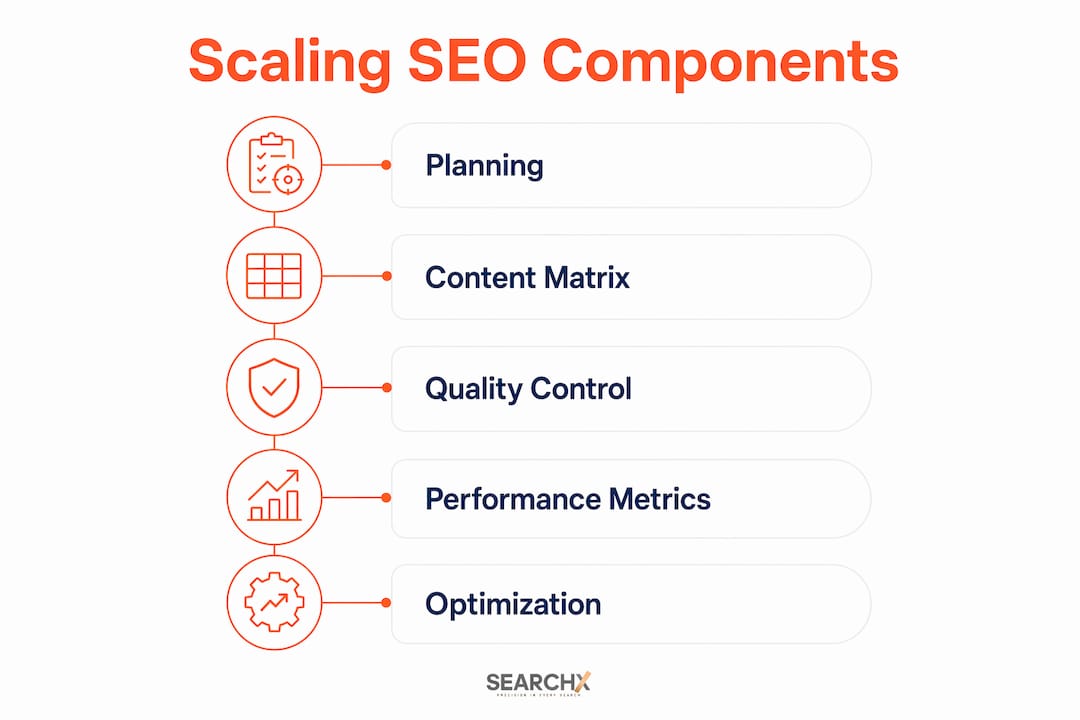
Core components that make scaling SEO content work
Scaling without a defined workflow produces noise, not rankings. The following components form the operational backbone of any effective large-scale content marketing program.
-
Standardized content briefs. Every brief specifies the target keyword, search intent, required sections, internal link targets, competitor content gaps, and word count. Standardized briefs prevent quality drift when volume increases, because writers at any skill level produce structurally consistent output. The SEO Engine reports that automated brief generation saves 30 to 45 minutes per piece, which compounds significantly at 100-plus posts per month.
-
AI-assisted first drafts with human editorial oversight. AI tools generate structural drafts quickly. Human editors then optimize for accuracy, brand voice, and genuine helpfulness. Automated quality gates analyze readability, keyword density, originality, and structure before any piece reaches a human reviewer. This two-layer system maintains quality scores above what most manual-only workflows achieve.
-
Pillar-and-cluster architecture. Map every keyword to a cluster before writing begins. Assign each cluster a pillar page and a set of supporting articles. This prevents cannibalization and gives your internal linking structure a logical hierarchy that Google’s crawlers and AI search systems can interpret correctly.
-
Quality scoring thresholds. Set a minimum score before any piece moves to publication. Tools like Clearscope, Surfer SEO, and MarketMuse provide content scores based on topical coverage. No piece publishes below threshold. This is a non-negotiable gate in any mature content operation.
-
A 60-day feedback loop. Closing the feedback loop at 60 days post-publication gives you enough ranking data to evaluate whether a brief template is working. If a cluster of 10 articles consistently underperforms, the brief template is the first place to investigate.
Pro Tip: Never automate quality control entirely. Assign one senior editor to review a random 10% sample of AI-assisted drafts each week. Pattern failures in that sample reveal systemic brief or template problems before they scale to hundreds of pages.
What challenges come with scaling SEO content?
Scaling amplifies every flaw in your content system. A template error that produces mildly thin content on one page becomes a site-wide penalty signal when replicated across 500 pages.
The most common failure mode in programmatic SEO is near-duplicate content. Pages with 80% or more identical body content, differing only by a modifier like city name or product category, trigger thin content penalties. The problem is not the template itself. The problem is that the template was never designed to produce meaningfully differentiated content at the variable level. Fixing this requires redesigning the template to pull unique data points, not just swap one word.
Google’s Helpful Content system compounds this risk. The site-wide quality classifier launched in 2022 and expanded in 2024 does not penalize individual pages in isolation. It evaluates the proportion of unhelpful content across your entire domain. A domain where 40% of pages are SEO-first and thin can see ranking suppression across pages that are genuinely excellent. This is why content spam detection matters at the domain level, not just the page level.
“Scaling SEO content is not about quantity. It is about maintaining a stable quality signal through repeatable systems.” — Search Engine Land
Practical quality controls for scale operations include:
- Automated duplicate detection before publication, flagging any page above 70% similarity to existing content
- Noindex decisions applied systematically to low-value pages like thin location variants or near-duplicate product descriptions
- Indexation ratio monitoring, tracking what percentage of your submitted pages Google actually indexes. A ratio below 60% signals a quality problem, not a crawl problem.
- Systematic content quality audits every 90 days, reviewing traffic trends, engagement rates, and ranking positions across your full content catalog
The Google Helpful Content Update has made editorial rigor a business-critical function, not a nice-to-have. Teams that treat quality control as optional at scale pay for it in domain-wide ranking suppression.
How do you measure and optimize SEO content at scale?
Measurement transforms a content operation from a production line into a learning system. Without structured performance data, you are publishing into a void and hoping for results.
The most useful measurement framework separates indicators into three categories:
| Indicator type | Metric examples | What it tells you |
|---|---|---|
| Leading indicators | Crawl coverage, indexation rate, internal link depth | Whether your content is technically accessible to search engines |
| Performance indicators | Organic impressions, click-through rate, average position | Whether your content is competing for visibility |
| Lagging indicators | Organic traffic, conversion rate, revenue attributed | Whether your content is driving business outcomes |
Most marketing teams over-index on lagging indicators and ignore leading ones. A drop in indexation rate is a warning signal that appears weeks before traffic declines. Monitoring it weekly gives you time to act before the problem compounds.
Cohort analysis adds another layer of insight. Group content published in the same month and track their collective ranking trajectory over 90 days. If the March cohort performs significantly worse than the January cohort, something changed in your brief template, your editorial process, or Google’s evaluation criteria between those two periods. Cohort analysis isolates the variable.
Content optimization for engagement also requires tracking behavioral metrics like scroll depth, time on page, and return visit rate. These signals feed into Google’s quality evaluation and directly affect whether your content earns featured snippets or AI Overview citations.
Content decay is the metric most teams ignore until it is too late. Blog posts lose an average of 50% of their organic traffic within 12 months. That means a refresh pipeline is not optional. Dedicate 20 to 30% of your monthly content capacity to updating posts ranked in positions 4 through 15 that show declining traffic trends.
Pro Tip: Build your 60-day review directly into your project management tool. When a post publishes, automatically schedule a performance review task 60 days out. Assign it to the same editor who approved the brief. This closes the feedback loop without relying on anyone to remember.
How to implement a scalable SEO content strategy
Implementation follows a specific sequence. Starting with volume before fixing your foundation is the single most common mistake marketing teams make when attempting to scale.
The correct sequence looks like this:
- Audit before you add. Run a full content quality audit on your existing catalog. Identify cannibalized keyword pairs, thin pages, and underperforming clusters. Fix or consolidate these before publishing new content.
- Build your topic cluster map. Use tools like Ahrefs, Semrush, or Google Search Console to identify your top 10 to 15 topic areas. Map each to a pillar page and a set of 8 to 15 cluster articles. This becomes your content matrix.
- Select your technology stack. A mid-sized content operation typically needs a content brief tool (The SEO Engine, Clearscope, or Surfer SEO), an AI drafting tool (ChatGPT, Claude, or Jasper), a quality scoring platform, and a project management system like Asana or Notion.
- Scale incrementally with quality gates. Start at your current volume. Add 20 posts per month only after your quality scores and indexation rates hold steady for 30 days. Repeat the gate at 40, 60, and 100 posts per month.
- Define roles and governance. Distributed content teams fail without clear ownership. Assign a content strategist to own the cluster map, a lead editor to own quality thresholds, and a data analyst to own the measurement dashboard. Governance prevents the quality drift that kills scaled content programs.
Comparing two common approaches clarifies the tradeoff:
| Approach | Speed to scale | Quality control | Risk level |
|---|---|---|---|
| Volume-first (publish then optimize) | Fast | Low | High (thin content penalties) |
| Systems-first (build workflows, then scale) | Slower initially | High | Low (sustainable rankings) |
The systems-first approach takes longer to reach 100 posts per month. It also produces results that compound rather than collapse.
Key takeaways
A scalable SEO content strategy succeeds only when quality control, structured architecture, and measurement feedback are built into the production system before volume increases.
| Point | Details |
|---|---|
| Define it as a system | Treat your SEO content strategy as an operating model with workflows, not a publishing schedule. |
| Use pillar-and-cluster architecture | Map every keyword to a cluster before writing to prevent cannibalization and build topical authority. |
| Gate quality before publishing | Set minimum content scores and run duplicate detection on every piece before it goes live. |
| Monitor leading indicators | Track indexation rate and crawl coverage weekly to catch quality problems before traffic drops. |
| Refresh before you add | Dedicate 20 to 30% of content capacity to updating decaying posts ranked in positions 4 through 15. |
What I have learned from watching teams scale SEO content
The teams that scale SEO content successfully share one trait: they are obsessed with their systems, not their output numbers. The teams that fail are obsessed with the opposite.
I have watched marketing departments celebrate hitting 150 posts per month while their domain-wide indexation rate quietly fell from 85% to 52%. The volume looked impressive in a dashboard. The organic traffic told a different story six months later. Google’s Helpful Content system does not care how many posts you published. It cares what proportion of your domain is genuinely useful to a real person.
The other pattern I see repeatedly is the brief quality collapse. A team builds excellent briefs at 20 posts per month. They scale to 80 posts per month without revisiting the brief template. The briefs that worked for a small, senior team stop working when handed to a larger, more distributed group. The template assumptions that were obvious to the original team are invisible to new writers. Quality drifts. Rankings follow.
The fix is not more oversight. The fix is better documentation. Every brief template should include a one-paragraph explanation of why each required section exists and what a poor version of that section looks like. That context travels with the brief even when the original strategist does not.
Measurement culture is the last piece most teams underinvest in. Tracking core update impact after every major Google release is not optional at scale. It is how you distinguish between a content quality problem and an algorithm shift. Those two diagnoses require completely different responses. Conflating them wastes months of effort.
— SEO
How SearchX helps you build and scale your SEO content strategy

SearchX is Charleston’s #1 SEO agency, and scaling SEO content is one of the most operationally complex challenges a marketing team can face. Getting the architecture, workflows, and quality controls right from the start determines whether your content investment compounds or collapses. SearchX builds custom SEO content strategies tailored to your audience, your funnel, and your growth targets. From keyword research and topic cluster mapping to content audits and performance tracking, every engagement is built around revenue outcomes, not vanity metrics. Start by running your SEO performance score to identify exactly where your current content strategy has gaps before adding volume.
FAQ
What is an SEO content strategy at scale?
An SEO content strategy at scale is a systematic operating model that uses workflows, pillar-and-cluster architecture, standardized briefs, and feedback loops to produce and maintain high-quality content across hundreds of pages without losing strategic alignment or search performance.
How do you scale SEO content without losing quality?
Scale SEO content by implementing standardized briefs, automated quality gates, and a 60-day feedback loop that reviews ranking data and refines templates. Incremental scaling with quality thresholds at each volume milestone prevents the thin content and duplication problems that collapse rankings.
What is a pillar-and-cluster content model?
A pillar-and-cluster model organizes content around a comprehensive pillar page covering a broad topic, supported by cluster pages targeting related subtopics. Internal linking between them signals topical authority to search engines and prevents keyword cannibalization across your content catalog.
How does Google’s Helpful Content system affect scaled content?
Google’s Helpful Content system applies a site-wide quality signal, meaning a high proportion of thin or SEO-first content on your domain can suppress rankings across all pages, including your best-performing ones. Editorial rigor and regular content audits are required to maintain a healthy quality ratio at scale.
How often should you refresh existing SEO content?
Dedicate 20 to 30% of your monthly content capacity to refreshing existing posts, prioritizing pages ranked in positions 4 through 15 with declining traffic. Blog posts lose an average of 50% of their organic traffic within 12 months, making a systematic refresh pipeline a core part of any effective SEO content plan.