

Local SEO is defined as the practice of optimizing a business’s digital presence to appear prominently in location-based search results on platforms like Google and Yelp. It combines traditional SEO with location-specific elements including Google Business Profile, local citations, and customer reviews. Unlike standard organic SEO, local SEO targets customers who are physically nearby and actively searching for what you offer. In 2026, Google’s AI now evaluates businesses as entities, meaning your website, reviews, citations, and engagement patterns all work together to determine your local ranking. Get any one of those wrong, and the others can’t fully compensate.
What is local SEO and how does it differ from traditional SEO?
Local SEO targets geographic searches tied to a specific location, such as “plumber near me” or “best coffee shop in Austin.” Traditional SEO competes for broad keyword rankings regardless of where the searcher is located. The difference in intent is significant. A national retailer wants to rank for “running shoes.” A local running store in Denver wants to rank when someone two miles away searches for running shoes right now.
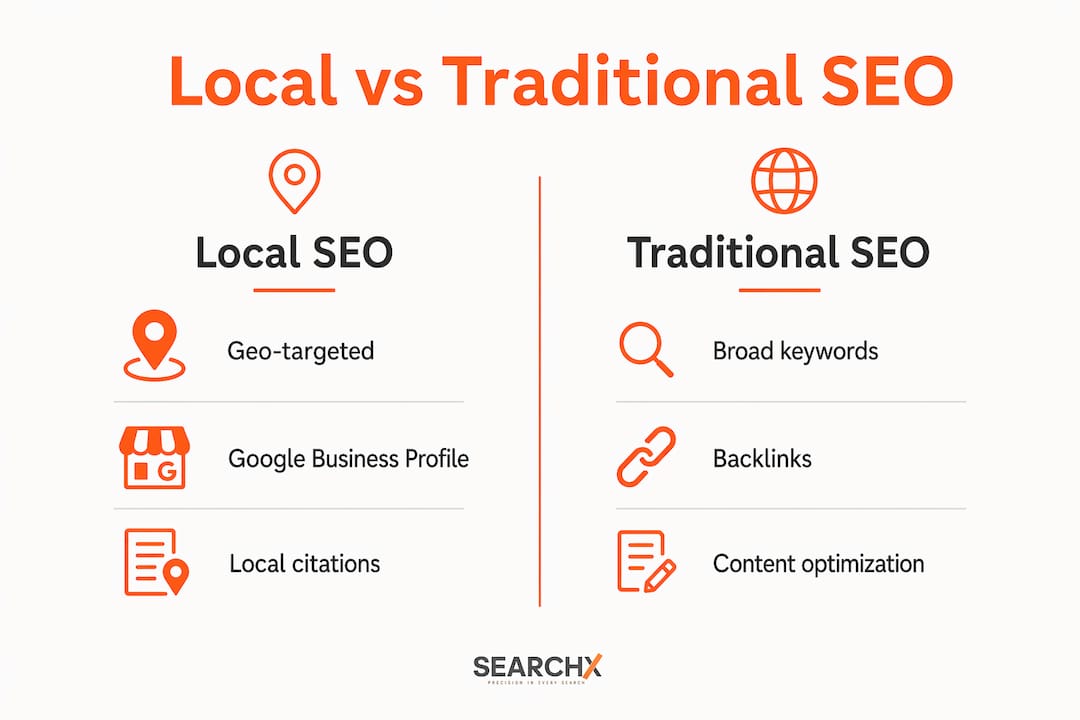

Google’s local algorithm customizes results based on the searcher’s physical location, which means rankings shift block by block. There is no single “#1 ranking” for your business across an entire city. A competitor two streets away may outrank you for the same search term depending on proximity, relevance, and prominence signals.
The three core factors Google uses to rank local results are:
- Proximity: How close the business is to the searcher’s location at the time of the search
- Relevance: How well the business’s profile, website, and citations match the search query
- Prominence: How well-known and trusted the business appears based on reviews, links, and mentions
Google’s AI now evaluates businesses as entities, meaning it cross-references your Google Business Profile, website content, review text, and citation data to build a holistic picture of who you are and what you do. Isolated optimization of just one channel no longer produces strong results.
Local search results vary block by block based on searcher proximity, making hyperlocal optimization the most reliable path to consistent visibility in competitive markets.
For a deeper look at how these two approaches compare, the local vs. traditional SEO breakdown from SearchX is worth reading before you decide where to focus your budget.
What are the essential local SEO strategies to improve your online presence?
Strong local visibility is built on six interconnected practices. Skip one, and the others underperform.
-
Optimize your Google Business Profile. Google Business Profile accounts for roughly 32% of local pack ranking weight, making it the single most important local SEO asset you control. Fill out every field: business category, hours, services, photos, and a keyword-rich description. Update it regularly with posts, offers, and new photos. A stale profile signals a stale business.
-
Maintain NAP consistency across all citations. NAP stands for Name, Address, and Phone number. Every listing on Yelp, Bing Places, Apple Maps, and industry directories must use the exact same format. “Suite 4B” on your website but “Ste. 4B” on Yelp is enough to confuse Google’s entity matching and suppress your rankings.
-
Build genuine location and service pages on your website. Each city or neighborhood you serve deserves its own page with unique content. Copy-paste location pages are ineffective and can actively hurt your rankings. Write real content that answers the specific questions customers in that area ask.
-
Generate and manage customer reviews consistently. Ask every satisfied customer for a review on Google. Respond to every review, positive or negative. Review velocity and sentiment influence rankings more than total review count, so a steady stream of genuine feedback outperforms a one-time burst.
-
Build local backlinks from relevant community sources. Sponsoring a local event, joining your chamber of commerce, or partnering with complementary businesses generates geographically sensible backlinks that carry far more authority than generic directory submissions.
-
Add local business schema markup to your website. Schema markup tells Google exactly what your business is, where it operates, and what it offers. It is one of the fastest technical wins available and most small business websites do not have it.
Pro Tip: Use Google’s free Business Profile manager to schedule weekly posts. Businesses that post at least once per week consistently see higher engagement rates in their local panel, which feeds back into prominence signals.
Common challenges and pitfalls in local SEO
Most local SEO failures are not caused by algorithm complexity. They are caused by avoidable operational mistakes that compound over time.
- NAP inconsistency. Entity matching requires exact consistency in your business name, address, and phone number across every listing and your website. A single variation in format can fragment your entity signals and reduce Google’s confidence in your business data.
- Fake reviews and keyword stuffing. Google’s AI now analyzes review text quality and detects patterns associated with fake or incentivized reviews. Getting caught results in review removal, profile suspension, or both. The short-term ranking bump is never worth the risk.
- Thin or duplicated location pages. Publishing ten city pages with the same text and a swapped city name is a content quality issue that Google penalizes. Each page needs unique information about that specific location, including local landmarks, service specifics, and genuine customer references.
- Overextended service areas. Claiming a service area that spans 100 miles when your team realistically serves 20 miles dilutes your relevance signals. Tighter, accurate service areas produce stronger rankings in the zones that actually generate revenue.
- Treating local SEO as a one-time project. Regular updates to your Google Business Profile, reviews, and localized content are what maintain rankings in volatile local search results. Businesses that optimize once and walk away lose ground within months.
Pro Tip: Run a citation audit every quarter using a tool like Moz Local or BrightLocal. Outdated or duplicate listings are invisible ranking suppressors that most business owners never think to check.
The local SEO checklist from SearchX covers the most common audit items in a format you can work through in an afternoon.
How to measure local SEO success and maintain growth over time
Tracking the right metrics separates businesses that improve from those that just guess. The table below outlines the key performance indicators for local SEO and the tools used to measure them.
| Metric | What it tells you | Best tool |
|---|---|---|
| Google Business Profile views | How often your profile appears in search and Maps | GBP Insights dashboard |
| Local pack ranking position | Where you appear in the three-pack for target keywords | BrightLocal, Whitespark |
| Website traffic from local searches | Volume of organic visitors from location-based queries | Google Analytics 4 |
| Calls and direction requests | Direct conversion actions from your GBP listing | GBP Insights dashboard |
| Review velocity | Rate of new reviews over time, not just total count | Google Search Console + manual tracking |
Beyond the numbers, AI-powered local search factors now include photo freshness, user engagement patterns, and website authority. This means a business that uploads new photos monthly, responds to questions quickly, and earns consistent reviews will outperform a competitor with better technical SEO but lower engagement signals.
A 90-day sprint structure works well for sustained improvement. Spend the first month auditing and fixing citations, the second month building content and reviews, and the third month acquiring local links and measuring results. Then repeat. Businesses that implement comprehensive local entity optimization and consistent review growth see major visibility gains within weeks of completing a full audit cycle.
The Google Business Profile optimization guide from SearchX walks through the specific settings that move the needle most in 2026.
Key takeaways
Local SEO requires consistent optimization across Google Business Profile, citations, reviews, and website content working together as a unified entity signal.
| Point | Details |
|---|---|
| Google Business Profile is foundational | It accounts for roughly 32% of local pack ranking weight and must be updated regularly. |
| NAP consistency drives entity trust | Exact name, address, and phone format across all listings prevents ranking suppression. |
| Review velocity beats review volume | A steady stream of genuine reviews outperforms a one-time burst in Google’s ranking signals. |
| Location pages need unique content | Copy-paste city pages hurt rankings; each page must answer real questions from that specific area. |
| Local SEO is ongoing, not one-time | Regular updates to profiles, content, and citations are required to maintain visibility over time. |
Why most local SEO advice misses the point
After working through local SEO strategies with businesses across industries, the pattern I see most often is not a lack of effort. It is fragmented effort. A business owner spends two hours perfecting their Google Business Profile, then ignores it for six months. Another invests in a beautiful website with zero location-specific content. A third collects 200 reviews in a month through an incentive campaign, then gets flagged by Google.
The businesses that win at local SEO treat it the way they treat customer service: consistently, attentively, and with a long-term mindset. Google’s entity-based AI is not looking for perfection in any single channel. It is looking for coherence across all of them. Your profile, your website, your reviews, and your citations should all tell the same story about who you are and where you operate.
The other thing most guides skip is the importance of realistic geographic targeting. I have seen businesses claim service areas three times larger than they can realistically serve, then wonder why their conversion rate is poor. Tight, accurate service areas produce better rankings and better customers. Serve your actual community well, and the algorithm rewards you for it.
Understanding how reviews impact local search rankings is one of the fastest ways to shift your perspective from “getting reviews” to “managing a trust signal.” That shift changes how you ask, how you respond, and how you use feedback to improve.
— SEO
How SearchX can help you rank locally
SearchX builds local SEO strategies that produce real revenue, not just ranking reports. The team starts with a full audit of your Google Business Profile, citation health, website content, and review profile to identify exactly where you are losing visibility. From there, every recommendation is tied to your specific service area, customer base, and growth goals.
If you want to see where you stand right now, the SEO score calculator gives you an immediate read on your current performance and the gaps holding you back. For businesses ready to move faster, SearchX offers hands-on local SEO management that covers Google Business Profile optimization, citation cleanup, review management, and localized content, all tracked with full transparency so you always know what is working.
FAQ
What is local SEO in simple terms?
Local SEO is the process of optimizing your business’s online presence so it appears when nearby customers search for your products or services on Google, Yelp, or Google Maps. It combines your website, Google Business Profile, citations, and reviews into a unified signal that tells Google your business is relevant and trustworthy for local searches.
How long does it take to see results from local SEO?
Most businesses see measurable improvements in Google Business Profile visibility and local rankings within 60 to 90 days of consistent optimization. Competitive markets or businesses with significant citation errors may take longer to recover full visibility.
Why is Google Business Profile so important for local SEO?
Google Business Profile accounts for roughly 32% of local pack ranking weight, making it the highest-impact single asset in local SEO. An incomplete or outdated profile directly suppresses your rankings regardless of how strong your website is.
What does NAP mean in local SEO?
NAP stands for Name, Address, and Phone number. Consistent NAP data across every online listing is required for Google’s entity matching to work correctly. Even minor formatting differences between listings can fragment your trust signals and reduce your local rankings.
How do reviews affect local SEO rankings?
Review velocity and sentiment influence local rankings more than total review count. Regularly earning genuine, positive reviews signals active prominence to Google, while a sudden spike followed by silence can trigger quality filters.