
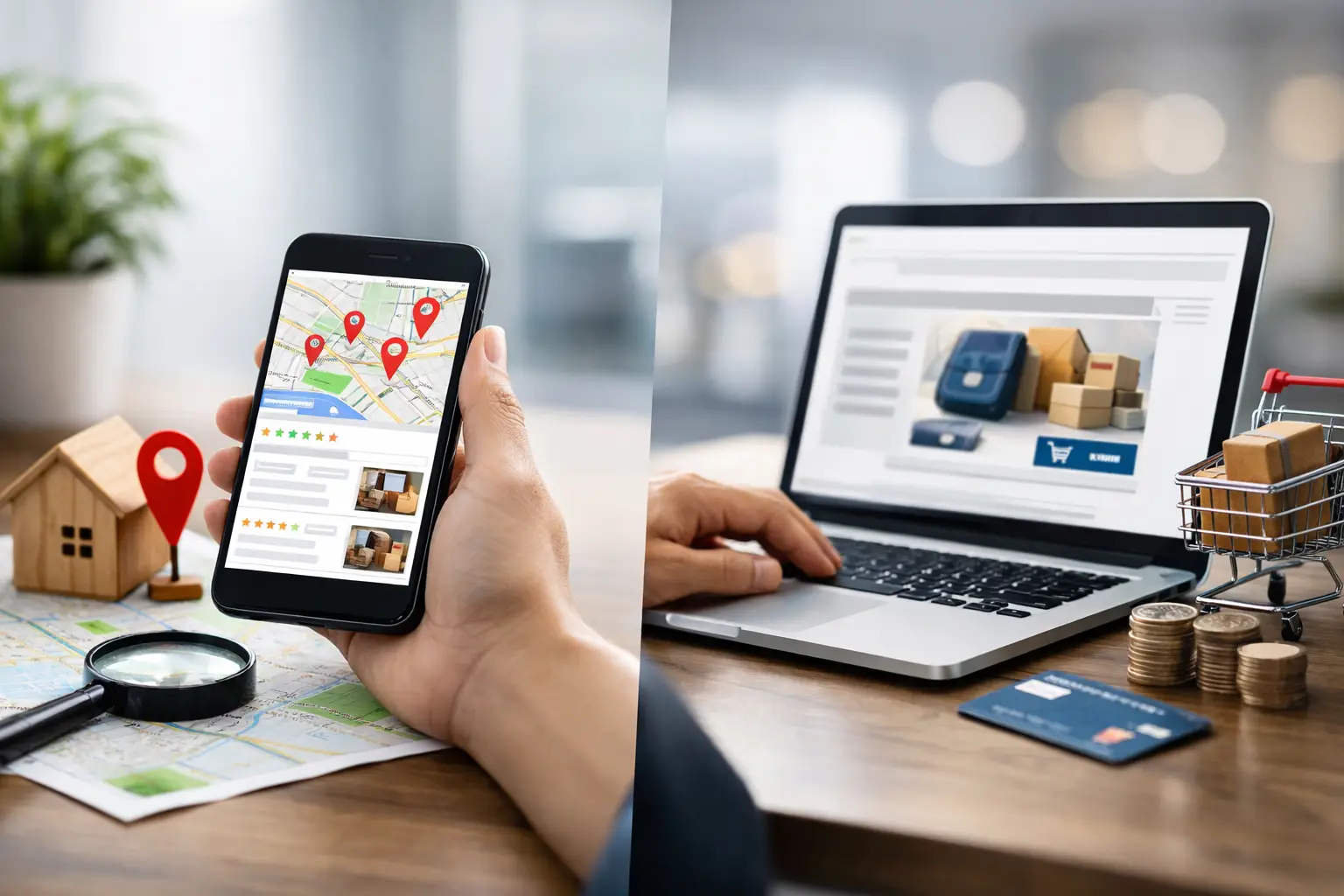
A business owner searches your service on Monday morning. One competitor shows up in the map pack with strong reviews. Another is sitting at the top with a sponsored ad. That single search captures the real debate around local seo vs paid ads: do you invest in visibility you earn over time, or visibility you can buy today?
The honest answer is that both can drive revenue. The better question is which one fits your market, timeline, margins, and growth targets. If you care about qualified leads, cost efficiency, and long-term market share, the decision should be based on business math, not channel bias.
Local SEO vs Paid Ads: The Core Difference
Local SEO is about earning visibility in local organic results, map listings, and location-based searches. It depends on signals like your Google Business Profile, website quality, local relevance, reviews, citations, proximity, and overall authority. When it works, your business shows up where nearby customers are already looking.
Paid ads put you in front of those same searchers immediately. You bid on keywords, build campaigns, set budgets, and pay for clicks or impressions. You can target by location, device, time of day, and intent. It is faster, easier to control in the short term, and often more expensive over time if campaigns are not tightly managed.
That distinction matters because these channels behave differently. SEO compounds. Paid media resets every month when the invoice hits.
Where Local SEO Usually Wins
For most service businesses, local SEO is the stronger long-term asset. Not because it is free – it is not – but because it keeps producing after the initial work is done well.
A strong local SEO program improves how often you appear in map results, branded searches, and high-intent local queries like “emergency plumber near me” or “family lawyer in Charleston.” These are not casual searches. They often come from users close to a decision. If your site, listings, and local authority are in place, you can capture demand without paying for every visit.
This channel also tends to create trust before the click. Reviews, proximity, business details, and organic placement all influence whether a prospect sees you as credible. An ad can buy attention, but it does not automatically buy confidence.
SEO also gets more efficient as it matures. A well-optimized location page, an active Google Business Profile, and a site with strong technical performance can keep driving leads month after month. Results are counted in dollars, not visitors, and local SEO often produces some of the best cost per lead economics once momentum builds.
The trade-off with local SEO
It takes time. In a competitive market, meaningful gains can take months, not weeks. If your website is weak, your profile is under-optimized, or competitors have years of authority built up, there is no instant fix. SEO is also less predictable on a day-to-day basis. Rankings move. Search features change. AI-driven search behavior is changing how discovery happens.
That does not make local SEO weaker. It makes it a strategic investment rather than a quick lever.
Where Paid Ads Usually Win
Paid ads are built for speed. If you need leads this month, have a proven close rate, and know your target economics, paid search can generate demand fast.
This is especially useful in three situations. First, when you are launching a new business or new location and have little organic visibility. Second, when you operate in a high-value category where even a few conversions justify aggressive spend. Third, when seasonality matters and you need to capture short windows of demand.
Paid ads also offer tighter control. You can test offers, landing pages, calls to action, service angles, and geographic targeting with real-time data. That makes paid media useful not just as a lead source, but as a market intelligence tool. If certain keyword themes convert well in ads, those insights can shape your SEO strategy too.
The trade-off with paid ads
The meter never stops running. Once you pause spend, traffic usually drops right behind it. In competitive local categories like legal, home services, med spas, and healthcare, cost per click can get expensive quickly. If landing pages are weak or lead handling is slow, you can burn budget without real return.
Paid media also has a quality problem when campaigns are broad or poorly managed. More clicks do not mean more revenue. You need strong keyword selection, negative keywords, conversion tracking, and clear attribution. Without that, it becomes a very efficient way to buy noise.
Cost, ROI, and Time Horizon
If you strip away the marketing language, local seo vs paid ads often comes down to time horizon.
Paid ads are typically stronger for immediate demand capture. You spend money, traffic arrives, and results appear fast enough to measure quickly. If your campaigns are profitable, you can scale. If they are not, you can cut them.
Local SEO usually has a slower ramp but a better long-term efficiency curve. Early months may look less dramatic because foundational work happens before rankings move. But once visibility improves, the marginal cost of each additional lead is often lower than paid search.
That is why the right question is not which one is cheaper. It is which one creates stronger unit economics over the period you actually care about.
If you need fast pipeline now, paid ads often make sense. If you want durable lead flow and lower acquisition costs over the next 12 to 24 months, local SEO deserves real investment.
Local SEO vs Paid Ads for Different Business Types
A local home service company usually benefits from both, but not equally at every stage. If the phone needs to ring now, paid search can fill the gap. If the goal is to dominate a metro area over time, local SEO should become the foundation.
A multi-location business has even more reason to prioritize local SEO. Each location can build visibility through optimized location pages, business profiles, review generation, and local content. Paid ads can support gaps, but buying traffic for every location forever is rarely the most efficient growth model.
For higher-ticket services with long sales cycles, paid ads can still work well, but only if tracking is strong enough to connect spend to closed revenue. Otherwise, SEO may look slower but actually produce better business outcomes because the leads arrive with more trust and lower acquisition cost.
The Smartest Approach Is Usually Not Either-Or
Most businesses should not frame this as a winner-take-all choice. The better model is sequencing and balance.
Use paid ads when speed matters, when testing new markets, or when you need to protect lead volume while SEO ramps. Use local SEO to build durable visibility, reduce dependency on ad spend, and increase your share of high-intent local searches over time.
When these channels work together, they make each other stronger. Paid search can cover keywords where organic visibility is still weak. SEO can capture searches that would otherwise require ongoing ad spend. Review strategy, landing page optimization, and conversion tracking improve performance across both.
The key is not running more tactics. It is building a system where each channel has a job.
How to Decide What to Prioritize First
Start with your timeline. If your business needs leads in the next 30 days, SEO alone is probably too slow. If you are tired of paying for every click and want stronger margins six months from now, SEO should move higher on the list.
Then look at your economics. What is a lead worth? What percentage of leads turn into revenue? How much can you spend to acquire a customer and still grow profitably? A business with strong margins and fast close rates can often support paid media more aggressively. A business focused on efficiency and long-term market position should be investing in local organic visibility.
Finally, look at your current assets. If your website is outdated, your Google Business Profile is neglected, and your reviews are thin, local SEO may have substantial upside. If your site converts well and you already know which services sell best, paid ads can scale faster.
At SearchX, this is where strategy matters most. No fluff – just proven strategies tied to revenue, conversion quality, and what your market will actually support.
What Businesses Get Wrong
The biggest mistake is treating channel choice like a matter of preference. Business owners often say they “like SEO better” or “trust ads more.” That is not a strategy.
The second mistake is measuring the wrong thing. Rankings without leads are vanity. Clicks without sales are vanity. The real benchmark is revenue impact, customer acquisition cost, and how reliably each channel produces qualified demand.
The third mistake is expecting one channel to solve every growth problem. SEO will not fix poor service differentiation. Paid ads will not fix a weak website or bad intake process. Marketing can increase opportunities, but it cannot rescue a broken funnel.
If you are weighing local seo vs paid ads, choose the option that fits your current stage, then build toward the mix that gives you both speed and staying power. The businesses that win locally are usually the ones that stop chasing marketing theater and start building compounding visibility with a clear path to revenue.