

In 2026, SEO is essential for med spas to stay competitive in a $25.9 billion industry. With 80% of consumers using Google to find local businesses, investing in professional SEO for medical spas can deliver long-term results and a 5–10x ROI. Costs vary based on location, competition, and services, but here’s a quick breakdown:
- Single-location med spas: Budget $2,500–$3,500/month.
- Multi-location med spas: Allocate $3,000–$8,000+/month based on size.
- Large chains: Spend $6,000–$10,000+ monthly for market dominance.
Key services include Google Business Profile management, content creation, technical SEO, and local link building. For example, managing citations costs $250–$500/month, while creating high-quality content ranges from $800–$2,500/month. Tracking metrics like organic sessions, booking rates, and local rankings ensures your investment drives real revenue growth.
SEO isn’t a quick fix – it’s a long-term strategy. Results typically become noticeable within 5–7 months, with substantial gains in 6–12 months. With competition rising, med spas must prioritize SEO to secure high-value clients and maintain a full schedule.
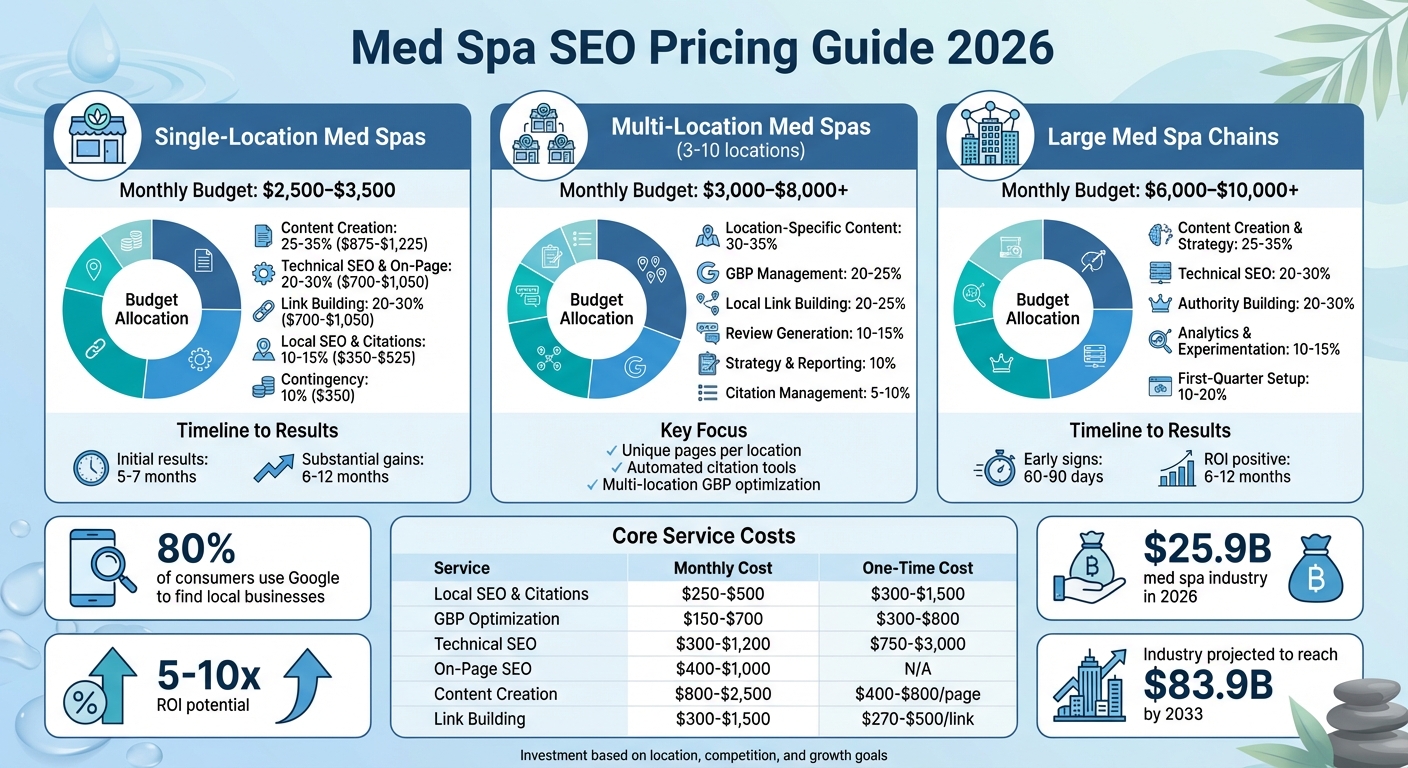
Med Spa SEO Pricing Guide 2026: Budget Breakdown by Business Size
Med Spa SEO Pricing: What You Should Actually Expect to Pay
What Drives Med Spa SEO Pricing in 2026
SEO pricing isn’t random. It’s influenced by several clear factors that determine what you’ll pay to stay competitive in 2026. Understanding these factors helps you assess whether you’re investing in meaningful results or just empty promises.
How Market Competition Affects Costs
Location plays a huge role in SEO costs. In major cities like New York, Los Angeles, and Miami, competition is fierce, driving up pricing. Meanwhile, smaller cities like Austin or Tampa tend to have lower costs because there’s less competition for rankings. Daniil Shpara, Team Lead at Webdelo, explains:
"Industries like healthcare, construction, real estate, and legal services are the most expensive. They’re packed with strong players… and huge content budgets."
This is especially true for med spas, where searches like "Botox near me" often signal a customer ready to book. These high-intent searches mean agencies charge premium rates to help med spas capture those valuable leads. Plus, the competitive landscape constantly evolves as search algorithms become more sophisticated, which adds another layer of complexity.
Search Algorithm Changes and Their Impact
By 2026, SEO isn’t just about ranking on Google. AI-driven platforms like ChatGPT, Perplexity, and Google’s AI Overviews are now part of the equation. This shift has introduced a new focus on Answer and Generative Engine Optimization, which can add anywhere from $300 to $1,500 to your monthly SEO costs.
Search engines have also cracked down on generic, AI-generated content. To stay compliant with E-E-A-T guidelines, your content must be verified by experts, which further impacts pricing. Technical requirements have become more demanding, too. Core Web Vitals and mobile-first indexing now require ongoing attention, adding $300–$1,200 to your monthly budget just to maintain competitiveness.
AI platforms are also pulling data from third-party sites like Yelp and RealSelf, meaning digital PR and citation management have become essential parts of SEO. These changes make local and mobile strategies more critical than ever, as we’ll explore next.
Why Local and Mobile SEO Matter
Local search is the battleground for med spas. A staggering 80% of customers use Google Search to find local businesses, and 49% rely on Google Maps specifically. Even more telling, over half of these searches happen on smartphones.
High-intent searches like "CoolSculpting in [city]" often lead directly to bookings. But capturing these searches requires targeted spending in areas such as:
- Google Business Profile (GBP) management: $150–$700/month
- Citation management across 50+ directories: $250–$500/month
- Mobile optimization for fast load times (under 3 seconds): $300–$1,200/month
Since 2023, local SEO costs have risen by roughly 18%, largely due to more complex algorithms and the need to optimize across multiple platforms at once. As Arc4 notes:
"The days of $300/month ‘full local SEO’ packages delivering real results are largely behind us." – Arc4
Google has also shifted its focus to hyper-local results, prioritizing businesses at the neighborhood or block level. This means med spas must now create micro-location landing pages as part of a broader SEO for doctors strategy instead of relying on broader city-wide content. Combined with the need to rank in AI-driven recommendations, local and mobile SEO now account for a significant share of your investment. However, this focus also directly connects you with high-value clients ready to walk through your door.
Core Med Spa SEO Services and Their Costs
Here’s a closer look at the essential SEO services that can help med spas achieve steady growth. Each service plays a crucial role in building a strong online presence and attracting more clients.
Local SEO and Citation Management
Your Google Business Profile (GBP) is a game-changer for capturing high-intent searches like "Botox near me." It drives visibility in the local Map Pack, which highlights the top three businesses in a given area. Managing your GBP involves tasks like posting updates, monitoring reviews, and fine-tuning the profile to generate leads. This service typically costs $150–$700 per month per location.
Citation management ensures your business details – name, address, and phone number – are consistent across platforms like Google, Yelp, and Healthgrades. Even small discrepancies can confuse search engines, potentially harming your visibility. Citation management costs range from $250–$500 per month, with occasional cleanup projects priced between $300 and $1,500.
"SEO isn’t a ‘nice-to-have’ – it’s foundational to sustainable growth. Paid ads may provide short bursts of traffic, but SEO builds equity over time."
Technical SEO and Core Web Vitals
Technical SEO makes sure your website is fast, mobile-friendly, and easy for search engines to navigate. A slow-loading site or a complicated booking form can cost you potential clients. Metrics like Largest Contentful Paint (LCP) and Interaction to Next Paint (INP) are now crucial ranking factors. For optimal results, your site should load in under three seconds, and booking processes should take no more than 2–3 clicks.
The cost for monthly technical SEO services ranges from $300 to $1,200, depending on the complexity of your site. One-time technical audits are priced between $750 and $3,000.
Keyword Research and On-Page Optimization
Keyword research has become more localized. Instead of just targeting broad terms like "Botox in Miami", it’s important to focus on neighborhood-specific phrases such as "Botox in Coral Gables" or "CoolSculpting in Brickell." This often involves creating dedicated landing pages for each micro-location.
Each treatment should have its own page with 600–800 words of informative, engaging content. Generic service pages no longer perform well. Costs for on-page SEO typically fall between $400 and $1,000 per month, depending on the number of pages and keyword competition.
Content Creation and Planning
High-quality content helps establish your med spa as a trusted authority. Service pages should answer common patient questions, explain treatment benefits, and include schema markup for rich snippets. Blog posts tackling questions like "How long does Botox last?" can further boost your credibility and attract organic traffic.
Content creation costs range from $800 to $2,500 per month, while individual service pages cost $400 to $800 each. Adhering to E-E-A-T guidelines (Experience, Expertise, Authoritativeness, Trustworthiness) is essential for meeting search engine standards in 2026.
Link Building and Off-Page SEO
Backlinks from reputable sources like medical publications or local directories signal trust to search engines, improving your rankings. In this niche, quality matters more than quantity. A single link from a respected source can be far more impactful than numerous low-quality ones.
High-quality backlinks cost between $270 and $500 each, and monthly link-building services range from $300 to $1,500. These links are especially important as AI-driven platforms increasingly rely on third-party data to recommend businesses.
Summary of SEO Costs
Here’s a quick overview of typical costs for these services:
| Service Component | Monthly Cost Range | One-Time Project Cost |
|---|---|---|
| Local SEO & Citations | $250 – $500 | $300 – $1,500 (Cleanup) |
| GBP Optimization | $150 – $700 | $300 – $800 (Setup) |
| Technical SEO | $300 – $1,200 | $750 – $3,000 (Audit) |
| On-Page SEO | $400 – $1,000 | N/A |
| Content Creation | $800 – $2,500 | $400 – $800 per page |
| Link Building | $300 – $1,500 | $270 – $500 per link |
These services are interconnected. For instance, great content won’t perform well if your website is slow, and even the best website won’t succeed without an optimized GBP. The key is choosing the right mix of services based on your med spa’s needs and competitive landscape.
How to Allocate Your Med Spa SEO Budget
Deciding how to distribute your SEO budget depends on your med spa’s size, competition, and growth objectives. Here’s how different types of med spa businesses should plan their spending for 2026.
Single-Location Med Spas
For a single-location med spa, plan to spend $2,500–$3,500 per month to establish a solid SEO foundation. This range covers the basics needed to compete locally without overextending on unnecessary strategies.
- Lower budgets ($2,200–$2,500/month): Focus on Google Business Profile (GBP) optimization and cleaning up citations. This is especially effective in less competitive markets.
- Higher budgets ($3,500/month): Allocate funds as follows:
- 25–35% ($875–$1,225): Content creation
- 20–30% ($700–$1,050): Technical SEO and on-page optimization
- 20–30% ($700–$1,050): Link building
- 10–15% ($350–$525): Local SEO and citation management
- 10% ($350): Contingency funds for unexpected needs.
SEO is a long-term game. Most single-location med spas start to see meaningful increases in traffic and bookings within five to seven months. For smaller websites (fewer than 50 pages), a basic retainer of $750–$1,500/month might be enough for technical upkeep and local visibility. However, this approach won’t support aggressive growth.
When dealing with multiple locations, the budgeting process becomes more intricate.
Multi-Location Med Spas
For med spas with multiple locations, the SEO strategy must adapt to the unique challenges of each market. Budget $3,000–$8,000 per month for 3–10 locations, and scale up to $8,000+ per month for larger operations.
- Google Business Profile (GBP) management: Allocate 20–25% of your budget here. This tactic provides the best return on investment for rankings.
- Location-specific content: Dedicate 30–35% to creating unique pages for each location. Avoid cookie-cutter templates – Google’s 2026 algorithms favor detailed, locally relevant content. Pages should highlight staff, parking info, nearby landmarks, and neighborhood details.
- Local link building: Set aside 20–25% for partnerships with local businesses and medical publications.
- Review generation systems: Use 10–15% to ensure a steady stream of fresh reviews across all locations.
- Citation management: Reserve 5–10% for automated tools to keep your contact details consistent across directories.
- Strategy and reporting: Devote the final 10% to ensure all efforts align and deliver measurable results.
If organic search is your main growth driver, consider allocating 20–40% of your overall digital marketing budget to SEO. This builds long-term value that paid ads can’t match, especially with cost-per-click rates averaging $5.70 in the beauty and personal care industry.
For enterprise-level med spa chains, the focus shifts to scaling content and building authority aggressively.
Large Med Spa Chains
Larger med spa chains should budget $6,000–$10,000+ monthly for robust campaigns aimed at dominating the market. At this level, the strategy focuses on producing content at scale and establishing strong authority.
- Content creation and strategy (25–35%): Aim to produce 6–12 high-quality pieces monthly, targeting specific topics and clusters.
- Technical SEO (20–30%): Address challenges like multi-site architecture, Core Web Vitals, and large-scale programmatic SEO.
- Authority building (20–30%): Invest in link earning, digital PR, and partnerships with medical publications.
- Analytics and experimentation (10–15%): Focus on conversion rate optimization and exploring new channels like Answer Engine Optimization (AEO). AEO costs range from $300–$1,500/month and ensures visibility in AI-driven search results.
- First-quarter setup (10–20%): Reserve this portion for initial technical fixes and operational setup.
Large med spa chains often see early signs of success, such as better rankings and impressions, within 60–90 days. ROI typically becomes cashflow-positive between 6 and 12 months. This approach builds lasting digital authority and supports steady growth in an increasingly competitive market.
How to Measure SEO Return on Investment
Measuring the success of your SEO efforts comes down to connecting your spending to actual revenue. By 2026, tracking ROI involves focusing on specific actions like form submissions, phone calls from your Google Business Profile, and confirmed bookings. For instance, the beauty and personal care sector saw conversion rates hit 7.82% in 2025, making every organic lead a potentially high-value opportunity.
To calculate ROI, multiply the number of new leads by your conversion rate and the average lifetime value of a customer. If your SEO strategy consistently delivers quality leads, you’ll not only recover your investment but also create a foundation for long-term growth. This approach helps break down how each part of your SEO plan contributes to overall business success.
"A med spa client considering injectables, body contouring, or laser treatments is not booking a $60 haircut. They are booking a $400 to $2,000+ treatment… One new client who finds you through Google can be worth $5,000 to $15,000 in lifetime revenue."
- Aditi Goyal, Zoca
Take Diamond Aesthetics in New York City as an example. In 2026, they shifted from expensive Google and Instagram ads to an organic local SEO strategy. By emphasizing consistent visibility and automating lead follow-ups, they achieved profitability while attracting higher-quality leads. As the owner put it:
"I’m not tech-friendly. I don’t know what SEO means. But I know I’m making profit – and that’s what matters."
- Diamond Aesthetics
The key is to focus on tracking traffic with strong commercial intent. Keywords like "Botox cost [city]" often indicate a readiness to purchase. Additionally, monitoring your brand’s search volume can provide insights into growing trust and awareness in your market.
Key Metrics to Track
Start by analyzing visibility metrics, which show where your business appears in search results. For local businesses, ranking in Google Maps’ local pack is especially important for drawing nearby customers.
Other essential metrics include:
- Organic sessions: This tracks the number of non-paid visitors to your website.
- Booking rate: Measures how many leads convert into actual appointments. For example, a solo practitioner in the southeastern U.S. improved their ranking for "Botox [city]", tripling their organic traffic and significantly boosting weekly appointment requests.
- Cost per acquisition (CPA): Helps evaluate how efficiently your SEO spending translates into new customers.
- Core Web Vitals: Metrics like an Interaction to Next Paint under 200ms and a Largest Contentful Paint under 2.5 seconds ensure a smooth user experience, which is crucial for conversions.
- Review velocity: A steady flow of 8–12 new reviews each month can improve rankings more effectively than a large but stagnant number of reviews.
With the rise of AI-driven search, measuring your brand’s visibility in AI-generated overviews and map pack placements is becoming increasingly important.
Tools for Tracking Performance
To monitor and fine-tune your SEO efforts, leverage tools like Google Search Console and Google Analytics 4. These platforms provide insights into keyword rankings, organic traffic, and conversion paths. Setting up GA4 conversion goals for your booking page can help you distinguish between casual visitors and actual clients.
For more advanced tracking, consider platforms such as:
- Ahrefs or Semrush: Ideal for keyword research and competitor analysis.
- BrightLocal: Useful for local SEO tracking, citation building, and review monitoring.
- Screaming Frog: Conducts technical audits to identify issues like broken links or slow load times.
As AI-driven search continues to evolve, tools like Advanced Web Ranking can help you track your visibility in AI-generated results, ensuring your brand remains prominent even in zero-click search scenarios.
One example of effective tracking comes from a multi-location franchise in Southern California. By creating neighborhood-specific landing pages, they secured local map pack rankings for most of their clinics, leading to a 40% increase in new client inquiries within six months.
Investing in professional analytics setup – typically costing $100–$300 for initial configuration and $50–$150 per month for ongoing monitoring – can help you focus on the metrics that truly impact revenue. These tools enable you to make data-driven decisions that align with your broader SEO goals.
Conclusion: Making Smart SEO Investment Decisions
Choosing the right SEO strategy depends on understanding your market position and aiming for consistent growth. For a single-location med spa in a smaller market, a monthly maintenance plan of $1,000–$2,200 may be sufficient. However, multi-location businesses in larger cities like Miami or Los Angeles often need to invest $5,000–$6,500 or more each month to stay competitive.
Successful med spas generally allocate 5%–15% of their gross revenue to digital marketing, with SEO as a key focus. The goal isn’t about vanity metrics like pageviews. What truly matters are measurable outcomes like booked appointments, calls from your Google Business Profile, and inquiries from new patients – activities that directly contribute to business growth. These budget ranges provide a solid foundation for crafting effective strategies to strengthen your online presence.
Before increasing your content budget, ensure your site’s technical health is in order. Address basics like broken links and optimize Core Web Vitals. These technical improvements often lead to quick, noticeable results, making them a smart first step.
It’s important to remember that SEO is a long-term investment. While you may see some initial results within 2–3 months, more substantial improvements typically occur between months 5–7. Focus on tracking high-value, commercial-intent keywords like “Botox cost [city]” and keep an eye on your visibility in AI-driven search platforms, as tools like ChatGPT and Google’s AI Overviews are changing how potential clients find med spas.
With the med spa industry projected to grow to $83.9 billion by 2033, at an annual growth rate of 15.7%, the stakes have never been higher. In this fast-growing market, ranking third instead of thirteenth in local search results could mean the difference between a fully booked schedule and empty treatment rooms. Tailor your SEO investments to your location, service offerings, and growth goals – and work with experts who understand the nuances of med spa SEO.
FAQs
What deliverables should a $3,000/month SEO plan include for a med spa?
A $3,000/month SEO plan for a med spa should cover the essentials to boost online visibility and attract local clients. This typically includes local SEO optimization, technical SEO, keyword research, content creation, backlink building, and performance analysis.
Here’s what you can expect:
- Improved Local Search Visibility: Optimize for local search with strategies like Google Business Profile updates, local citations, and geo-targeted keywords.
- Technical Audits: Identify and fix issues like slow page speed, broken links, or mobile usability problems.
- Targeted Content Development: Create blog posts, service pages, or FAQs tailored to your audience and industry.
- Quality Backlink Acquisition: Build authoritative links to strengthen your website’s ranking.
- ROI-Focused Reports: Get regular updates that highlight performance metrics, showing how your investment translates into growth.
These services work together to help med spas thrive in a competitive market by driving sustainable growth and delivering measurable outcomes.
How can I tell if my SEO is leading to booked appointments, not just traffic?
To make sure your SEO efforts are actually driving appointments (and not just traffic), it’s crucial to track conversions and key appointment metrics. Here’s how:
- Set up conversion tracking: Use tools like Google Analytics to monitor bookings or inquiries directly tied to your website. This helps you measure how effectively your SEO strategy turns visitors into leads or clients.
- Use call tracking: If phone inquiries are part of your business, implement call tracking software. This allows you to connect phone calls back to organic search visits, giving you a clearer picture of how SEO contributes to your overall success.
- Analyze booking page behavior: Dive into how users interact with your booking or inquiry pages. Are they dropping off before completing a form? Use this data to refine your strategy and target high-intent keywords that align with what your audience is searching for.
Keeping a close eye on these metrics ensures your SEO efforts are aligned with your ultimate goal: driving actual appointments, not just boosting site visits.
When should I add AEO for AI search, and what does it change?
Incorporating AEO (Answer Engine Optimization) into your strategy is essential if you want to stand out in AI-driven search results. This approach allows for quicker content updates and increases your chances of earning citations from AI platforms. Instead of focusing solely on traditional search engines, AEO shifts your efforts toward optimizing for AI tools like ChatGPT and Perplexity. By doing so, you ensure your strategy keeps pace with the rapidly changing world of AI-powered search technologies.