
Want your med spa website to drive bookings instead of just traffic? In 2026, SEO is all about turning searchers into paying clients. Here’s what matters most:
- Google Business Profile (GBP): Optimize for local visibility with precise categories, geotagged photos, and consistent reviews.
- Location-Specific Keywords: Target high-conversion phrases like "Botox near me" or "lip filler [city]" on dedicated service pages.
- Site Speed: Over 50% of users leave if your site takes more than 3 seconds to load.
- Reviews: Aim for 8–12 new reviews monthly to boost rankings and build trust.
- Booking Process: Keep it simple – 2–3 clicks max. Use tools like online schedulers to capture after-hours leads.
- Structured Data: Use schema markup for treatments, FAQs, and reviews to improve visibility in search and AI tools.
Bottom line: Traffic alone doesn’t grow your business – booking consultations does. This guide explains how to optimize your site and strategy to convert visitors into clients.
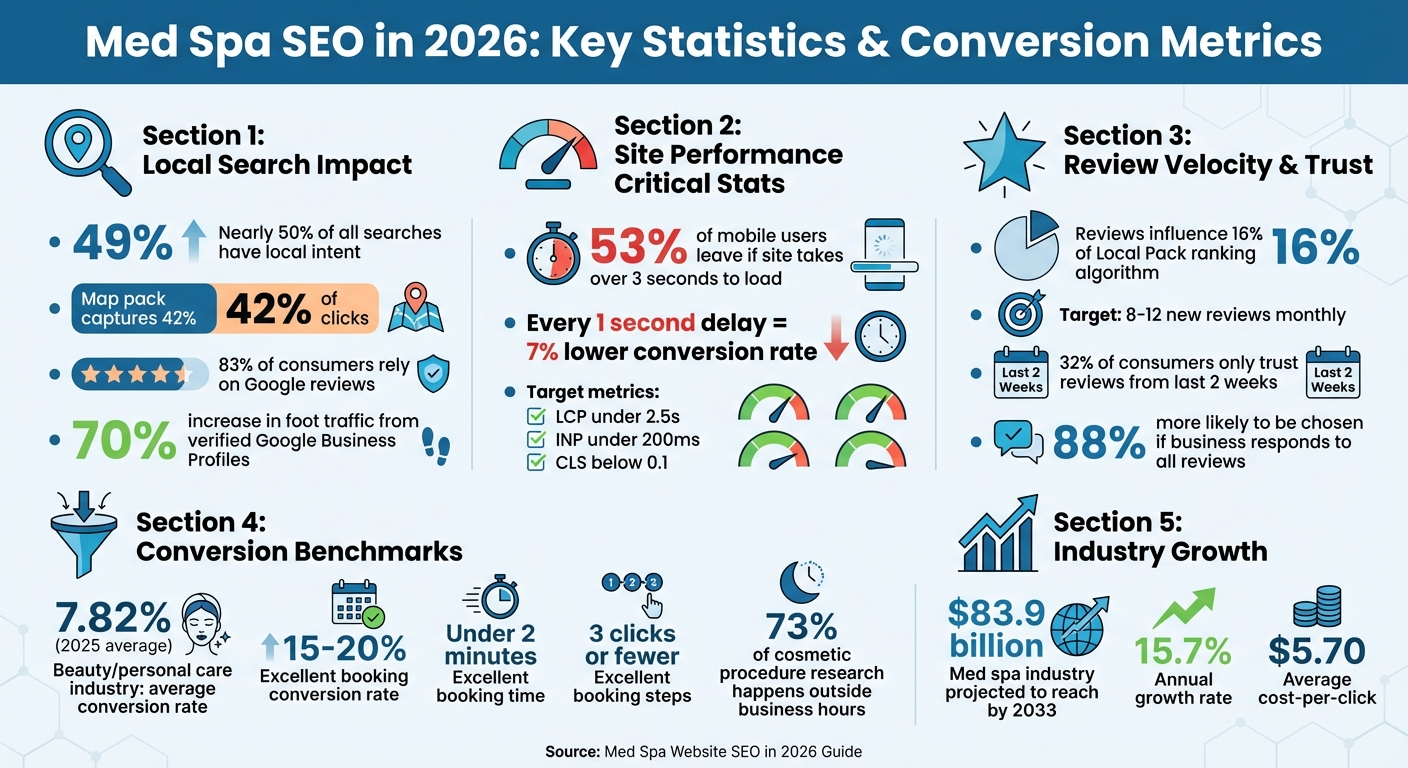
Med Spa SEO Statistics and Conversion Metrics 2026
Med Spa Websites: How to Turn Your Site Into a Sales Machine
Local SEO for Med Spas
Local SEO is a game-changer for med spas looking to book more consultations. With nearly half of all searches having local intent and the map pack grabbing 42% of clicks, not showing up means losing potential clients.
Setting Up Your Google Business Profile
Your Google Business Profile (GBP) is a cornerstone of local visibility. Start by setting "Medical Spa" as your primary category – not "Day Spa" or "Beauty Salon." This ensures you show up for high-intent searches like "Botox near me" rather than getting lost in unrelated queries. To broaden your reach, add up to nine secondary categories like "Laser Hair Removal Service", "Skin Care Clinic", or "Cosmetic Surgery Clinic".
Consistency is key when it comes to your NAP (Name, Address, Phone). Even small differences like "Suite 200" versus "Ste 200" across platforms like Google, Yelp, and Healthgrades can hurt your rankings. In your services section, list treatments with detailed descriptions and pricing. Instead of just "Botox", try "Botox for Forehead Lines" with a price range. This approach helps you rank for specific searches and sets client expectations.
Photos are another critical element. Upload 25–30 high-quality, geotagged images of your exterior, treatment rooms, and staff – no stock images allowed. You can even create a virtual tour using the Google Street View app to build trust before clients book.
Keep your profile active by posting weekly updates about offers, new services, or educational content. This signals Google that your profile is well-maintained. Use the Q&A section proactively by posting and answering common questions, which lets you shape the conversation and include relevant keywords. Finally, enable messaging and respond quickly – ideally within five minutes – to convert mobile leads into bookings.
| GBP Feature | Optimization Action | Ranking Factor Impact |
|---|---|---|
| Primary Category | Set to "Medical Spa" | High (Relevance) |
| Photos | 100+ unique, geotagged images | Medium (Engagement/CTR) |
| Reviews | Maintain 8–12 new reviews/month | High (Prominence) |
| Posts | Weekly updates with CTA buttons | Medium (Freshness) |
| Services | List individual treatments with prices | Medium (Relevance) |
Once your GBP is optimized, you’re ready to implement proven med spa SEO strategies to target local treatment keywords and attract nearby clients.
Targeting Location-Based Keywords
To dominate local search, create dedicated service pages for each core treatment. In highly competitive areas, go even more specific by targeting neighborhood-focused keywords like "Botox in [Neighborhood]" instead of broader city-wide terms.
Focus on high-intent search patterns such as "Service + City" (e.g., "lip filler Scottsdale"), "Service + near me", and "Concern + treatment + City" (e.g., "double chin treatment Scottsdale"). Incorporate these location modifiers into your titles, meta descriptions, and headings. Use clear, keyword-rich URLs like yourmedspa.com/botox-scottsdale.
Each service page should include 600 to 1,500 words of well-written, informative content. This not only helps establish your authority but also gives search engines enough material to index. If you operate multiple locations, make sure each location page has 40%–60% unique content to avoid penalties for duplicate content. Adding "LocalBusiness" and "Service" schema markup can also improve how search engines interpret your site.
While keyword optimization is essential, managing client reviews plays an equally important role in strengthening your local presence.
Managing Reviews and Online Reputation
Reviews influence about 16% of Google’s Local Pack ranking algorithm. A steady flow of new reviews – around 8–12 per month – is more impactful than sporadic bursts. Google looks at the number of reviews, how recent they are, and whether they include relevant keywords. In fact, 32% of consumers only trust reviews written within the last two weeks.
Timing is everything. Request reviews within 24–48 hours of treatment via SMS, email, or QR codes to capture fresh feedback. Encourage clients to mention specific services and locations in their reviews, such as "Loved my HydraFacial in Scottsdale." These details boost your relevance. Avoid review gating (filtering out negative feedback before asking for reviews), as it violates Google’s guidelines and could result in penalties.
Responding to reviews is just as important. Businesses that reply to all reviews are 88% more likely to be chosen by customers. For negative reviews, apologize, explain any changes you’ve implemented, and offer to take the conversation offline. For example, a restaurant chain with 12 locations saw three of its locations re-enter the Map Pack and raised its average rating from 3.7 to 4.2 stars after implementing a QR-code review system and responding to all reviews within 48 hours.
Platforms like RealSelf and Healthgrades also play a role in building your authority and visibility. While 83% of consumers rely on Google reviews, diversifying across platforms strengthens your reputation. Plus, AI-driven tools like ChatGPT and Perplexity now analyze review sentiment and service mentions to generate local recommendations.
Keyword Research and Search Intent
Building a smart keyword strategy does more than just improve your visibility – it helps bring in consultations, which is a key goal for med spas. The process starts with understanding why someone is searching. For example, a query like "what is microneedling" shows curiosity or research, while "microneedling near me" signals someone is ready to book. Google rewards content that aligns with user intent, and as of 2026, AI tools like ChatGPT and Perplexity rely heavily on structured, straightforward content to provide accurate answers.
Types of Search Intent
Search intent generally falls into four main categories:
- Informational: These searches (e.g., "dermal filler safety risks") are about gathering knowledge or learning.
- Commercial: Queries like "lip fillers cost Scottsdale" suggest users are comparing options, pricing, or services.
- Transactional: Searches such as "book Botox near me" show someone is ready to take action, like booking an appointment.
- Local: Phrases like "med spa in Chicago" reflect a preference for services in a specific area.
To maximize results, tailor your content to match each type of intent. Blog posts are great for answering informational queries, service pages help with comparisons, and landing pages with booking tools work best for transactional searches.
High-Conversion Keywords for Med Spas
When targeting keywords, focus on these three tiers:
- Tier 1 (High-Intent): These include searches like "Botox near me" or "lip filler [city]" that indicate someone is ready to book.
- Tier 2 (Problem-Aware): Phrases such as "how to get rid of wrinkles" or "non-surgical double chin removal" show users know their issue but haven’t picked a solution yet.
- Tier 3 (Brand/Competitor): These keywords involve competitor names or comparison-based searches.
Long-tail keywords like "microneedling for acne scars" are often easier to rank for and attract visitors who are closer to making a decision. To uncover high-potential local keywords, try Google Autocomplete – just type in your core services and see what pops up. Then, validate those ideas using Google Keyword Planner. Look for keywords with a local search range of 100–1,000 monthly searches. Avoid terms that don’t convert well, such as "free", "DIY", "jobs", or "side effects", as they can dilute your strategy. With beauty and personal care conversion rates projected to hit 7.82% in 2025 and cost-per-click averaging $5.70, focusing on organic, high-conversion keywords can deliver excellent returns.
Using these keywords effectively on your service pages strengthens your relevance and positions you for better search rankings.
Using Keywords on Service Pages
To optimize your service pages, include the primary keyword (treatment name + city) in key areas like the page title, H1, and body text. Use simple, keyword-focused URLs (e.g., yourmedspa.com/botox-scottsdale), and add "LocalBusiness" and "Service" schema markup to help search engines understand your content.
If you have multiple locations, make sure each location page has unique content to avoid duplicate content penalties. Use Google Search Console to find keywords with high impressions but low clicks – tweaking these pages can often lead to quick traffic improvements.
| Intent Type | Search Example | Target Page Type |
|---|---|---|
| Informational | "How long does Botox last?" | Blog Post / FAQ Section |
| Commercial | "Best med spa for fillers in Scottsdale" | Service Page / Comparison Guide |
| Transactional | "Lip filler appointment today" | Landing Page with Booking Calendar |
| Local | "Med spa near me" | Google Business Profile / Homepage |
Technical SEO and Site Performance
The technical setup of your website plays a major role in both search rankings and user conversions. With mobile-first indexing now the standard, Google prioritizes the mobile version of your site for crawling and ranking. A poorly functioning or slow mobile site can undermine even the best desktop experience.
Mobile Performance and Page Speed
Website speed is no longer negotiable. 53% of mobile users leave a site that takes over three seconds to load, and every additional second of delay can lower conversion rates by 7%. For med spas, where local consultations are key, a slow site can mean losing potential patients.
To stay competitive, aim for these metrics:
- LCP (Largest Contentful Paint): Under 2.5 seconds
- INP (Interaction to Next Paint): Less than 200 milliseconds
- CLS (Cumulative Layout Shift): Below 0.1
"A slow website costs you twice: once when visitors leave, and again when Google pushes you down in rankings." – Monsoft Solutions
Speed up your site by optimizing images. Use modern formats like WebP or AVIF and compress files. Implement the srcset attribute to serve smaller images to mobile users (e.g., 400px width for phones, 1,200px for desktops). Add a <link rel='preload'> tag for your hero image to ensure it loads immediately, and avoid lazy-loading content above the fold.
For scripts, defer non-essential ones like chat widgets or tracking pixels. Move non-critical JavaScript to the bottom of your page using async or defer attributes. Enable browser caching by setting static assets to expire in a year and HTML pages to refresh every one to seven days. If technical SEO feels overwhelming, consider consulting experts to identify and resolve bottlenecks.
Mobile usability is another key factor. Avoid font sizes smaller than 16px, ensure touch targets are at least 48×48 pixels, and eliminate horizontal scrolling. Buttons and links should have at least 8 pixels of spacing, and body text should use a line height between 1.5 and 1.7.
Once your site runs smoothly, you can further enhance visibility using structured data.
Adding Schema Markup
Schema markup helps search engines better understand your content and enables rich results like star ratings, FAQs, and price ranges that make your listing pop. By 2026, schema will also play a critical role in AI-driven search tools like Google AI Overviews, ChatGPT, and Perplexity, which depend on structured data for accurate summaries and citations.
"In 2026, it’s not just about rich results. AI systems like Google’s AI Overviews, ChatGPT, Perplexity, and others rely heavily on structured data to understand, summarize, and cite your content accurately." – Backlinko
Here’s how to use schema effectively:
- MedicalBusiness schema: Add this to your homepage and location pages to define your address, hours, and specialties.
- FAQPage schema: Use this on service pages (e.g., Botox or CoolSculpting) to answer common questions like "How long does it last?" or "Is it safe?".
- Review schema: Apply this to testimonials so star ratings appear in search results.
- Service schema: Use this for treatment pages to define procedures, pricing, and availability.
Use JSON-LD format for schema – it’s easier to manage than other options. Validate your schema regularly with tools like the Schema.org Validator or Google’s Rich Results Test to avoid errors, as invalid schema won’t be recognized. For more guidance, check out how to add local business schema markup.
After optimizing performance and schema, focus on site security and navigation to build trust and improve usability.
Security and Site Navigation
HTTPS is non-negotiable. It protects sensitive patient data and builds trust – especially important for medical services. If your site still uses HTTP, switch immediately. Modern browsers flag non-secure sites as unsafe, and Google penalizes them in rankings.
Simplify navigation for both users and search engines:
- Use descriptive URLs like
yourmedspa.com/botox-scottsdaleinstead of generic ones likeyourmedspa.com/page?id=123. - Create internal links between treatment pages, content focused on specific concerns (e.g., "wrinkle reduction"), and pricing pages to guide visitors toward booking.
- Fix broken links quickly – they harm user experience and waste Google’s crawl budget.
Display trust signals prominently. Highlight provider credentials, include safety notes for treatments, and use authentic photos of your clinic and team instead of stock images. Clearly outline policies for deposits, cancellations, and refunds. Avoid intrusive popups on mobile – Google penalizes sites with full-screen popups, though small cookie banners or age verification notices are acceptable.
Finally, ensure content parity between desktop and mobile. Don’t hide key information behind accordion menus or "load more" buttons, as this can prevent Google from indexing it. If content requires JavaScript to display, it might not get crawled. Keep essential details visible by default, especially on mobile.
These technical tweaks not only improve your rankings but also create a smooth, trustworthy experience for visitors – critical for turning traffic into consultations.
Converting Website Visitors Into Consultations
Getting visitors to your website is only half the battle. The real challenge is turning them into actual consultations. Many med spa websites focus too much on aesthetics, leaving you with a beautiful site but no appointments to show for it. What sets successful sites apart is their ability to remove barriers and build trust through smart design and messaging. Let’s dive into how clear calls-to-action (CTAs) and credibility can make all the difference.
Writing Clear Calls-to-Action
The way you phrase your CTAs can have a big impact on conversions. Instead of using vague buttons like "Contact Us" or "Learn More", opt for direct and action-driven phrases like "Book Your Free Consultation", "Schedule Now", or "Claim an Offer". These guide visitors on exactly what to do next.
Placement matters, too. Your primary booking button should be immediately visible – place it above the fold so users see it right away. Secondary CTAs should appear in strategic spots, such as after patient reviews, before-and-after galleries, or at the end of service descriptions. For mobile users, sticky booking buttons that follow them as they scroll, along with click-to-call or WhatsApp options, ensure easy access.
"The booking path should require no more than two or three clicks from your homepage to a confirmed appointment. If a client has to search for your booking button, you have already introduced friction that costs you bookings." – Aditi Goyal, Zoca
Keep the booking process short and sweet – two or three clicks max. Any extra steps can cost you around 10% of potential patients for each one.
Building Credibility with Visitors
Trust is everything when it comes to converting visitors into patients. Showcase provider credentials, medical certifications, and professional association logos prominently on your homepage and service pages. Use real photos of your clinic and team, as people want to visualize who they’ll meet and where they’ll be treated.
Each service page should include specific evidence of results. For example, a Botox page should feature its own before-and-after gallery and reviews from patients who’ve had that exact treatment. To compete locally, aim for at least 50 Google reviews – this is often the baseline for appearing in the local map pack.
"Patients do not read everything. They scan, compare, and choose the med spa that feels safest, most credible, and easiest to contact." – xperiainfotech, The Viral Lines
Transparency also helps build trust. Include pricing details or consultation-based estimates on your service pages. This not only reduces doubts but also ensures that only serious leads proceed to book. Address common concerns in FAQs or blog posts, such as "Does Botox hurt?" or "How long does CoolSculpting last?" – this positions you as an authority and builds confidence.
Simplifying the Booking Process
Here’s a key stat: 73% of cosmetic procedure research happens outside business hours. If your booking system requires a phone call during office hours, you’re likely losing a significant number of potential patients. Instead, integrate scheduling software like Boulevard or Mangomint so visitors can book appointments instantly, anytime.
Streamline your forms. Only ask for essentials like Name, Phone, Email, Procedure, and Preferred Date/Time. Use dropdown menus instead of open text fields to avoid overwhelming users. Also, skip account creation requirements – this adds unnecessary friction and raises privacy concerns.
For mobile users, ensure booking buttons are at least 44×44 pixels for easy tapping and use a single-column layout to eliminate the need for pinching or zooming. Adding small notes like "Takes 2 minutes" or "Instant confirmation" near the CTA can reassure users that booking won’t be a hassle.
| Metric | Poor Performance | Average | Excellent |
|---|---|---|---|
| Booking Conversion Rate | Under 5% | 5–10% | 15–20% |
| Time to Book | Over 5 minutes | 3–5 minutes | Under 2 minutes |
| No-Show Rate | Over 30% | 20–30% | Under 10% |
| Booking Steps | 7+ clicks | 4–6 clicks | 3 clicks or fewer |
Test your booking process on a mobile device. If it takes more than 2 minutes or involves more than 5 fields, simplify it. Instead of a "Cancel" button, offer a "Pick a new slot" option – this small change can reduce cancellations by up to 30%.
"The booking page has one job: get the appointment scheduled." – Monsoft Solutions
Once you’ve streamlined the system, tracking key metrics will help you fine-tune your approach and maximize results.
Tracking Results and Making Improvements
You’ve optimized your website, simplified your booking process, and started attracting visitors. Now comes the crucial part: measuring your performance. Without tracking the right metrics, you’re essentially flying blind. The med spas dominating local search in 2026 aren’t leaving things to chance – they’re consistently analyzing their data and making calculated adjustments based on what they uncover. To turn traffic into consultations, keeping a close eye on your data is non-negotiable.
Key Metrics to Monitor
It’s easy to get fixated on total traffic, but the real question is: what happens after visitors land on your site? Focus on conversion and visibility metrics to understand performance. Key numbers to track include organic leads, consultation booking rates, clicks on phone numbers (those tel: links on mobile), and contact form submissions. For context, the beauty and personal care industry achieved an average conversion rate of 7.82% in 2025, far surpassing the 2–3% seen in other sectors. If your site is converting below 5%, there’s room to grow.
"A website that gets 500 visitors and 25 phone calls beats a website that gets 5,000 visitors and 10 phone calls."
- Samuel Godfrey, CEO and Founder, Luminous Digital Visions
Visibility metrics are another critical area. Use Google Search Console to monitor your average ranking for key phrases like "Botox [your city]" or "CoolSculpting near me." Keep track of how many terms rank in the Top 3, Top 10, and on Page 2. Also, pay attention to your local pack rankings – those map results can drive significant foot traffic. Verified Google Business Profiles, for instance, can see a 70% increase in foot traffic from local searches.
Engagement metrics help you gauge how well your content resonates with visitors. In Google Analytics 4 (GA4), prioritize Engagement Rate, which measures sessions lasting over 10 seconds or involving a conversion event. Your Click-Through Rate (CTR) from search results is another key metric. For positions 1–3, a healthy CTR ranges between 15–30%, while positions 4–10 typically see 3–10%.
Don’t overlook technical health. Keep an eye on Core Web Vitals (LCP, INP, CLS) and ensure your pages are indexed properly. If over 15% of your pages show up as "Crawled – currently not indexed" in Search Console, it’s likely due to thin or low-quality content that needs to be addressed.
Lastly, your local reputation plays a big role. Monitor how many new reviews you’re getting each month. A steady flow of 8–12 new reviews per month can help you outperform competitors who might have more reviews overall but lack recent activity. Regularly check your Google Business Profile insights, including direction requests and profile views.
| Metric Category | What to Track | Target Benchmark |
|---|---|---|
| Conversion | Website Conversion Rate | 8–12% (optimized sites) |
| Visibility | Average Position (Top Keywords) | Positions 1–3 |
| Engagement | Search CTR (Positions 1–3) | 15–30% |
| Local | Review Velocity | 8–12 new reviews/month |
| Technical | Page Load Speed | Below 3 seconds |
Setting up your analytics to capture these actions is essential for success.
Setting Up Conversion Tracking in Google Analytics
Many med spas install Google Analytics but fail to configure proper conversion tracking, which means they’re only counting visitors instead of tracking meaningful business results.
To start, set up a property in Google Analytics 4 (GA4) if you haven’t already. You’ll receive a Measurement ID (e.g., G-XXXXXXXXXX) that needs to be added to your site’s tracking code.
Next, define your conversion events. Focus on tracking key actions like phone number clicks, contact form submissions, and CTA button clicks such as "Schedule Consultation". For example, use a JavaScript listener to trigger a phone_call_click event anytime someone taps your phone number.
After tracking these events, manually mark them as "Conversions" in the GA4 Admin panel under Events. This step is critical – if you skip it, these actions won’t show up in your conversion reports.
Compliance tip: Standard GA4 setups can unintentionally transmit Protected Health Information (PHI), which could violate HIPAA regulations. Use server-side tagging and IP anonymization to stay compliant. If you’re unsure, consult a developer experienced in healthcare privacy requirements.
Also, link Google Search Console to your GA4 property. This integration lets you track "striking distance" keywords – terms ranking in positions 4–10 that can be bumped into the top 3 with minor tweaks. For example, a solo-practitioner med spa in the Southeast optimized for "Botox [city]" in late 2025. In just three months, they moved from page three to position four, tripled their organic traffic, and increased weekly appointment requests from 2 to 12.
These insights can guide your strategy adjustments, which we’ll explore next.
Using Data to Refine Your Strategy
Data isn’t just for tracking – it’s a tool for action. The med spas thriving in 2026 are those that review their data weekly and make intentional improvements based on what they see.
Start by identifying "striking distance" keywords in Google Search Console – terms ranking in positions 4–15. These represent opportunities where small updates, like refining meta descriptions or adding internal links, can push your pages into the top 3 and attract more clicks.
Next, analyze CTR performance. Look for pages with high impressions but a low CTR (below 3%). Revamp these pages’ meta titles and descriptions to make them more compelling. For instance, instead of "Botox Treatment", try "Botox in [Neighborhood] – Free Consultation – Board-Certified."
Check your indexation regularly. If a significant number of pages aren’t indexed, it’s likely due to content quality issues rather than technical problems. Merge thin pages, eliminate duplicates, and focus on creating in-depth service pages that answer user questions effectively.
In GA4, examine which pages draw high traffic but have low engagement. If visitors are leaving quickly, the content might not align with their search intent. Refresh these pages by adding updated stats, new sections, or better internal links to related content.
"The businesses that win at local SEO long-term are the ones that look at their numbers every week, spot problems early, and make data-driven adjustments."
- Samuel Godfrey, CEO and Founder, Luminous Digital Visions
Finally, experiment with your conversion funnel. Test different CTA button texts (e.g., "Call Now" vs. "Get Free Quote"), placements (above the fold vs. sticky), and designs. Use your conversion data to figure out what works best.
Diamond Aesthetics, a med spa in New York City, embraced this data-driven approach in 2026. By shifting from expensive ad campaigns to an organic SEO strategy, they identified the services and neighborhoods delivering the best results. With automated local SEO and lead follow-up, they replaced ad-related stress with steady, high-quality clients and consistent monthly profits.
Conclusion
The med spa industry is on track to hit $83.9 billion by 2033, with an annual growth rate of 15.7%. But here’s the catch: growth will favor businesses that understand one critical truth – traffic alone doesn’t pay the bills, bookings do.
This guide lays out a system designed to bridge that gap. Your Google Business Profile boosts local visibility, while well-crafted service pages address patient concerns and attract high-intent searches. Adding schema markup helps your site show up in AI-generated responses, and prioritizing mobile speed paired with strong calls-to-action clears the path for seamless bookings. On top of that, tracking your data ensures every decision is backed by real-world conversion insights.
FAQs
Which treatments should I create service pages for first?
To attract more local clients and boost conversions, concentrate on treatments that have high local demand and strong commercial intent. These often include Botox, laser hair removal, chemical peels, and CoolSculpting.
For each of these procedures, ensure the pages are fully optimized by including:
- Unique titles: Use descriptive, keyword-rich titles that reflect what potential clients are searching for.
- Detailed descriptions: Provide thorough explanations of the treatment process, benefits, and expected results.
- Testimonials: Showcase reviews from satisfied clients to build trust and credibility.
- Before-and-after images: Visual proof of results can be a powerful tool to convert visitors into consultations.
By focusing on these popular procedures, you can strengthen your local SEO, draw in highly qualified traffic, and increase the likelihood of turning website visitors into paying customers.
How do I track booked consultations from SEO in GA4?
To track booked consultations from SEO in GA4, you’ll need to set up conversion tracking for specific actions – like form submissions, call clicks, or booking completions. Here’s how to do it:
- Set up event tracking: Use GA4 or Google Tag Manager to track these key actions.
- Mark events as conversions: In GA4, designate these tracked events as conversions to measure their impact.
- Leverage UTM parameters: Add UTM tags to your URLs to link bookings back to organic search traffic.
- Analyze conversions: Regularly review your GA4 data to understand how SEO contributes to consultations.
This setup ensures you can clearly see how organic search drives consultations, making it easier to refine your SEO strategy.
What schema types should a med spa site add in 2026?
Med spa websites can benefit significantly from implementing schema types such as LocalBusiness, MedicalBusiness, and Service. These schemas help search engines interpret your site more effectively, improving local SEO. By using these structured data types, you make it easier for potential clients to discover essential details about your services, ultimately increasing your visibility online.