
Local med spa SEO in 2026 revolves around three key areas: optimizing Google Maps listings, leveraging AI-driven search tools, and preparing for voice search. Here’s what you need to know:
- Google Maps Visibility: The Map Pack drives over 40% of local search clicks. A well-maintained Google Business Profile (GBP) with consistent details, high-quality photos, and regular updates is essential.
- AI Search Integration: AI platforms like ChatGPT and Google rely heavily on structured data. Schema markup, such as
MedicalBusinessandFAQPage, helps your med spa appear in AI-generated search results. - Voice Search Readiness: Over 50% of local searches via voice assistants demand conversational, question-based content. Addressing common patient queries with concise, clear answers boosts visibility.
Technical SEO, like improving site speed and using schema, supports these efforts. Regularly tracking local search rankings and AI citation frequency ensures your strategy stays effective. Missing out on these updates could mean lost revenue in a competitive market.
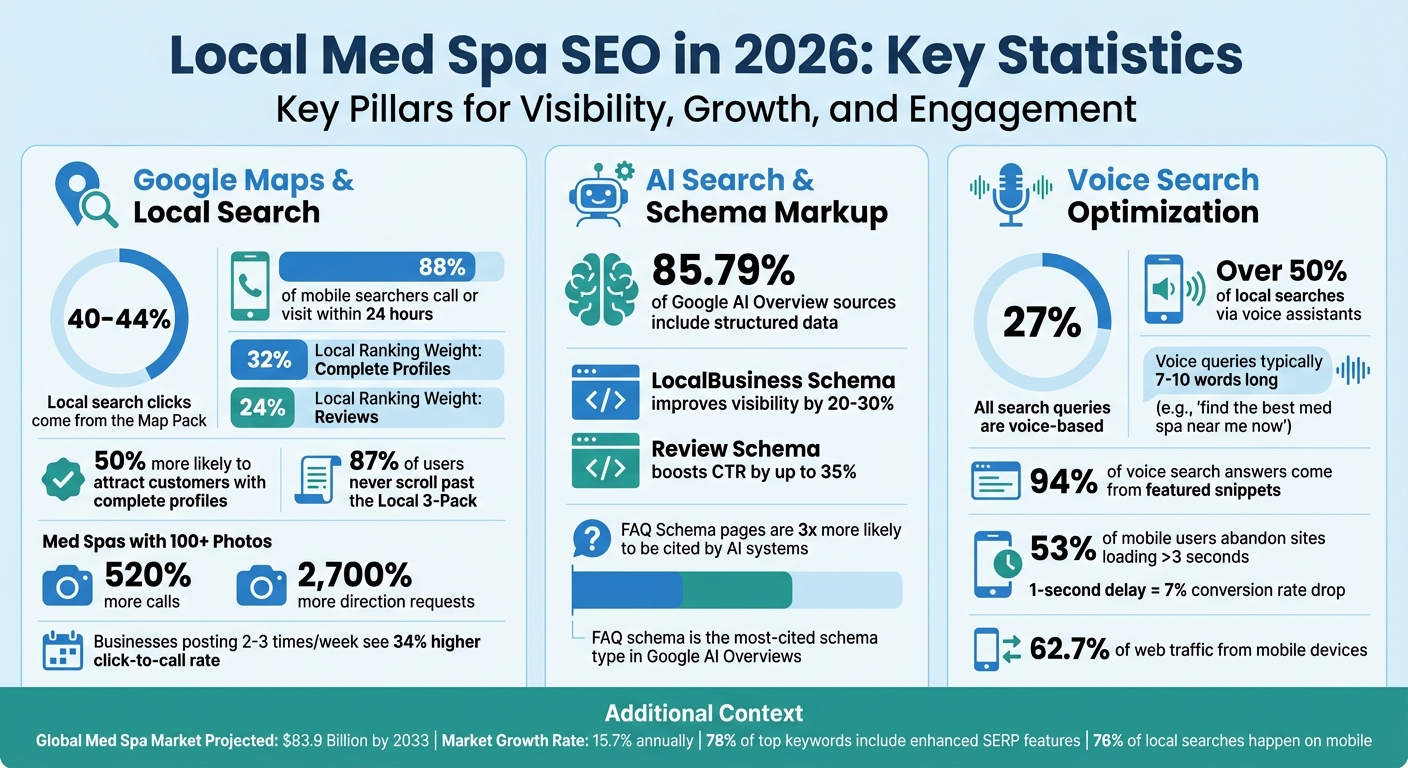
Local Med Spa SEO Statistics 2026: Maps, AI, and Voice Search Performance Data
How to Dominate Google Maps with Your Business Profile
Your Google Business Profile (GBP) is your top weapon for attracting local med spa clients in 2026. Here’s why: the Map Pack drives 40–44% of all local search clicks, and 88% of mobile searchers either call or visit a business within 24 hours. That’s a huge opportunity.
Google now evaluates businesses as "entities", cross-checking your photos, reviews, and posts with your website to confirm your expertise in services like Botox, laser hair removal, or body contouring. Did you know that having a complete profile accounts for 32% of your local ranking weight, while reviews add another 24%? These factors determine whether your med spa shows up when someone searches "med spa near me." So, how can you make your GBP work harder for you? Let’s break it down.
Setting Up Your Google Business Profile Correctly
Getting your GBP set up right starts with the basics. Choose "Medical Spa" as your primary category – not "Day Spa" or "Beauty Salon" – because it aligns better with what people are searching for in 2026. Then, add up to nine secondary categories like "Laser Hair Removal Service", "Skin Care Clinic", or "Wellness Center" to cover specific treatments.
Next, focus on NAP consistency. Your business Name, Address, and Phone number need to match exactly across every platform – Google, your website, Yelp, social media, and beyond. Even minor differences like "Suite 200" vs. "Ste 200" can hurt your rankings. Google’s algorithm flags these inconsistencies as potential trust issues, especially for YMYL (Your Money or Your Life) businesses like med spas.
Don’t skip any details. Fill out every attribute – business hours, service areas, appointment links, and a treatment-focused description. Complete profiles are 50% more likely to attract customers than incomplete ones. Also, turn on the messaging feature and reply within 24 hours. Doing so earns you a "responsive" badge, which Google considers a ranking signal.
Using Photos, Reviews, and Posts to Increase Visibility
Photos are a game-changer. Med spas with 100+ photos see 520% more calls and 2,700% more direction requests. Google’s Vision AI now analyzes your images to verify the services you offer. Upload high-quality, authentic photos – think before-and-after shots of Botox treatments, your treatment rooms, and equipment like CoolSculpting machines. Skip the stock photos; Google favors real "action shots" of your team performing treatments.
Reviews are just as critical. In 2026, review velocity (how often you get new reviews) matters more than the total number. Aim for 8–10 fresh reviews each month to show Google that your business is active and trustworthy. When clients mention specific treatments – like "the Botox was painless" or "best lip filler in Dallas" – it helps Google’s AI rank you for those searches. Responding to about 90% of reviews within 24–48 hours boosts your engagement signals.
"Instagram builds desire, but Google closes the sale. When a client sees your reel, their next step is searching your clinic name on Google Maps to verify you are a safe, 5-star medical facility." – RankLadder
Finally, don’t underestimate the power of regular posts. Share updates at least once a week. Use "What’s New" posts to promote seasonal deals (like spring laser hair removal specials) or highlight trending treatments such as exosome therapy. Businesses that post 2–3 times per week see a 34% higher click-to-call rate than those that don’t. Even though posts disappear from the front end after six months, Google rewards active management with better rankings.
Using Schema Markup for AI-Generated Search Results
Schema markup helps search engines and AI systems understand your med spa’s services, location, and offerings. And in 2026, this is more important than ever: 85.79% of sources cited by Google AI Overviews include structured data. Without schema, your business might miss out on being featured in AI-driven search results.
"AI search engines are becoming the new local directory. When someone asks ChatGPT for ‘the best Italian restaurant near me,’ your local schema determines whether you’re in that conversation." – Yue Zhu, Product Manager, Seenos.ai
Using LocalBusiness schema effectively can improve your local search visibility by 20–30%, while review schema can boost click-through rates by up to 35%. When AI systems read your schema, they can instantly display details like your business hours, star ratings, and treatment options – no manual input needed.
This structured data approach is a game-changer for med spas navigating AI-powered search engines. To get started, choose schema types that accurately represent your business.
Adding LocalBusiness and MedicalBusiness Schema
Instead of using the generic LocalBusiness schema, opt for more specific types like MedicalBusiness, BeautySalon, or MedicalClinic. This helps AI systems classify your med spa more precisely. For example, if your services include medical-grade treatments like Botox or laser resurfacing, the MedicalBusiness schema signals that you’re a healthcare provider rather than a standard day spa.
Add your schema in JSON-LD format – the preferred format for AI crawlers in 2026 – in the <head> section of your website’s HTML. Include critical details such as your business name, address, phone number, operating hours, and latitude/longitude coordinates. In competitive areas like Manhattan or Los Angeles, GeoCoordinates ensure AI and map systems pinpoint your exact location.
Make sure your schema’s NAP (Name, Address, Phone) matches your Google Business Profile exactly. Google’s algorithms, especially for YMYL (Your Money or Your Life) businesses like med spas, are sensitive to discrepancies.
You can also embed a Service schema within your main business schema to define specific treatments. For each service – like Botox, CoolSculpting, or laser hair removal – include the name, a short description, and pricing details if applicable. This helps AI systems match your services to user searches like "lip filler cost in Austin."
Use the @id property with a unique identifier, such as https://yourmedspa.com/#business, to create a Knowledge Graph entity that ties all your schema elements together.
Implementing FAQPage and Review Schema
FAQPage schema is a powerful tool for increasing visibility in AI-driven search results. It’s the most-cited schema type in Google AI Overviews, and pages using it are 3x more likely to be cited by AI systems.
"FAQ Schema is no longer just about winning rich snippets in Google. It has become the single most effective bridge between your content and AI systems. When you structure your Q&A pairs in JSON-LD, you are literally handing AI engines the exact format they use internally to match user queries to answers." – Atilla Kuruk, SEO & AI Search Specialist
Add FAQ schema to your service pages – whether for Botox, laser hair removal, or body contouring – to address popular questions like "How long does Botox last?" or "What’s the recovery time for CoolSculpting?" Aim for 3 to 8 questions per page to provide enough context without overwhelming the reader or appearing spammy. Ensure the questions and answers in your schema match the visible text on your page to avoid penalties from Google.
Review schema, using AggregateRating, allows your star ratings to appear directly in search results, creating instant trust with potential clients. Add this to your homepage and location pages by pulling data from your Google reviews, such as an average rating (e.g., 4.8 out of 5) and total review count (e.g., 342 reviews). This trust signal can increase click-through rates by 35%.
Finally, update your robots.txt file to whitelist AI bots like GPTBot, Google-Extended, and PerplexityBot. Allowing these crawlers to access your schema ensures your business information is displayed effectively in AI-powered search results. This structured data foundation supports the advanced SEO strategies discussed in later sections.
Voice Search Optimization for Med Spas
Voice search optimization plays a key role in building a strong local SEO strategy, working alongside map listings and AI-driven search tools. By 2026, 27% of all search queries will be voice-based, and for local searches like "find a med spa near me", that number jumps to over 50%.
"Voice search at 27% of all queries is not a future consideration – it is present behavior that requires immediate strategic attention." – Digital Applied
Voice search differs from traditional typed searches. Instead of simple keywords like "Botox NYC", voice users often ask full, conversational questions such as, "Where can I get Botox in Manhattan today?" These queries typically range from 7 to 10 words, and 94% of voice search answers come from featured snippets. If your content isn’t optimized for these snippets, you’re essentially invisible to voice search users.
The good news? Once you understand how patients phrase their questions and what voice assistants prioritize, optimizing for voice search becomes much easier.
Finding and Using Conversational Keywords
Traditional keyword strategies focus on short phrases like "lip filler" or "laser hair removal." Voice search, on the other hand, requires targeting natural, conversational questions that match how people speak when using Siri, Alexa, or Google Assistant.
Start by analyzing your Google Search Console for queries longer than five words. These longer phrases reveal how patients already search for your services. Examples might include: "How much does CoolSculpting cost in [your city]?" or "What’s the best treatment for under-eye bags?"
Another great resource? Your own internal data. Review front desk logs, intake forms, and common consultation questions to identify recurring patient inquiries. Your staff hears these questions daily, making them a goldmine for voice search optimization.
To expand your keyword list, use a question-word matrix. For every service you offer, create content that answers questions starting with "who, what, where, when, why, and how". For example, if your med spa offers Botox, develop content around questions like:
- "How long does Botox last?"
- "What does Botox cost in [city]?"
- "Who is the best Botox provider near me?"
| Typed Search Pattern | Voice Search Pattern |
|---|---|
| Short (2-3 words) | Long (7-10 words) |
| Fragmented ("Botox Nashville") | Full Question ("Where can I get Botox in Nashville?") |
| Research/Browsing Intent | Immediate Action/Local Intent |
For local searches, avoid overusing "near me." Instead, mention specific neighborhoods, landmarks, or cross-streets to help voice assistants naturally understand your service area.
Once you’ve identified these conversational keywords, focus on creating content that directly addresses patient questions.
Creating Content That Answers Patient Questions
Using your keyword research, craft content that provides clear, immediate answers voice assistants can easily relay. Voice assistants prefer concise answers, typically around 40–50 words. Structure your content using the "answer-first" format: start with a direct answer under a question-based heading, then expand with supporting details.
For example, if your heading is "How long does Botox last?", your content might begin:
"Botox typically lasts 3 to 4 months. Most patients schedule touch-up appointments every 12 to 16 weeks to maintain their results."
You can then elaborate on factors that affect results, such as lifestyle or dosage.
"Clinics that use patient language and answer real questions clearly are much easier for search engines to match to these queries." – Propel Your Company
To make your content more relatable, use simple, patient-friendly language. Patients often say "tight hips" or "pinched nerve" instead of medical terms. Aim for an 8th-grade reading level, keep sentences under 20 words, and write in active voice.
Finally, follow voice search best practices by implementing schema markup for your Q&A sections. This helps AI assistants accurately interpret your content. And don’t forget: fast, secure pages are essential. Slow-loading sites are often excluded from voice search results, no matter how good the content is.
Technical SEO Requirements for Local Med Spas
The technical setup of your website plays a huge role in whether Google and AI-driven search engines can locate, understand, and rank your content. This foundation is critical for boosting visibility and supports the strategies we’ve already discussed.
"Technical SEO is the foundation that everything else sits on. Without it, even the best content in the world will struggle to rank." – Luminous Digital Visions
For local med spas in 2026, staying aligned with both Google’s algorithms and AI crawlers (like those powering ChatGPT) is essential. Fortunately, many technical upgrades benefit both traditional search engines and AI-driven platforms simultaneously.
Improving Site Speed, Mobile Performance, and Core Web Vitals
A strong technical foundation enhances the effectiveness of your on-page strategies and schema markup. Google evaluates site performance using Core Web Vitals metrics, which include:
- Largest Contentful Paint (LCP): Should be under 2.5 seconds.
- Interaction to Next Paint (INP): Should be under 200 milliseconds.
- Cumulative Layout Shift (CLS): Should remain under 0.1.
Why do these numbers matter? Because 53% of mobile users abandon a site if it takes more than three seconds to load. Plus, a one-second delay in loading time can slash conversion rates by 7%. For med spas, slow-loading pages can mean missed appointments.
Start by analyzing your site’s performance with Google PageSpeed Insights at pagespeed.web.dev. This tool generates separate scores for mobile and desktop and provides actionable recommendations.
One common issue is image sizes. High-resolution images, like before-and-after galleries, often account for 50-70% of a page’s total size. To optimize these, convert images to WebP format, which is 25-35% smaller than JPEG files while maintaining quality. Implement lazy loading and define image dimensions to minimize layout shifts.
Mobile optimization is equally critical. With 62.7% of web traffic now coming from mobile devices, Google prioritizes mobile-first indexing. A poor mobile experience doesn’t just frustrate users – it can tank your rankings on both traditional search engines and AI-powered tools. Ensure that:
- Touch targets are at least 48×48 pixels.
- Text is legible without zooming.
- The site functions seamlessly on smartphones.
If your site is hosted on shared servers, upgrading to managed WordPress hosting (e.g., WP Engine or Kinsta) or static hosting platforms like Vercel can improve your Time to First Byte (TTFB), reducing the time it takes for your page to start loading.
| Metric | Good (Target) | Needs Improvement | Poor |
|---|---|---|---|
| LCP (Largest Contentful Paint) | < 2.5s | 2.5s – 4.0s | > 4.0s |
| INP (Interaction to Next Paint) | < 200ms | 200ms – 500ms | > 500ms |
| CLS (Cumulative Layout Shift) | < 0.1 | 0.1 – 0.25 | > 0.25 |
Setting Up XML Sitemaps and Robots.txt Files
Beyond speed and performance, your site’s structure plays a big role in how search engines index your content. XML sitemaps and robots.txt files help guide search engines and AI crawlers through your site.
Your XML sitemap should include all public pages, with priority values assigned as follows:
- Homepage: 1.0
- Service pages: 0.8
- Blog posts: 0.6
Submit your sitemap directly to Google Search Console under the "Sitemaps" menu. This triggers crawling within 24-48 hours. For med spas, ensure your sitemap reflects a clear topical structure. For example, services like Botox or laser hair removal should have distinct URLs. This helps search engines understand how your content is organized.
Your robots.txt file is equally important. In 2026, it should include "Allow" directives for AI crawlers like GPTBot (OpenAI), Google-Extended (Google AI), PerplexityBot, ClaudeBot, and Anthropic-AI. Without these allowances, your med spa might not appear in AI-driven recommendations when users ask tools like ChatGPT for local services.
"AI search engines are becoming the new local directory. When someone asks ChatGPT for ‘the best Italian restaurant near me,’ your local schema determines whether you’re in that conversation." – Seenos.ai
To identify and resolve technical issues, use tools like:
- Google Search Console: For crawl errors.
- Google PageSpeed Insights: For performance metrics.
- Screaming Frog: Free for up to 500 URLs, it provides a detailed audit.
For ongoing monitoring, services like SearchX offer custom dashboards to track Core Web Vitals, crawl errors, and AI crawler access in real-time. These tools ensure your site stays optimized and visible across all platforms.
How to Track and Measure Your SEO Results
You’ve optimized your site, added schema markup, and improved Core Web Vitals. Now comes the crucial part – figuring out if all those efforts are actually driving revenue. In 2026, tracking SEO success for med spas goes beyond traditional rankings. You need to keep tabs on your visibility in Google Maps, AI-generated summaries, and voice search results, while also understanding how each channel contributes to your bottom line.
"The businesses winning in 2026 are those treating rank tracking as a diagnostic intelligence system, not a vanity metric dashboard." – SEO Webster Team
For example, did you know that 87% of users never scroll past the Google Maps "Local 3-Pack" when searching for local services? If your med spa isn’t showing up there, you could be missing out on a significant number of appointments. Regular monitoring is especially critical for high-value keywords like "Botox near me", where rankings can fluctuate by 3–5 positions daily. Automated alerts can help you catch and fix technical issues within 24 hours, preventing lost opportunities. Here’s how to monitor your SERP features and measure ROI effectively.
Monitoring SERP Features and Rankings
Tracking rankings today requires more than just looking at the standard blue links. By 2026, 78% of top keywords include at least one enhanced SERP feature. For med spas, this means keeping an eye on features like the Local 3-Pack, AI Overviews, People Also Ask boxes, and image carousels showcasing before-and-after photos.
To stay organized, divide your tracking into two categories: Google Business Profile rankings (for Map Pack visibility) and organic website rankings. This dual approach ensures you’re covering all bases. For instance, your med spa might rank #1 for "lip filler near me" in the Map Pack but not appear on the first page of organic results – or vice versa. Tracking these separately helps pinpoint which strategies are driving results.
Hyper-local tracking is another must. Your rankings can vary dramatically depending on the user’s location – even within the same city. Tools that scan visibility across multiple GPS points (like a 9×9 grid) can reveal gaps in your local presence. For example, if your med spa ranks well downtown but struggles in nearby suburbs, you might need to tweak local citations or improve your local SEO with neighborhood-specific content.
Device-specific rankings also matter. With mobile devices accounting for over 76% of local searches, it’s critical to monitor how your site performs on mobile versus desktop. If your mobile rankings lag behind, it might be time to optimize your mobile site speed.
Don’t forget to track AI Overviews. Success here isn’t about a numbered position but instead depends on factors like how often your med spa is mentioned (citation frequency), where those mentions appear (citation position), and the range of questions for which you’re included (query coverage). Tools like Seenos.ai offer free options for monitoring these features.
| Tracking Frequency | Keyword Type (e.g., "Botox near me") | Business Impact |
|---|---|---|
| Daily | Transactional, brand terms | High: Prevents revenue loss from sudden drops |
| Weekly | Informational blog posts, long-tail terms | Medium: Tracks long-term content trends |
| Monthly | Brand awareness, new content (pre-ranking) | Low: General SEO health check |
Measuring ROI with SearchX Tools
Tracking rankings is only half the battle – you also need to connect those rankings to real business outcomes. To get the full picture, align your ranking data with insights from your Google Business Profile. For example, if you’re ranking #2 in the Map Pack but getting fewer calls than a competitor at #3, it’s a sign that something on your profile – like your photos, reviews, or description – needs attention.
Another key metric is Share of Voice (SOV), which measures your domain’s presence across targeted keywords. A med spa that appears in the Map Pack, organic results, and a People Also Ask box for "microneedling near me" will have a stronger SOV (and likely more revenue) than one that only appears in organic results.
SearchX offers custom dashboards that make tracking easier. These tools monitor Core Web Vitals, crawl errors, AI crawler access, and SERP feature visibility in real time. You can also use their SERP feature tracking tools to compare your visibility with competitors and identify areas for improvement. Their ROI measurement features help tie organic traffic growth directly to appointment bookings and revenue.
"I love the AI Overview reporting from SEOmonitor. It’s the only tool I’m seeing that provides that kind of tracking." – Emma Kessinger, Chief Strategy Officer, Relevance
Set up automated alerts to catch ranking drops quickly, and monitor competitors’ citation shares in AI Overviews to adjust your strategy as needed. SearchX’s competitor SERP ranking tools can help you stay ahead by showing how often competitors appear in AI features, giving you the insights needed to refine your approach.
Conclusion
Local med spa SEO in 2026 isn’t about relying on just one strategy – it’s about combining three essential elements: an optimized Google Business Profile (GBP) for better Map Pack visibility, a strong technical foundation that allows AI crawlers to navigate your site effectively, and conversational, question-driven content tailored for voice search.
Med spas that focus on building trust and visibility through strong SEO fundamentals consistently outperform competitors, even those with solid reputations but weaker online strategies. For instance, a med spa that updates its GBP weekly, garners 8–12 reviews per month, and creates detailed service pages is well-positioned to dominate local search rankings.
Technical SEO plays a critical role in this approach. By integrating AI-friendly optimization techniques like FAQPage schema, answer-first formatting, and modular content blocks, you increase your chances of appearing in AI-driven overviews that attract high-intent traffic. Structuring your content with question-based headings and natural language is key to capturing users who search for things like, “Where can I get Botox near me?” on their mobile devices. This technical groundwork is essential to meet the fast-paced demands of local search.
If your business isn’t showing up in the Local 3-Pack, you’re likely missing out on valuable appointments. Tools like SearchX’s SERP feature tracking tools can help you monitor your visibility across Maps, AI overviews, and organic results. Additionally, their ROI measurement features make it easier to connect your SEO efforts to revenue growth.
With the global med spa market forecasted to reach $83.9 billion by 2033, growing at 15.7% annually, the businesses that capitalize on this growth will be those prioritizing SEO now. The path to success involves refining your Google Business Profile, implementing LocalBusiness and FAQPage schema, and creating content that directly addresses patient concerns. While these efforts may not yield instant results, the long-term benefits will give you a lasting edge over competitors still leaning heavily on paid ads.
FAQs
What should I fix first if my med spa isn’t showing in the Google Maps 3-Pack?
To get started, make sure your Google Business Profile is fully optimized. This means filling out every detail accurately, from your business name and contact information to your operating hours. Don’t forget to include high-quality photos that showcase your business in the best light.
Another crucial step? Focus on earning positive reviews. Encourage satisfied customers to leave feedback, as glowing reviews can significantly improve your credibility and visibility. Additionally, build local backlinks by connecting with nearby businesses, local directories, or community organizations.
A well-maintained and complete profile is your foundation for increasing visibility – especially when aiming for a spot in the coveted Google Maps 3-Pack.
Which schema types matter most for getting cited in AI Overviews?
The LocalBusiness schema and its subtypes are essential for getting cited in AI Overviews. These schemas provide search engines and AI models with vital information such as your business’s location, the services you offer, and customer reviews. This data is crucial for creating precise summaries. By prioritizing these schemas, you can boost your visibility in AI-powered search functionalities.
How do I write pages that voice assistants will pick as answers?
To make your pages more appealing to voice assistants, aim for short, natural-language answers (around 40–50 words) that directly address common user questions. Implement FAQ or HowTo schema markup to improve your chances of being featured in snippets. Also, ensure your page loads quickly – ideally in under 2 seconds – and structure content clearly for better visibility in search results.