
SEO delivers higher-value clients over time, while social ads offer faster results but at a higher cost per lead.
For med spas in 2026, the choice between SEO and social ads depends on your goals:
- SEO attracts high-intent users actively searching for services like "Botox near me", delivering conversion rates of ~14.6%. It takes 6–12 months to show results but builds a lasting pipeline of organic leads.
- Social ads generate quick leads within days by targeting users on platforms like Instagram and Facebook. Conversion rates range from 1.7% to 4.9%, with costs between $12–$70 per lead. However, results stop as soon as ad spend ends.
Quick Comparison
| Factor | SEO | Social Ads |
|---|---|---|
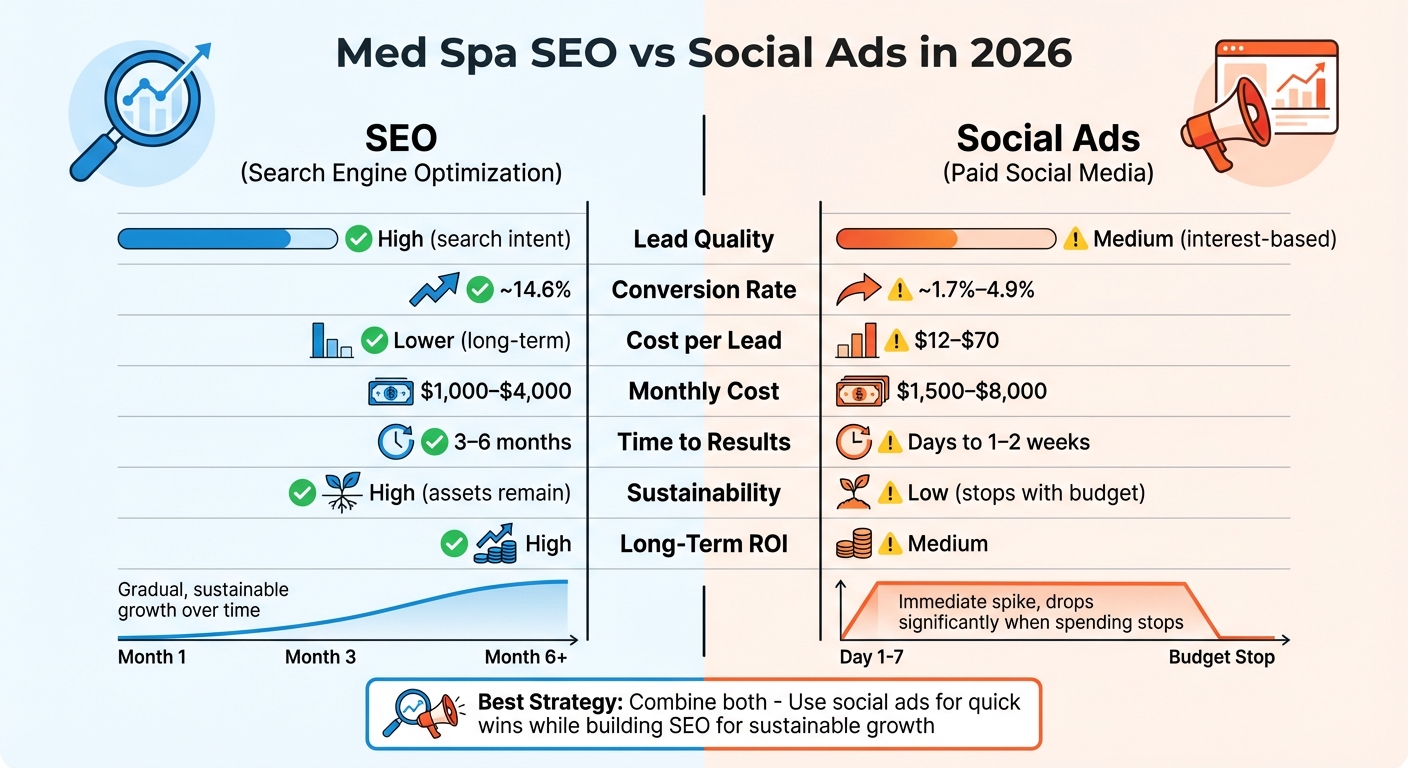
| Lead Quality | High (search intent) | Medium (interest-based) |
| Conversion Rate | ~14.6% | ~1.7%–4.9% |
| Cost per Lead | Lower (long-term) | $12–$70 |
| Time to Results | 6–12 months | Days |
| Sustainability | Long-term growth | Ends with ad spend |
Key takeaway: Use social ads for quick bookings but invest in medical spa SEO for consistent, high-value growth over time. A combined strategy often works best.
SEO vs Social Ads for Med Spas: Cost, ROI and Conversion Comparison
The Best Lead Gen and Marketing Strategies for Med Spas in 2025
Med Spa SEO: Building Organic Visibility for Consistent Growth
SEO isn’t just about rankings – it’s about building trust and showing up when potential clients are ready to book. For med spas, this means being visible at the exact moment someone searches for treatments like Botox or fillers. Unlike paid ads, SEO doesn’t rely on paying for every click. Instead, it creates a long-term presence that drives the kind of high-value bookings med spas need to grow in 2026.
When someone searches "Botox near me" or "lip filler appointment today", they’re not casually browsing – they’re ready to take action.
Local SEO and Google Business Profile Setup
Your Google Business Profile (GBP) is your most powerful tool for local visibility. It determines whether your med spa appears in the coveted "Local 3-Pack", which dominates mobile searches. Did you know that 76% of people who perform a local search on their smartphone visit a related business within 24 hours? That’s the kind of impact a strong GBP can have.
Here’s a real-world example: In February 2026, a solo-practitioner med spa in a Southeastern city launched a three-month SEO campaign. By focusing on local citations, GBP optimization, and service-specific pages, they jumped from page three to position four for "Botox [city]." This shift tripled their organic traffic and increased weekly appointment requests from 2 to 12.
Reviews matter, but consistency is key. A steady flow of 8–12 new reviews each month often beats a profile with more reviews but no recent activity. Automate review requests to go out within 48 hours after a client’s visit – response rates drop sharply if you wait longer. Weekly updates to your GBP, like adding fresh photos, also signal that your business is active and relevant.
Don’t overlook consistency across directories. Your business Name, Address, and Phone number (NAP) must match exactly across platforms like Yelp, Healthgrades, and RealSelf. Any discrepancies can confuse Google and hurt your rankings.
Once your local SEO foundation is strong, refining your keyword strategy can take your visibility to the next level.
Keyword Targeting and Schema Markup for Better Rankings
Targeting the right keywords is about understanding intent. Commercial intent keywords – such as "Botox cost [city]" or "laser hair removal appointment today" – attract users who are ready to book. These keywords convert at a rate of 7.82% in the beauty and personal care sector, far exceeding the typical 2–3% average. In competitive areas, using neighborhood-specific keywords like "Botox in Buckhead" can help you stand out against larger competitors.
To get started, focus on 10–15 primary keywords for your core treatments. Then, expand with 30–50 long-tail variations using tools like Google’s autocomplete feature.
Schema markup is another game-changer. Adding LocalBusiness, MedicalBusiness, and FAQ schema to your site helps search engines display rich snippets – think star ratings, pricing, and FAQs – directly in search results. This structured data not only boosts visibility but also helps AI tools like ChatGPT accurately reference your business when users search for the "best med spa near me."
Here’s another success story: In 2025, a multi-location med spa franchise in Southern California created neighborhood-specific landing pages for each of its seven clinics. Within six months, five locations ranked in the Google local pack, leading to a 40% increase in new client inquiries and a significant reduction in paid ad spend.
By combining targeted keywords with technical enhancements like schema markup, you can achieve sustainable growth without relying heavily on ads.
Technical SEO and Content Development
Med spas face unique challenges when it comes to SEO. Google holds medical-related content to higher standards, so your site must establish credibility. This means including practitioner credentials and accurate, detailed information about treatments. Each service – whether it’s Botox, fillers, or laser hair removal – should have its own dedicated page with 600–800 words of locally relevant content. Thin content simply won’t rank well.
As Aditi Goyal from Zoca explains:
"A website that describes your services beautifully but uses minimal text is a brochure. It looks great but does almost nothing for your search rankings."
Site speed is another critical factor. Over 50% of mobile users abandon a site if it takes more than 3 seconds to load. With 80% of customers using Google Search to find local businesses – and 49% relying on Google Maps – a fast, mobile-friendly website is essential. Make sure booking an appointment from your homepage takes no more than two or three clicks.
Adding a blog or FAQ section can also boost your rankings. Answering common questions like "How long does Botox last?" or "What’s the difference between Botox and Dysport?" not only builds authority but also captures potential clients during their research phase. Combined with strong technical SEO, this kind of content can maintain high rankings with minimal ongoing effort, reducing client acquisition costs over time.
Take Diamond Aesthetics, for example. In early 2026, this New York City med spa shifted from a high-spend ad strategy to a focus on organic SEO. By prioritizing local search visibility and automating lead follow-ups, they replaced their ad budget with a steady stream of high-value organic clients, achieving consistent monthly profits without overspending.
Through strategic content development and technical optimizations, med spas can build a strong, sustainable online presence that keeps clients coming back.
Social Ads: Quick Results Through Paid Targeting
While SEO helps build long-term organic growth, social ads are all about speed. They can get your med spa noticed almost immediately. Within hours of launching a campaign, your ads can appear in the feeds of thousands of potential clients. Platforms like Meta (Facebook and Instagram) are especially effective at targeting specific groups – say, women aged 35–55 who are interested in skincare. This makes social ads perfect for filling appointment slots quickly or promoting time-sensitive offers.
But speed has its price. Social ads can generate leads at a relatively low cost – around $12–$30 per lead for Botox treatments and $35–$70 for body contouring – but these leads tend to convert at lower rates than organic traffic. For example, Meta leads typically convert to booked consultations at a rate of 10–22%, compared to 25–40% for Google Search leads. Why? Social ads often reach people who aren’t actively searching for your services. They’re scrolling for entertainment, not typing "Botox near me" into a search engine.
Audience Targeting and Retargeting Options
Social ads go beyond speed – they excel at targeting and retargeting potential clients. By 2026, manual interest targeting has become outdated. Meta’s Andromeda algorithm now uses the content of your ad itself to determine the audience. This means the visuals and messaging in your ad play a bigger role than simply selecting "skincare" as an interest. For med spas, running an Advantage+ campaign that combines educational content, testimonials, and direct booking offers can help guide clients through their decision-making process.
Retargeting is where social ads truly shine. Only 3–8% of first-time visitors convert into a lead or booking. Retargeting can reduce the cost per booked consultation by 30–50% and achieve conversion rates 2–3 times higher than cold traffic. The key is tailoring your retargeting strategy by treatment type. For example, Botox and fillers, which have shorter decision cycles, benefit from a 14-day retargeting window. Meanwhile, body contouring or weight loss programs, which require more consideration, perform better with a 30-day window. Ads targeting users who abandoned a booking form – using messaging like "Still thinking about it?" – can recover 10–20% of lost leads.
Here’s a real-world example: In early 2026, a med spa revamped its $3,000 monthly Meta campaign. Initially, they ran "50% Off" ads that generated over 200 leads at $14 each, but only 6 converted into clients – resulting in a $500 cost per patient. By shifting to treatment-specific ads targeting women aged 35–55 with specific skin concerns and using Conversions API (CAPI) to provide Meta with treatment acceptance data, they achieved 18 treated patients at $167 each, tripling their revenue.
As Camply.ai explains:
"The algorithm stopped finding Groupon-hunters and started finding women ready to invest $500–$2,000+ in their skin."
This kind of precise targeting can transform the performance of your campaigns and boost your return on investment.
Ad Creative and ROI Measurement
Your ad creative is the backbone of your targeting strategy. By 2026, video content consistently outperforms static images. Short 60–90 second videos explaining treatments or featuring client testimonials work especially well. Forget stock photos – ads that showcase real injectors or medical directors speaking directly to the camera tend to perform better than generic visuals. Even behind-the-scenes clips filmed in your treatment room can outshine polished studio ads.
To test whether your ad stands out, try the "Blurred Eye Test." Blur your eyes and see if you can still easily read the service name and price on the graphic. If not, your ad might struggle to grab attention. For more complex aesthetic services, long-form ad copy often works better by providing the context needed to build trust.
Measuring ROI goes beyond tracking form fills. If you optimize Meta campaigns for form fills alone, the algorithm will prioritize people who are likely to fill out forms – not necessarily those ready to spend $2,000 on a body contouring package. Instead, use CAPI to send offline data, like booked consultations and revenue, back to Meta. This helps the algorithm focus on finding high-value clients. Well-optimized campaigns can acquire treated patients for $100–$300 each, though Meta’s average Return on Ad Spend (ROAS) across industries is about 1.8x, compared to 3.3x for Google Search.
To avoid ad fatigue, refresh your creative every 4–6 weeks. This is especially important in the aesthetic industry, where the audience is smaller and more niche. Also, limit feed ads to 1–2 impressions per user per day to avoid overwhelming potential clients. Remember, the goal isn’t just cheap leads – it’s booked consultations that actually convert.
Lead Quality, Costs, and ROI: SEO vs Social Ads
Now that we’ve broken down how each strategy operates, let’s put them side by side. When comparing lead quality, costs, and long-term returns, the differences between SEO and social ads become clear – especially for med spas.
Lead Quality and Conversion Rates
SEO leads tend to be much higher quality than social ad leads. Why? Because SEO captures people who are actively searching for solutions. If someone searches for "best med spa for laser resurfacing", they’re already in the market for your services. These individuals are further along in their decision-making process and more likely to book.
Social ads, however, rely on targeting users based on demographics and interests. These users are often scrolling for entertainment, not actively seeking services. This gap in intent directly impacts conversion rates.
Brittany Woitas from Kōvly Studio explains it well:
"Organic search results produce conversion rates averaging around 14.6%, compared to roughly 1.7% to 4.9% for paid channels. That’s not a marginal difference – it’s a multiple."
In short, social ads often attract less committed prospects, making it harder to turn them into paying clients. SEO leads, on the other hand, are high-intent and more likely to result in high-value bookings.
| Metric | SEO (Organic Search) | Social Ads |
|---|---|---|
| Lead Quality | High | Medium |
| Conversion Rate | ~14.6% | ~1.7%-4.9% |
| High-Value Bookings | Strong | Moderate |
While SEO clearly wins in lead quality, the next factor to weigh is cost efficiency and return on investment over time.
Cost Analysis and Long-Term ROI
The financial side of these strategies reveals even more differences. SEO and social ads operate on very different timelines and cost structures. Social ads start delivering leads quickly – often within 1–2 weeks. But the moment you stop spending, the leads stop too. SEO, in contrast, takes longer to gain traction, typically requiring 3 to 6 months to see meaningful results. However, once your content ranks, it can generate leads for years without ongoing ad spend.
Monthly costs for SEO typically range between $1,000 and $4,000, depending on how competitive your market is. Social ads, including both ad spend and management fees, generally cost between $1,500 and $8,000 per month. While social ads may feel faster, SEO functions more like a long-term investment. It compounds over time, delivering sustained growth. Chris Fink from The Med Spa Agency puts it this way:
"SEO is your long game. It starts slow but delivers powerful, cost-efficient growth."
Take Diamond Aesthetics in New York City as an example. In 2026, they shifted from heavy spending on Instagram and Google Ads to focusing on SEO. By building organic visibility and local search authority, they replaced their "ad budget burnout" with a steady stream of high-value clients. This approach allowed them to achieve consistent profits without the need for constant ad spending.
| Metric | SEO | Social Ads |
|---|---|---|
| Monthly Cost | $1,000-$4,000 | $1,500-$8,000 |
| Time to Results | 3-6 months | 1-2 weeks |
| Long-Term ROI | High | Medium |
The takeaway? Social ads are great for quick results, but SEO builds a sustainable pipeline. For med spas aiming to lower patient acquisition costs and create a lasting marketing asset, SEO offers unmatched long-term value.
Why SEO Delivers Better Long-Term Results for Med Spas
When it comes to sustainable growth for med spas, SEO stands out as the clear winner over social ads. While social ads can deliver quick results, they only work as long as you’re actively paying for them. SEO, on the other hand, builds lasting assets – optimized pages, structured content, and authoritative rankings – that continue generating leads long after the initial investment.
This difference in approach directly impacts your bottom line. SEO tends to attract high-intent users – people actively searching for services like yours. These users are more likely to convert into loyal clients, which is especially important in a med spa setting where a single client can bring in $5,000 to $15,000 in lifetime value.
But it’s not just about conversion rates. SEO also builds trust in ways that ads simply can’t. Ranking organically signals authority and credibility – key factors when clients are choosing where to invest in treatments. Looking ahead to 2026, tools like ChatGPT and Perplexity increasingly rely on structured, well-cited local content. Med spas with detailed service pages and consistent review activity are better positioned to be featured by these AI platforms, further solidifying their reputation and visibility.
As Brittany Woitas from Kōvly Studio puts it:
"Paid ads stop working the moment you stop paying. A well-optimized page can drive consultations for years".
Main Findings
The decision between SEO and social ads depends on your goals and timeline. Here’s how they compare:
| Factor | SEO | Social Ads |
|---|---|---|
| Speed of Results | Moderate (3–6 months) | Fast (Days) |
| Sustainability | High (Assets remain) | Low (Stops with budget) |
| Cost Efficiency | High (Long-term) | Medium (Ongoing spend) |
| Lead Quality | High (High intent) | Medium (Often price-sensitive) |
| Conversion Rate | ~14.6% | ~1.7%–4.9% |
For med spas, the most effective strategy often combines both approaches. Start with social ads to generate quick leads while building your SEO foundation. Then, as your organic visibility grows, shift more of your budget toward SEO to lower your overall cost per acquisition.
The takeaway? Social ads are like renting attention, while SEO builds equity. For med spas aiming to attract high-value clients and achieve consistent profitability, investing in organic visibility is the smarter long-term play.
FAQs
How much should a med spa budget for SEO vs social ads in 2026?
By 2026, med spas should plan to invest 8–15% of their annual revenue in digital marketing. This budget should focus on two key areas: SEO and social ads.
- SEO: Expect to spend between $1,500 and $5,000+ per month. SEO is a long-term strategy that helps drive consistent growth by improving your online visibility.
- Social Ads: Budgets for social ads can vary widely, depending on the campaign. Monthly costs could range from just a few hundred dollars to several thousand.
To get the most out of your marketing dollars, balance your spending based on your business’s revenue, growth objectives, and the level of competition in your area. A well-planned budget can help you secure more high-value bookings.
What should I do first if my med spa needs bookings fast?
If your med spa needs to fill up its schedule fast, focus on high-intent paid ads like Google Ads or social media campaigns. These can bring in leads within 1–3 months. At the same time, make sure your Google Business Profile is fully optimized. Include detailed service descriptions, encourage recent reviews, and use local SEO strategies to boost your visibility in local search results. This approach combines immediate results with a foundation for steady, long-term growth.
How can I track which channel brings higher-value patients?
To figure out which channel brings in higher-value patients, you’ll need to set up conversion tracking on both your website and booking system. This allows you to connect appointments back to specific sources, such as SEO efforts or social media ads.
Tools like UTM parameters, unique tracking links, or dedicated landing pages can help you track these sources effectively. Beyond that, dig into lead quality by reviewing CRM data or conducting post-appointment surveys.
Make it a habit to regularly review these insights. This will help you pinpoint the channels that work best and fine-tune your strategy to maximize results.