
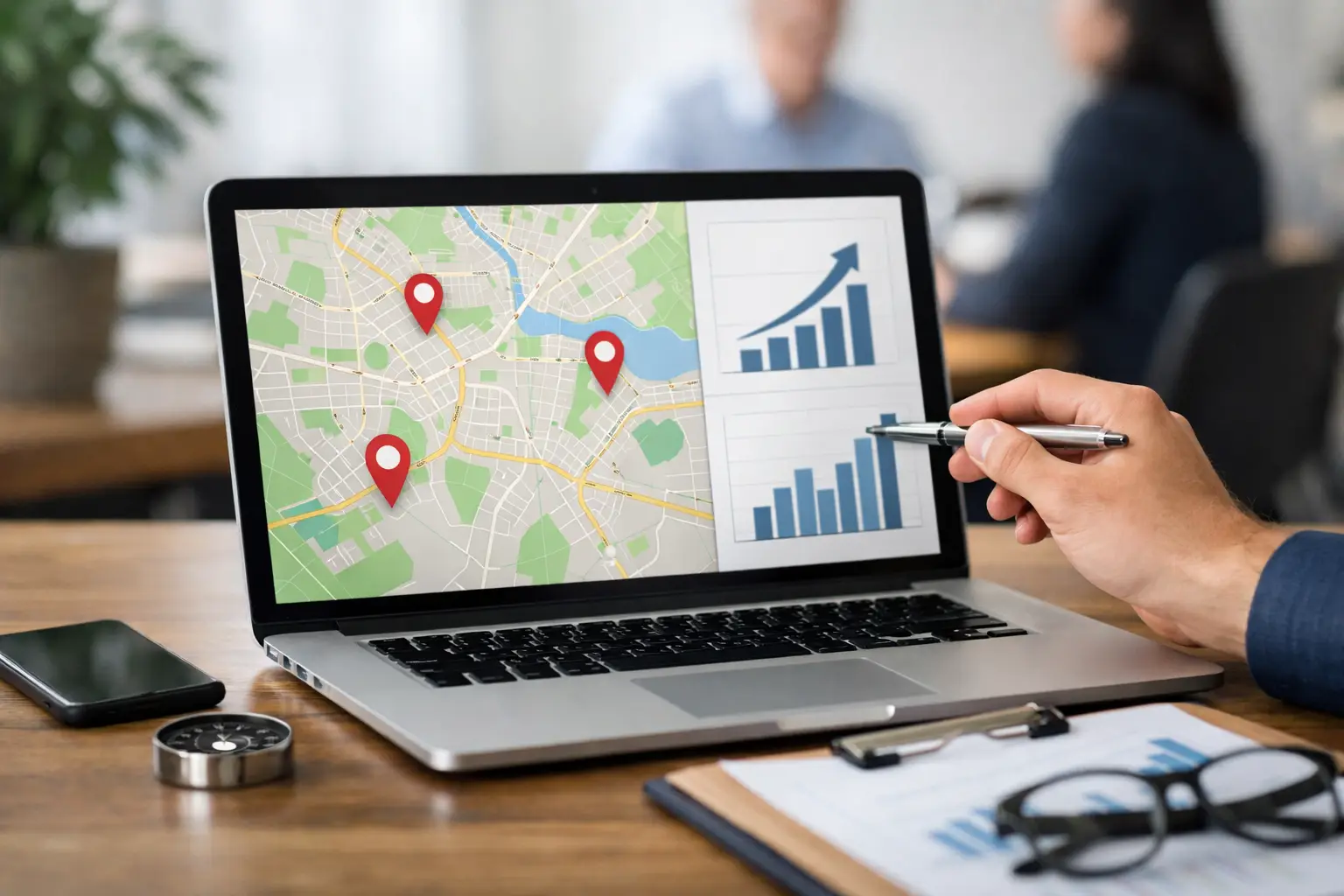
If your business shows up below weaker competitors in the map pack, you do not have a visibility problem alone. You have a revenue problem. That is why learning how to improve local rankings matters – not for bragging rights, but because local search drives calls, form fills, store visits, and high-intent leads from people ready to buy.
Local SEO is often treated like a checklist. Claim your profile, add a few keywords, ask for reviews, and hope for movement. That approach rarely holds up in competitive markets. Strong local performance comes from alignment across your Google Business Profile, website, reviews, citations, on-page signals, and user behavior. When those pieces reinforce each other, rankings tend to improve. When they conflict, results stall.
How to improve local rankings starts with search intent
Most businesses aim at the wrong target. They optimize for broad visibility when they should optimize for local buying intent. Someone searching “roof repair Charleston” or “personal injury lawyer near me” is not browsing. They are evaluating options fast, and Google knows that.
That means your local strategy should focus less on vanity traffic and more on signals that match service intent in a defined geography. Service pages need to reflect what you do and where you do it. Your Google Business Profile needs complete, accurate category and service information. Reviews should mention real experiences and, when natural, the service delivered. These are not isolated tasks. They are trust signals that help search engines connect your business to the right searches.
There is also a trade-off here. If you over-optimize pages for city terms without adding real local value, rankings may not improve and conversions can drop. People can tell when a page was written for an algorithm instead of a buyer.
Build your Google Business Profile like a sales asset
For most local businesses, the Google Business Profile is the front line. It influences map pack rankings, click-through rates, phone calls, and direction requests. Yet many profiles are incomplete or outdated.
Start with the fundamentals. Your primary category matters more than most businesses realize because it shapes the searches you are eligible to rank for. Secondary categories help, but they should support the core offer rather than chase every possible variation. Your business description should be clear and specific, not stuffed with keywords. Services, service areas, hours, photos, and business attributes all strengthen the profile when they are accurate.
Then look at engagement. Fresh photos, updates, and consistent review activity can improve profile quality over time. That does not mean posting for the sake of posting. It means showing Google and potential customers that the business is active, credible, and relevant.
If you are a service-area business, be careful with geography settings. Many companies try to rank everywhere and end up diluting relevance. It is usually better to build authority in the areas you can realistically serve and support with localized website content.
Your website has to validate your local relevance
A strong profile alone is not enough. Google cross-checks local signals against your website, and that is where many ranking gaps appear.
Your homepage should clearly communicate your core service and market. Your title tags, headings, internal links, and body copy should support that positioning without sounding forced. If you serve multiple cities or neighborhoods, create location pages only when there is enough differentiation to justify them. Thin, duplicated city pages usually underperform and create maintenance problems.
Good local pages do three things well. They explain the service, prove you can deliver it in that market, and make conversion easy. That proof might come from local testimonials, project examples, nearby landmarks, case outcomes, or market-specific FAQs. The point is simple: generic content does not win local trust.
Technical issues also matter more than many owners expect. Slow mobile load times, weak site architecture, broken internal links, and inconsistent schema can undercut otherwise solid local signals. If your site makes it hard for search engines to understand your business or hard for users to convert, rankings and lead volume both suffer.
Reviews are ranking signals, but they are also conversion assets
If you want to know how to improve local rankings in a way that compounds, look at your review strategy. Reviews influence trust, click behavior, and local prominence. They also shape how your business appears to searchers comparing options side by side.
Quantity matters, but quality matters more. A steady stream of detailed, recent reviews usually outperforms a burst of generic five-star ratings. The best reviews mention the service, the outcome, and the customer experience. They help Google understand relevance and help buyers reduce uncertainty.
Responding to reviews matters too. Not because every reply changes rankings directly, but because it signals business activity and professionalism. A thoughtful response can reinforce your brand, address concerns, and improve conversion confidence for future customers.
There is an operational reality here. Businesses that build review generation into the customer journey consistently outperform those that ask occasionally. That might mean requesting feedback after a completed job, following up after a successful appointment, or training staff to trigger requests at the right moment. The process should feel natural, not desperate.
Citations and consistency still count
Citations are not the most exciting part of local SEO, but inconsistency creates drag. If your name, address, phone number, website, or hours vary across major directories, search engines get mixed signals. So do customers.
Clean up the core listings first. Accuracy on primary platforms is more valuable than chasing dozens of low-quality directories. Then audit for duplicates, outdated addresses, old tracking numbers, and franchise-level inconsistencies. These issues are common after rebrands, moves, and phone system changes.
For multi-location businesses, governance matters. One location with bad data can affect more than one profile, especially when pages, listings, and tracking setups are managed inconsistently across markets.
Local authority is built off-page too
Google does not rank businesses based only on what they say about themselves. It looks at authority signals across the web. That includes backlinks, local mentions, brand references, and topical credibility.
Not all links are equal. A handful of relevant local and industry links can move the needle more than a pile of low-value placements. Sponsorships, local partnerships, trade associations, chambers, regional publications, and community involvement can all support local authority when they are real and relevant.
This is where strategy matters. A local dentist, HVAC company, and law firm do not need the same off-page playbook. Competitive intensity, search behavior, and trust requirements differ by category. The right link and mention strategy depends on the market you are trying to win.
Behavioral signals can amplify or weaken rankings
Google watches how users interact with local results. If searchers click your listing, stay engaged, visit your site, call, ask for directions, or continue interacting with your brand, those signals can reinforce relevance. If they bounce back immediately, your listing may be visible without being competitive.
That is why local SEO is not separate from conversion optimization. Your profile photos, review rating, business description, page speed, mobile UX, and call-to-action all affect user behavior. Better rankings bring opportunity, but better conversion mechanics turn that visibility into revenue.
This is also where many agencies lose the plot. They report ranking improvements while leads stay flat. That is not a win. Results are counted in dollars, not visitors.
Track the metrics that show local growth
If you are serious about improving local performance, measure outcomes that connect ranking movement to business impact. Look at map pack visibility, Google Business Profile actions, local organic traffic, calls, direction requests, form submissions, booked appointments, and close rates from local channels.
You should also segment by location, service, and device where possible. A ranking gain for branded searches is not the same as a gain for high-intent non-branded terms. More impressions are not the same as more qualified leads. Better reporting creates better decisions.
For businesses in competitive markets, local SEO usually works best as an ongoing system rather than a one-time fix. Profiles need updates. Pages need expansion. Reviews need velocity. Technical issues need monitoring. Competitors do not stand still, and neither does Google.
That is the larger point. If you want to know how to improve local rankings, stop looking for a shortcut and start building consistency across every signal that influences trust, relevance, and conversion. The businesses that win locally are rarely the loudest. They are the clearest, the most credible, and the easiest to choose. If you want a partner to pressure-test that system, SearchX helps businesses turn local visibility into measurable growth at https://searchxpro.com.
The best local strategy is the one that makes you more visible and more convincing at the same time.