

In 2026, dental SEO is essential for attracting new patients. It takes 3–6 months to see results, with significant progress by 6–12 months. Here’s a quick breakdown:
- 0–3 Months: Fix technical issues, optimize your Google Business Profile, and focus on local SEO basics.
- 3–6 Months: Rank for mid-level keywords and see more calls and inquiries.
- 6–12 Months: Compete for high-value keywords like "dental implants [City]" and generate consistent leads.
Key factors influencing timelines include local competition, keyword difficulty, and your website’s technical health. To succeed, focus on:
- Local Keywords: Target specific services and locations (e.g., "emergency dentist in [Neighborhood]").
- Schema Markup: Use local business schema markup to stand out in search results.
- Technical SEO Audits: Ensure your site is fast, mobile-friendly, and error-free.
SEO isn’t instant – it builds over time. Practices that invest in these strategies see lower costs per lead and steady patient growth.
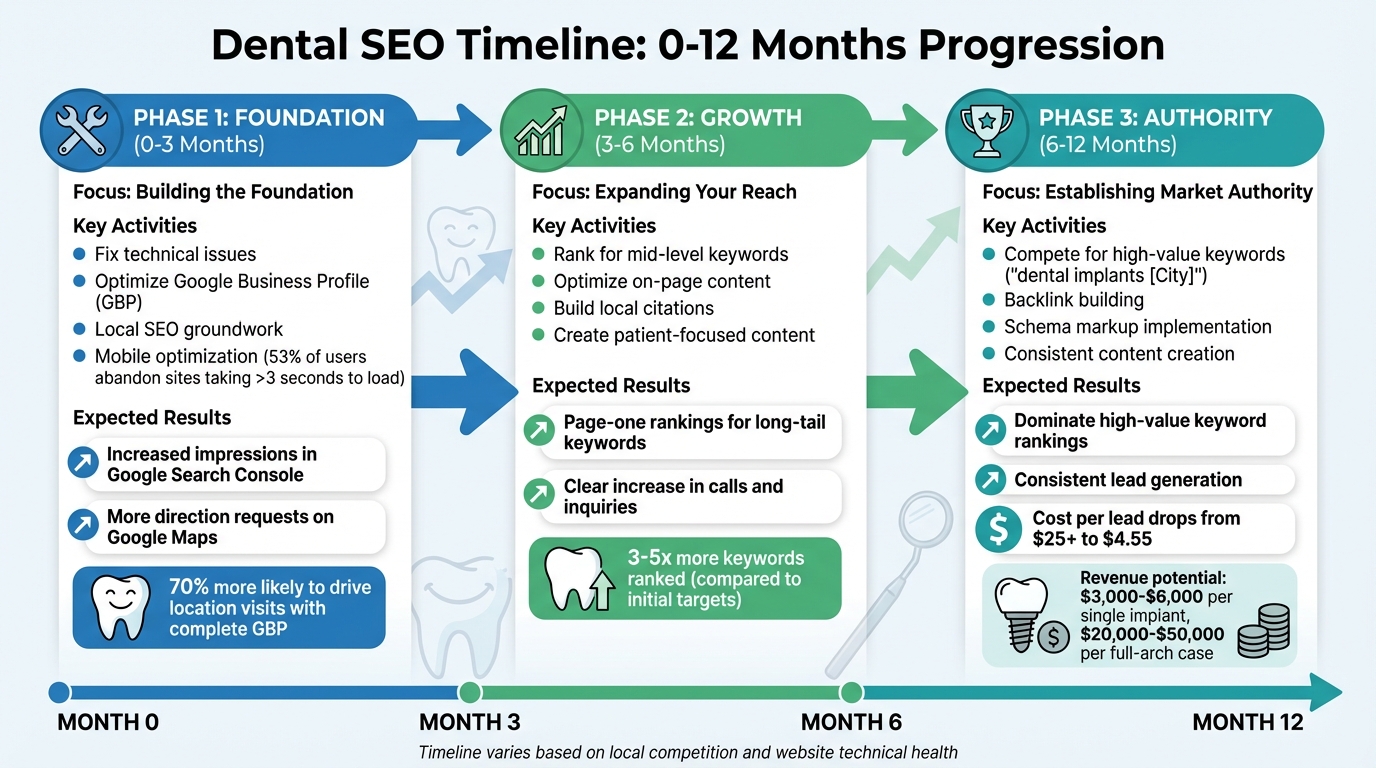
Dental SEO Timeline: 3-12 Month Results Roadmap
Unlocking Dental SEO: Insights from Ron J. Fortier of Doctor Genius
How Long Does Dental SEO Take in 2026?
You should plan for 3–6 months to start seeing meaningful results, though the exact timeline depends on your current SEO status and how competitive your market is. SEO is a gradual process that gains strength over time. By the six-month mark, many dental practices see a significant boost, ranking for three to five times more keywords than they initially targeted. This steady progression builds from laying a solid foundation to eventually establishing authority in your niche.
The process unfolds in three main phases. During the first 30–90 days, the focus is on fixing technical issues and optimizing your Google Business Profile. Between months 3–6, practices often achieve page-one rankings for mid-level keywords and notice a clear increase in calls and inquiries. By months 6–12, you’re competing for high-value terms like "dental implants" or "Invisalign", and your SEO efforts begin to deliver consistent leads, reducing the need for paid ads.
30-90 Days: Building the Foundation
The first three months are all about technical SEO basics and local SEO groundwork. A fast-loading website is essential – 53% of mobile users will abandon a site that takes longer than three seconds to load. This phase includes fixing crawl errors, improving mobile responsiveness, and ensuring proper indexing.
Your Google Business Profile (GBP) is another priority. A complete GBP is 70% more likely to drive visits to your location. Add professional photos, verify your hours, and populate the Q&A section with common patient questions like "Do you accept [Insurance]?" or "Do you offer emergency care?" Early progress often shows up as increased impressions in Google Search Console and more direction requests on Google Maps, even before your website rankings improve.
3-6 Months: Expanding Your Reach
Once the foundation is set, the focus shifts to growing your online visibility. During this phase, you’ll start ranking on page one for long-tail keywords like "pediatric dentist in [Neighborhood]" and other mid-tier terms tied to your core services. This is when you’ll likely notice a jump in phone calls and online inquiries.
Efforts during this stage include optimizing on-page content for high-intent services like implants, emergency care, or cosmetic dentistry. Building local citations in trusted directories also plays a key role. Additionally, producing detailed, patient-focused content – like a guide comparing "Invisalign vs. Braces Costs" – can help establish your expertise. Since most patients search with local intent, they often read reviews, compare options, and then call, making this phase critical for generating leads.
6-12 Months: Establishing Market Authority
By the six-month mark, your SEO efforts should start to pay off in a big way. This is often referred to as the "momentum zone," where practices begin to dominate rankings for high-value keywords like "dental implants [City]" or "Invisalign." These terms can drive significant revenue, as a single-tooth implant can bring in $3,000–$6,000, while full-arch cases can generate $20,000–$50,000.
At this stage, consistent efforts in backlink building, schema markup, and content creation amplify your initial work. As organic traffic grows, the cost per lead drops dramatically – some practices report going from over $25 per lead to just $4.55. However, keep in mind that newer dental websites often face a three-to-six-month "sandbox period" where Google evaluates their credibility, so established sites with clean histories tend to see faster results.
| Phase | Timeline | Expected Progress |
|---|---|---|
| Foundation | 0–3 Months | Technical fixes, GBP optimization, and increased impressions in Search Console |
| Growth | 3–6 Months | Page-one rankings for mid-tier terms and a rise in calls/leads |
| Authority | 6–12 Months | High-value keyword dominance, steady lead flow, and strong ROI |
What Affects Your Dental SEO Timeline?
Several factors play a role in how quickly dental SEO efforts yield results. These include the level of local competition, the difficulty of your chosen keywords, and the overall health of your website. Let’s break down how each of these elements impacts your timeline.
Local Market Competition
The number of dental practices in your area heavily influences how long it takes to see SEO results. If you’re in a smaller town or suburban area, you might notice progress within 3–5 months because fewer competitors are actively optimizing for SEO. On the other hand, in major cities where 20 or more practices are competing for top rankings, it could take 6–12 months – or even longer – to make significant headway.
"More competition means Google has more choices – and it takes longer to outperform established players." – Innovate Dental Marketing
In highly competitive metro areas, targeting hyperlocal terms like "pediatric dentist in Lincoln Park" can help you gain traction faster. However, high-value procedures such as dental implants often come with steep competition. For instance, Google Ads clicks for terms like "dental implants near me" can cost anywhere from $20 to $80 per click.
Understanding the competitive landscape in your area allows you to set realistic goals and milestones for your 3–12-month SEO plan.
Keyword Difficulty and Search Intent
The keywords you target significantly affect both your ranking timeline and the quality of leads you attract. Long-tail keywords, which are more specific, often rank within 1–3 months, while broader, more general terms may take 6–12 months to achieve a solid ranking. This is largely due to the competition and revenue potential of these terms. For example, securing a single full-arch implant case can generate $20,000 to $50,000, making these keywords highly competitive.
Search intent also plays a major role. Informational keywords like "what is a root canal" are easier to rank for because they cater to users in the research phase. In contrast, transactional keywords such as "emergency dentist near me" signal an intent to book an appointment, making the competition much stiffer. A strategic approach involves balancing both types: using informational content to establish authority early on while gradually working to rank for high-intent terms that drive appointments.
| Keyword Type | Search Intent | Competition Level | Estimated Timeline |
|---|---|---|---|
| Long-tail / Hyperlocal | Transactional / Specific | Low to Medium | 1–3 Months |
| Informational / FAQ | Educational | Low | 1–3 Months |
| Service-Specific (e.g., Implants) | High-Value Transactional | High | 6–12 Months |
| Broad City Terms | General Transactional | Very High | 6–12+ Months |
Website Age and Technical Health
The age of your website and its technical condition can either speed up or slow down your SEO progress. Older websites with a history of quality content and trusted backlinks often rank faster for competitive terms – sometimes within 3–6 months – because they’ve already earned Google’s trust. Newer websites, on the other hand, need more time to build credibility, which can extend the timeline to 6–12 months or more.
Technical issues, such as slow loading times, mobile responsiveness problems, or indexing errors, can also hinder progress. Performing a DIY SEO audit and fixing these issues early – ideally within the first month – can lead to immediate improvements, like more indexed pages and fewer crawl errors. This is especially important as AI-driven search tools become more prevalent and prioritize technically sound websites.
In short, an established site with a solid technical foundation can significantly reduce the time needed to rank for competitive terms. Addressing technical issues early on is a crucial step in accelerating your SEO timeline.
What Actually Moves the Needle in Dental SEO
Now that we’ve covered the timeline and factors influencing dental SEO, let’s dive into the strategies that deliver real results. These tactics not only boost your rankings but also drive more patient inquiries – helping you grow your practice. Below are three proven methods that can accelerate your SEO efforts, from quick wins to building long-term credibility.
Targeting Local Keywords
Using local keywords is one of the quickest ways to connect with potential patients who are ready to book an appointment. Focus on long-tail keywords that combine your services with specific locations, such as "dental implants in Austin" or "emergency dentist near Lincoln Park." These terms often face less competition and attract patients who are already deep into their decision-making process.
For example, informational searches like "how much do veneers cost" require in-depth, educational content to answer questions thoroughly. On the other hand, transactional queries such as "cosmetic dentist open Saturday" need clear, actionable steps – like prominently displaying your phone number, office hours, and an online booking link.
Looking ahead, search engines are likely to favor hyper-local relevance over broader city-wide results. Instead of targeting generic terms like "pediatric dentist Chicago," aim for more specific phrases such as "pediatric dentist in Wicker Park" or "kids dentist near Humboldt Park." This focused approach can help your practice rank faster, especially in the neighborhoods where you’re located.
To further enhance your local SEO efforts, pair these keyword research strategies with structured data for better visibility.
Adding Schema Markup
Schema markup is a small but powerful piece of code that helps search engines understand your content better. It can highlight important details – like your office hours, patient reviews, or appointment links – directly in search results. Think of it as giving search engines a cheat sheet to display your information in a more engaging way.
Adding schema markup can increase organic click-through rates by 20–35% by creating rich snippets that stand out in search results. When more users click on your listing, search engines interpret this as a sign of relevance, which can further improve your rankings.
"Context, not content, now drives AI visibility, making structured data the strategic data layer every enterprise must prioritize." – Martha van Berkel, CEO, Schema App
For dental practices, prioritize these schema types:
- LocalBusiness schema: Displays your name, address, and phone number.
- Review schema: Highlights patient star ratings.
- FAQ schema: Answers frequently asked questions directly in search results.
- Service schema: Details specific treatments like whitening or dental implants.
This structured data is especially valuable for AI-driven search tools and voice assistants like Siri or Alexa, making it easier for patients to find and interact with your practice.
Running Technical SEO Audits
Technical SEO ensures your website is functioning smoothly so search engines can properly crawl and index it. Regular audits can identify and fix issues like slow loading times, broken links, mobile usability errors, and missing security certificates. The best part? These fixes often lead to noticeable ranking improvements within 4–6 weeks.
Start by setting up Google Search Console and Google Analytics 4 to monitor your site’s performance. Then, use tools like Screaming Frog to uncover issues with your robots.txt file, XML sitemap, or internal link structure. With 68% of dental searches happening on smartphones, it’s crucial to have a mobile-friendly site with easy-to-tap buttons and readable fonts.
"Technical fixes like site speed improvements and mobile optimisation typically impact rankings within 4-6 weeks." – Dominate Dental Team
Pay close attention to Core Web Vitals, which measure key aspects of user experience. Aim for:
- Largest Contentful Paint (LCP) under 2.5 seconds.
- Cumulative Layout Shift (CLS) below 0.1.
Compress large images, such as before-and-after photos, to under 100 KB to prevent slow loading speeds. Conduct these technical audits at least quarterly to catch and resolve new issues before they harm your rankings.
Conclusion
The long-term advantages of dental SEO are undeniable when you stick to proven strategies. By 2026, dental SEO remains a steady investment with returns that grow over time. While some practices notice initial improvements within 30–90 days, more substantial progress typically happens in 3–6 months, with full market authority often achieved within 6–12 months. The exact timeline depends on factors like local competition, your website’s technical setup, and how consistently you apply effective strategies.
As Tana, Founder of Dental Marketing BFF, wisely notes:
"SEO growth is slow at first – then unstoppable." – Tana, Founder, Dental Marketing BFF
The key to standing out isn’t just patience – it’s focusing on tactics that truly make a difference. Strategies like targeting hyperlocal keywords, using schema markup, and conducting regular technical audits can lead to quicker, measurable results compared to generic content approaches. For instance, a well-planned SEO campaign for doctors can double your organic traffic and even triple patient inquiries.
But ranking high isn’t enough. Those rankings need to translate into real patient appointments. Metrics like call volume and form submissions are more telling than keyword rankings alone. Over time, SEO not only builds your online presence but also reduces your cost per patient acquisition. The goal is to ensure your website doesn’t just attract visitors – it converts them into booked appointments.
"When SEO is done right, it doesn’t just bring traffic – it brings patients." – Innovate Dental Marketing
Practices that fully embrace this well-rounded approach don’t just survive in crowded markets – they thrive. By ensuring every element of your SEO strategy complements the next, you set the foundation for consistent and sustainable growth.
FAQs
What should I track to prove SEO is bringing new patients?
To show that SEO is bringing in new patients, focus on tracking a few important metrics: local search rankings, website traffic, call volume, and new patient inquiries. These measurements give you a clear picture of how well your SEO strategies are working and how they contribute to patient growth.
How much content do I need each month for dental SEO to work?
Most dental practices can expect to see results from SEO efforts within 90 to 180 days, provided the foundational elements are handled correctly. However, if you’re in a highly competitive market or starting from a less developed position, it might take a bit longer to see meaningful improvements.
When should I add schema markup, and which types matter most?
When optimizing your website for local search, include schema markup to help search engines better interpret your practice’s details. Prioritize the most effective types: DentalClinic, LocalBusiness, and Organization schema. These can boost your rankings and make your practice more visible in local search results.