

If you’re a dental practice deciding between SEO and paid ads in 2026, here’s the key takeaway: SEO is your long-term investment, while paid ads deliver immediate results. Both strategies have their place, but understanding their differences helps you allocate your budget wisely.
- Paid Ads: Instant visibility but costly. You pay for every click, and ad costs have surged – CPCs now range from $7.85 to $35 for high-value keywords. Great for urgent services like emergencies but expensive for long-term growth.
- SEO: Slower to build but cost-effective over time. Initial setup can cost $750–$3,000, with monthly retainers between $500–$5,000 depending on your location and goals. Once rankings stabilize, costs decrease, and organic leads cost less – $7–$14 per lead compared to $70 for paid ads.
- ROI: SEO delivers 600%–900% ROI over time, while paid ads average 350%–550%. SEO patients tend to be more engaged and trust organic results, leading to higher treatment acceptance rates.
- Patient Quality: SEO attracts research-driven patients who are likely to invest in long-term care. Paid ads often bring price-sensitive or urgent patients, which may result in lower lifetime value.
Quick Comparison
| Metric | SEO | Paid Ads |
|---|---|---|
| Cost Per Acquisition | $80–$200 | $175–$350 |
| Timeline | 6–12 months to see results | Immediate |
| ROI | 600%–900% | 350%–550% |
| Patient Type | Long-term, high-value | Urgent, price-sensitive |
| Annual Cost | $19,000–$32,500 | $28,400–$56,000 |
For new practices, start with 70% paid ads and 30% SEO to generate quick leads while building organic presence. Established practices should flip this ratio, focusing on SEO for sustainable growth. Combining both strategies maximizes visibility and ROI.
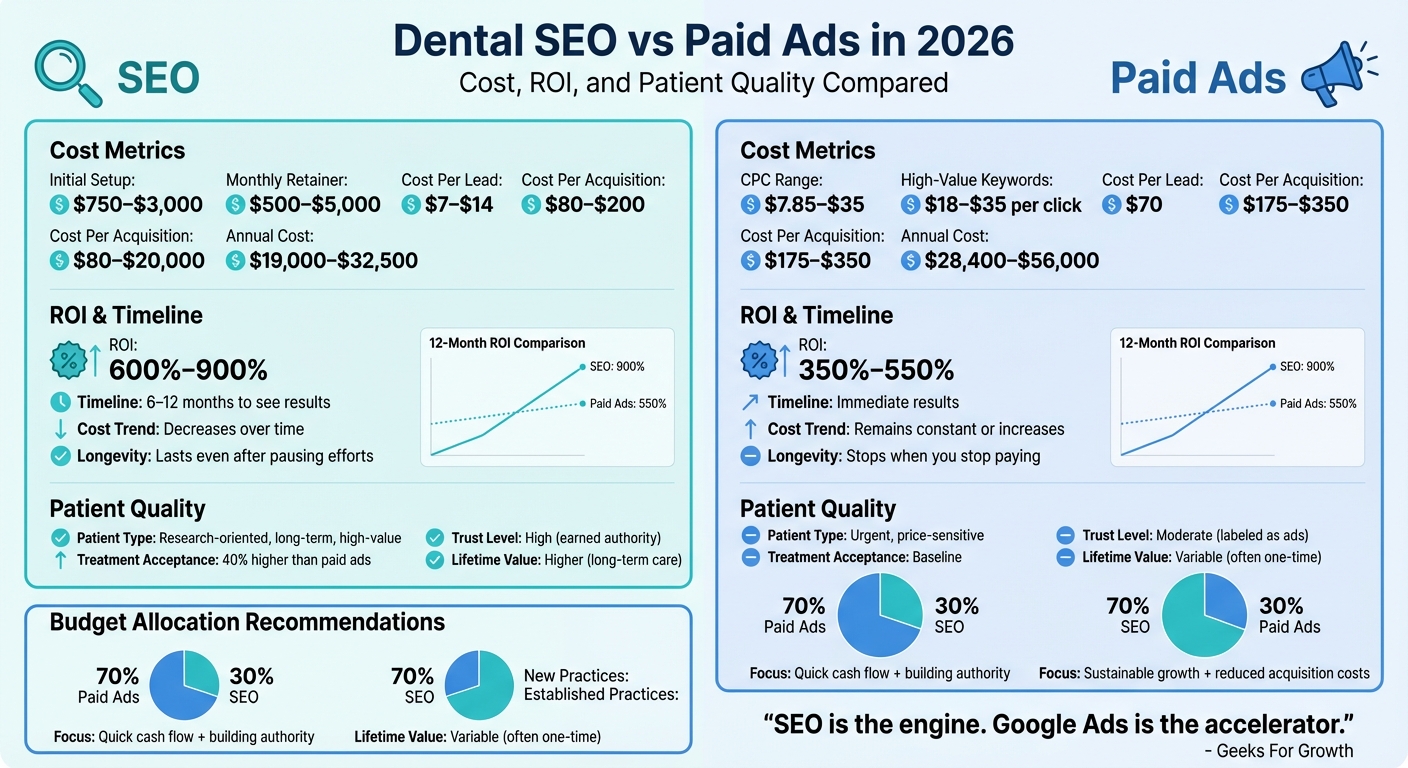
Dental SEO vs Paid Ads: Cost, ROI and Patient Quality Comparison 2026
Renting vs. Owning Your Online Visibility
Paid Ads: Instant Results That Stop When You Stop Paying
Paid ads offer quick visibility at the top of search results, but only as long as you’re paying. The moment you stop, your presence disappears entirely. Adrian Lefler, CEO of My Social Practice, highlights the harsh reality: ad costs have surged, doubling or even tripling. As Lefler explains, "if you used to spend $2,000 a month on ads, you’re spending four for the same number of clicks".
This means every patient you attract through ads comes with a continuous price tag. And in competitive fields like dentistry, the cost per click for keywords can range from $6 to over $19. The challenge grows even steeper with AI-driven search changes. By 2026, around 60% of Google searches are expected to end without a single click, as AI summaries answer users’ questions directly. This reduces available ad space and drives costs even higher. On the other hand, SEO offers a more enduring solution.
SEO: Building Visibility That Lasts
SEO works differently. Instead of renting visibility, you’re building an asset you own. Luc Wade, Marketing Director at Hive Business, puts it this way:
"With SEO, you’re building equity that grows over time; with advertising, you’re only paying rent. When your lease ends, you have nothing to show for your money".
Once your practice secures organic rankings for terms like "dental implants [your city]" or "emergency dentist near me", those rankings tend to stick – even if you pause active efforts. Adrian Lefler elaborates:
"Once you’ve built it, it’s hard to destroy it. You rise and then you just maintain. The cost to get there is a fraction of the cost for ads".
Beyond cost efficiency, organic results carry more credibility. Patients often trust these results more than paid ads, seeing them as earned authority rather than purchased placements. This trust, combined with SEO’s staying power, makes it a compelling choice.
How Long Each Strategy Delivers Results
The difference in timelines between paid ads and SEO is striking. Paid ads deliver instant results – launch a campaign today, and patients could be calling tomorrow. But the moment you stop spending, those leads vanish. SEO, on the other hand, requires patience. It typically takes three to six months to see strong results, with full impact often taking six to 12 months. However, once you’ve built your rankings, they decline gradually over weeks or months, not immediately.
Think of it like this: paid ads are like a faucet – you turn it on, and the water flows, but turn it off, and it stops immediately. SEO is more like digging a well – it takes effort upfront, but once it’s in place, it keeps providing over time. For dental practices looking to grow beyond the next quarter, this distinction can make a big difference. Understanding these timelines lays the groundwork for analyzing costs effectively.
Cost Breakdown: What You’ll Actually Spend
SEO Costs: What to Expect
When it comes to SEO, there’s an upfront setup fee followed by monthly retainers. For most dental practices, the initial setup – covering technical audits, competitor content analysis, and groundwork for your Google Business Profile – ranges from $750 to $3,000.
Monthly retainers depend on your location and goals. In smaller towns, a basic SEO plan typically costs between $500 and $1,500. For practices focusing on growth, single-location strategies generally fall in the $1,500 to $2,500 range. However, if you’re in a competitive metro area like New York or Miami, expect to spend $2,500 to $5,000+ per month for more aggressive campaigns. Over time, as your rankings improve and require less active management, costs often decrease as you transition into maintenance mode.
One reason SEO for dental practices can be pricier is because Google classifies dental content under its "Your Money or Your Life" (YMYL) category. This means higher standards for expertise and, in some cases, medical reviews are required.
Paid Ads Costs: How Fast Your Budget Gets Spent
Paid advertising involves two main expenses: the ad budget paid directly to Google and the management fee charged by your agency. For dental services, the average cost-per-click (CPC) is $7.85 as of 2026. But high-value keywords can be much more expensive. For example, terms like "dental implants" can cost $18 to $35 per click, while emergency-related searches like "tooth pain" range from $12 to $25.
Ad budgets can vanish quickly. If you’re getting 10 clicks per day, that alone could run you over $2,300 per month. To collect enough data for optimization, most practices need a minimum spend of $1,500 to $3,000. For specialty services like implants or Invisalign, ad spend often climbs to $3,000 to $6,000+ per month. On top of this, agency management fees range from $800 to $2,000+ monthly, making paid advertising a significant investment.
Tommaso Liu cautions about the financial impact:
"If you spend $1,200 to get that patient [via ads], the campaign may look ‘busy’ – but it weakens your margin."
12-Month Cost Comparison
The financial contrast between SEO and paid ads becomes clear when you look at annual expenses. A growth-tier SEO strategy, including setup, costs between $19,000 and $32,500 in the first year. On the other hand, maintaining visibility through paid ads for general dental services costs $28,400 to $56,000 annually.
| Cost Component | Dental SEO (Growth Tier) | Paid Ads (General Services) |
|---|---|---|
| Upfront/Setup Fees | $1,000 – $2,500 | $800 – $2,000 (Management Setup) |
| Monthly Ongoing Cost | $1,500 – $2,500 | $2,300 – $4,500 (Spend + Fee) |
| Total Year 1 Investment | $19,000 – $32,500 | $28,400 – $56,000 |
| Cost Trend | Decreases/Stabilizes | Remains constant or increases |
The key takeaway? While SEO costs tend to stabilize or even decrease over time as your rankings improve, paid ad costs stay steady – or rise – due to competition. This also reflects in Patient Acquisition Costs: SEO averages $50 to $150 per patient, compared to $150 to $350 for Google Ads.
Next, we’ll dive into how these expenses translate into ROI and the quality of patients you attract.
ROI and Patient Quality: Which Brings Better Results?
SEO ROI: Returns That Grow Over Time
SEO offers returns that build momentum over time, making it a powerful long-term strategy. By 2026, established dental SEO campaigns are delivering an average ROI of 600% to 900%, far outpacing the returns from paid ads. As your website climbs in search rankings, the cost of acquiring leads drops significantly, while the volume of leads continues to grow. Over a 12-month span, SEO-generated leads can cost as little as $7–$14, compared to a steady $70 per lead from paid ads.
The real payoff with SEO starts to become evident between months 6 and 12. While paid ads might generate more leads in the initial months, SEO eventually surpasses them as the cost-per-acquisition (CPA) for organic leads plummets. Adrian Lefler, CEO of My Social Practice, highlights the long-term benefit:
"The reality of it is if you didn’t want to get quick money and you spent $35,000 a month on [ads]… you would get to a point [with SEO] where you don’t have to spend $35,000 a month and you’re making $70,000 a month."
When viewed in the context of Patient Lifetime Value (LTV) – which ranges from $4,000 to $10,000 per dental patient – a well-executed SEO campaign can deliver an ROI of 300% to 1,000%. Plus, maintaining those rankings costs far less than running continuous ad campaigns to achieve the same results. While SEO takes time to gain traction, its compounded returns make it a standout for practices looking for sustainable growth.
Paid Ads ROI: Fast Leads at Higher Costs
If speed is your priority, paid ads deliver instant results, but they come at a price. Properly optimized Google Ads typically generate an ROI of 350% to 550%, though rising competition has been driving costs up. By 2026, AI-generated search summaries have reduced ad inventory, causing dental cost-per-click (CPC) rates to double or even triple in some markets. Adrian Lefler explains the impact:
"Ad costs have doubled, sometimes tripled. If you used to spend $2,000 a month on ads, you’re spending four for the same number of clicks."
Paid ads are particularly effective for urgent, immediate needs, such as emergency dental care, where patients are ready to book an appointment right away. However, the cost-per-acquisition for paid ads usually ranges from $175 to $350, compared to $80 to $200 for long-term SEO. The downside? Once you stop running ads, the leads dry up, leaving no lasting benefit. While effective for quick wins, paid ads are a more expensive way to generate leads over time.
Patient Quality: Who Converts Better?
When it comes to patient quality, SEO tends to attract more engaged and higher-value patients. Organic search results appeal to individuals who are researching their options thoroughly before selecting a provider. These patients have 40% higher treatment acceptance rates compared to those who come through paid ads. They see organic results as more trustworthy and credible, which makes them more likely to commit to high-value treatments like Invisalign or dental implants.
In contrast, paid ads often attract patients who are either in a rush to solve an immediate problem or are shopping based on price. While these leads may convert quickly, they are less likely to commit to comprehensive, long-term care plans. The table below highlights the key differences:
| Metric | SEO Patients | Paid Ads Patients |
|---|---|---|
| Patient Intent | Research-oriented, high trust | Urgent or price-sensitive |
| Treatment Acceptance Rate | 40% higher than paid traffic | Baseline |
| Cost Per Acquisition | $80 – $200 | $175 – $350 |
| Lifetime Value | Higher (long-term care) | Variable (often one-time) |
| Trust Level | High (earned authority) | Moderate (labeled as ads) |
For dental practices offering premium services like cosmetic dentistry or implants, SEO proves to be a double win – it not only delivers better ROI but also attracts patients who are more likely to invest in long-term, high-value treatments. Mature SEO campaigns can account for 40% to 60% of all new patient inquiries, making it an essential tool for practices focused on sustainable growth and patient quality.
When to Use SEO vs. Paid Ads
Best Times to Use Paid Ads
Paid ads are your go-to for immediate visibility, especially during time-sensitive campaigns. For instance, they’re perfect for promoting emergency dental services – when patients need help right now. They also shine during limited-time offers, like teeth whitening specials before wedding season or back-to-school checkup promotions. If your practice is dealing with negative reviews or confusion around your name, a short branded ad campaign can help manage your online reputation quickly. Unlike SEO, which takes time to build, paid ads provide that instant impact when you need results fast.
Best Times to Invest in SEO
SEO is the better choice when you’re aiming for steady, long-term patient growth. It’s particularly helpful if you’re looking to escape the constant pressure of rising ad costs. Once your site ranks well organically, it keeps working for you – even when you’re not actively spending on it. SEO is especially effective for high-value services like dental implants, Invisalign, or cosmetic dentistry, where patients tend to do more research and trust organic search results. Optimizing for local search and securing a spot in the Google Maps pack can also drive more "near me" calls. Just remember, building a strong SEO foundation takes time – typically six to 12 months of consistent effort.
Matching Strategy to Your Practice Stage
Your practice’s stage plays a big role in determining the right balance between SEO and paid ads. If you’re just starting out, it often makes sense to allocate about 70% of your marketing budget to paid ads and 30% to SEO. This approach helps generate immediate cash flow while your website gains authority. On the other hand, if your practice is well-established with a steady patient base, consider flipping that ratio – putting 70% into SEO. This shift reduces long-term acquisition costs and lessens your reliance on unpredictable ad auctions. A mix of both strategies can work too, using paid ads for quick wins while SEO builds a solid, lasting presence.
Using Both SEO and Paid Ads Together
Why Using Both Works Better
When you combine SEO and paid ads, you get what’s often called “double visibility.” This means your practice can show up in both paid and organic search results, boosting credibility and increasing the chances of someone clicking through. For instance, 70% of users are more likely to click on organic results, but seeing your paid ad alongside it can strengthen trust. Plus, paid ads give you immediate feedback on which keywords are driving bookings, which can directly shape your SEO strategy. On the flip side, strong organic rankings allow you to scale back paid ad spending on certain terms, cutting your overall cost per patient.
"SEO and PPC aren’t competitors – they’re teammates. SEO builds long-term trust and authority. PPC gives you instant visibility and data you can use to boost your SEO faster."
– Tana, Founder, Dental Marketing BFF
Here’s an example: in 2026, Design Co Studio worked with a dental practice to address two goals – filling emergency slots and growing Invisalign cases. They used Google Ads to target same-day emergency appointments while focusing on organic rankings for terms like “Invisalign [city].” Within months, organic inquiries for Invisalign outpaced paid ones, allowing the practice to reduce ad spending without sacrificing results.
How to Split Your Budget
Balancing SEO and paid ads starts with a smart budget allocation. For new practices, dedicating 70% of your budget to paid ads and 30% to SEO can help generate quick cash flow while your website gains traction. As your organic rankings improve, you can flip this to 70% SEO and 30% paid ads to cut long-term acquisition costs.
Established practices often benefit from a 50/50 split, which balances immediate lead generation with building a long-term online presence. But this isn’t set in stone – revisit your budget quarterly. If ad costs rise or you secure strong organic rankings for a key term, shift more funds to the channel delivering the best ROI. On average, growing clinics allocate 5% to 15% of their monthly revenue to digital marketing.
Here’s another tip: reserve a small portion of your paid ad budget to bid on your practice’s name. This helps protect branded searches from competitors looking to poach your traffic.
Measuring Performance Across Both Channels
To gauge success, look beyond clicks and impressions. The real metric? Cost per booked patient. Integrating web forms and call tracking with your management system can reveal which channels are driving actual revenue. Tools like dynamic number insertion (DNI) can help – assigning unique phone numbers to organic and paid traffic makes it easier to track conversions. This is especially important since only 26% of practices offer online booking.
A unified dashboard can bring everything together, letting you monitor cost per lead, conversion rates, and keyword performance. For example, if a keyword ranks #1 organically, you might pause PPC spending on it. Alternatively, high-performing paid keywords can guide your SEO content strategy. Using tools like Google Analytics 4 (GA4) to track the entire patient journey is essential, as many patients engage with both organic and paid content before booking. And don’t forget the big picture – the average dental patient’s lifetime value is around $6,700. That figure can help you set realistic and sustainable acquisition goals.
The Perfect Combination of SEO and PPC for Your Dental Website
Conclusion: Choosing the Right Strategy for Your Dental Practice
Paid ads provide immediate visibility, while SEO focuses on building a long-term organic presence. In 2026, this distinction is especially important as advertising costs have significantly increased. Think of it this way: paid ads deliver quick, short-term traffic, while SEO ensures a steady stream of visitors over time.
For most dental practices, combining both approaches is the way to go. If you’re just starting out, consider allocating around 70% of your budget to paid ads for faster results, while simultaneously investing in SEO. As your organic rankings grow – usually within 6 to 12 months – shift the balance to 70% SEO and 30% paid ads to reduce patient acquisition costs in the long run. Established practices can benefit from periodically reviewing and adjusting their budget split to maintain optimal ROI. This balanced approach supports both immediate growth and long-term sustainability.
An expert from Geeks For Growth sums it up perfectly:
"SEO is the engine. Google Ads is the accelerator. Conversion is the transmission." – Geeks For Growth
Beyond budget allocation, don’t overlook the importance of having a well-optimized website. Before diving into ads or SEO, make sure your site includes clear calls-to-action, trust-building elements, and easy booking options. Also, use your patient lifetime value (typically between $4,000 and $10,000) as a benchmark to guide your spending on patient acquisition.
While paid ads deliver instant results, SEO provides enduring visibility and cost efficiency. The right mix of these strategies will depend on your practice’s goals and the growth trajectory you’re aiming for.
FAQs
How do I choose the right SEO vs ads budget split for my practice?
To figure out the best way to divide your budget, start by identifying your objectives. If your priority is bringing in patients quickly, putting more money into Google Ads can deliver fast visibility and immediate results. On the other hand, if you’re aiming for steady, long-term growth, directing funds toward SEO helps build organic rankings, which can lead to consistent inquiries over time.
The smartest strategy often combines both approaches. For example, you could ramp up ad spending during busy seasons while continuing steady SEO efforts year-round. Make sure to regularly track your ROI and assess the quality of the patients you’re attracting. This will help you fine-tune your approach and ensure your budget is working effectively.
What should I track to measure cost per booked patient (not just leads)?
To figure out the cost per booked patient, start by adding up all your marketing and advertising expenses. This includes everything – staff time, overhead, and spending on channels like SEO or paid ads. Next, track how many leads actually turn into scheduled appointments or completed treatments. Once you have these numbers, divide your total marketing spend by the number of booked patients. This calculation gives you a clear view of how much you’re spending to secure each patient and helps you better understand your ROI.
When can I safely reduce Google Ads after SEO starts working?
You can cut back on Google Ads once your SEO efforts start delivering consistent organic visibility and bringing in a steady stream of patients. This usually takes a few months as your rankings improve and your site builds trust. Keep a close eye on patient traffic and conversions to make sure your practice continues to grow as you adjust your ad budget.