
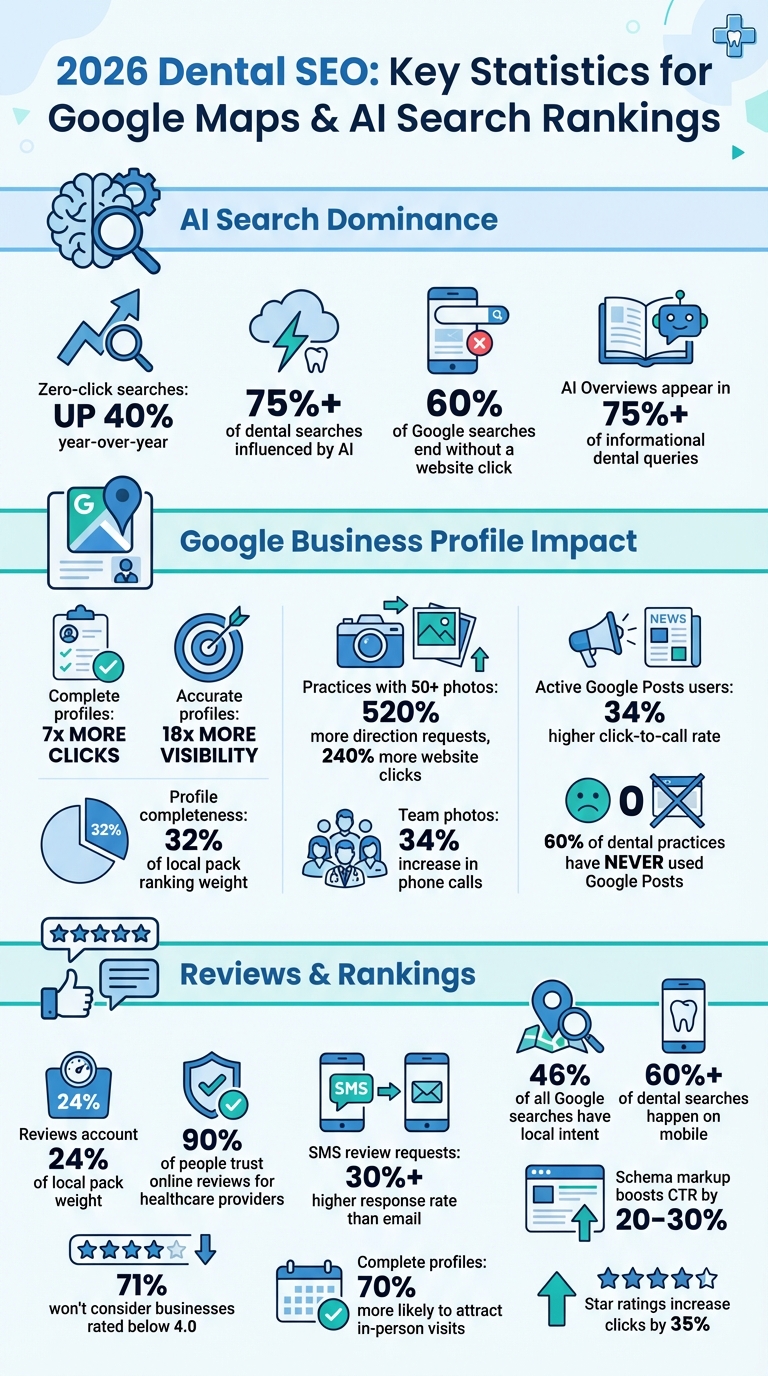
In 2026, finding a dentist has shifted dramatically. Patients now rely heavily on AI-generated summaries and the Google Map Pack, with zero-click searches up by 40% year-over-year. AI tools like Google’s AI Overview and ChatGPT prioritize practices based on authority, review sentiment, and local relevance – making it harder for smaller practices to compete without proper optimization.
Key takeaways for improving visibility:
- Google Business Profile (GBP): Complete profiles get 7x more clicks and 18x more visibility. Add accurate details, photos, and service descriptions.
- Customer Reviews: Frequent, high-quality reviews are critical. Practices with consistent review growth rank higher.
- Service-Specific Pages: Create dedicated landing pages for each treatment (e.g., Invisalign, dental implants) with localized content and schema markup.
- Local Schema Markup: Use structured data like
DentistandLocalBusinessschema to help AI understand your practice details. - AI-Optimized Content: Write concise, question-based content that AI can easily summarize for search results.
With over 75% of dental searches now influenced by AI, ranking on Google Maps and appearing in AI-generated recommendations is no longer optional. Success depends on building trust through accurate profiles, consistent reviews, and AI-friendly content.
2026 Dental SEO Statistics: Google Maps and AI Search Rankings
Local SEO for Dentists: The Strategy Everyone Gets Wrong
How to Optimize Your Google Business Profile
Your Google Business Profile (GBP) plays a crucial role in how dental practices are discovered on Google Maps, AI-driven answers, and zero-click searches. Here’s a striking fact: complete profiles get seven times more clicks than incomplete ones. Even better, businesses with the most accurate profiles enjoy up to 18 times more visibility in search results compared to those with incomplete information. This is because Google’s algorithm views businesses as "entities" and cross-checks your GBP details with your website, social media, and local mentions to determine relevance.
Profile completeness is a game changer, accounting for 32% of local pack ranking weight. The primary category you select – like "Cosmetic Dentist" instead of just "Dentist" – is especially influential. You can also add up to nine secondary categories to widen your reach. Consistency in your Name, Address, and Phone (NAP) information across your website, signage, and directories is non-negotiable. Google relies on this consistency to build trust in your practice as an entity.
Complete and Verify Your Profile
Verification is the first step. Use your official clinic email (e.g., info@yourpractice.com) to verify your profile via mail, phone, email, or video.
Next, list all your specific services, like Invisalign, dental implants, or emergency tooth extractions, with 300-character descriptions for each. These descriptions help trigger AI snippets, which explain why your practice is relevant in search results. Since Google frequently updates its category options, auditing your categories every three months ensures you’re staying current with search trends.
Once verified, enhance your profile with engaging visuals and regular updates to keep it dynamic.
Add Photos, Posts, and Service Details
Photos are a powerful tool for engagement. Dental practices with over 50 photos see 520% more direction requests and 240% more website clicks compared to those with fewer than 10 photos. Include real images of your office exterior, reception area, treatment rooms, dental technology, and team members. Photos of before-and-after smile transformations (with patient consent) and candid team interactions build trust. In fact, profiles with team photos experience a 34% increase in phone calls.
Avoid using stock photos – Google’s AI evaluates image quality and associates real, high-quality photos with trustworthiness. To strengthen your local ranking, geo-tag your photos with EXIF data that matches your practice’s location.
Regularly publish 1–2 Google Posts per week with clear calls to action like "Book Now" or "Call Now", linking directly to your appointment page. Content ideas for posts include special offers, dental health tips, new technology announcements, staff features, and seasonal reminders. Businesses that actively use Google Posts see a 34% higher click-to-call rate, yet surprisingly, 60% of dental practices have never used this feature.
Get and Manage Customer Reviews
Reviews are a major ranking factor, accounting for 24% of local pack weight. But it’s not just about the number of reviews anymore – Google now emphasizes "review velocity", or how frequently you receive new reviews. For example, a practice with 200 fresh reviews in the last year will outrank one with 250 reviews that are three years old. Reviews matter to potential patients, too: 90% of people trust online reviews when choosing a healthcare provider, and 71% won’t even consider a business with an average rating below 4.0.
"In 2026, Google reviews are no longer just social proof. They are infrastructure." – LocalMighty
Timing is everything. Send automated SMS review requests within two hours of an appointment – delays significantly lower response rates. SMS requests have a 30%+ higher response rate than email. Simplify the process by using a direct Google review link instead of directing patients to your homepage. You can also place QR codes in your checkout area or treatment rooms to gather feedback before patients leave.
Engagement is key. Respond to all reviews within 24–48 hours to show you’re actively involved. However, be cautious – never reveal a reviewer’s patient status, even if they identify themselves. Violating HIPAA can lead to hefty fines, like the $23,000 penalty faced by New Vision Dental in California for disclosing protected patient information in a Yelp response.
While reviews are critical, they’re just one piece of the puzzle. Next, focus on creating service-specific landing pages to further boost your online presence.
Create Service-Specific Landing Pages
If you want to rank higher on Google Maps and in AI-driven search results, creating dedicated pages for each core dental service is a must. Instead of lumping all your treatments onto one "Services" page, focus on building individual pages for high-priority offerings like emergency care, dental implants, Invisalign, and pediatric dentistry. This strategy directly targets patients searching for specific treatments, which is key since nearly 46% of all Google searches have local intent.
Each landing page should include 500–800 words of unique, localized content. Make it relevant by mentioning nearby landmarks or neighborhoods. For example: "Our emergency dental clinic serves patients near the South End and downtown Riverwalk." Adding photos of your staff, treatment rooms, and before-and-after images builds trust. You can also embed patient reviews specific to that service for added credibility. According to research, businesses with complete profiles are 70% more likely to attract in-person visits.
Don’t overlook the technical side. Use service-specific and FAQ schema markup to help AI-driven search engines understand and summarize your content. Make sure appointment booking links are easy to find – especially for high-urgency services like emergency care – to drive conversions. As Tyson Downs, Founder of Titan Web Agency, aptly says:
"If your website ranks but does not generate calls, your SEO is incomplete".
By combining engaging content with smart technical optimizations, you set the stage for precise keyword targeting and improved rankings.
Target High-Intent Keywords
For each service page, focus on keyword research for one main keyword using the "Service + Location" format, like "Invisalign Gilbert" or "Emergency Dentist Capitol Hill". Back this up with two or three long-tail variations, such as "clear aligners" or "invisible braces". Place the primary keyword strategically in the title tag, H1 heading, meta description, the first 100 words, and image alt text.
Address different types of patient intent – Transactional (e.g., "emergency dentist open now"), Navigational (e.g., "[Practice Name] reviews"), and Informational (e.g., "how much do dental implants cost"). Tailor your content to match these needs. For example, an emergency page should emphasize immediate availability and feature a click-to-call button, while a dental implant page might focus on costs and procedures. With 77% of patients using search engines before booking and 88% of local mobile searches leading to a call or visit, aligning your content with search intent can make a big difference. Websites that optimize for relevant keywords and search intent can see up to 70% higher visibility in organic rankings. Just remember to use synonyms naturally to avoid keyword stuffing.
Structure Pages for Easy Navigation
Clear organization is critical for both users and AI crawlers. Each service page should follow a logical structure. Use one H1 tag for the main topic (e.g., "Emergency Dentist in Austin, TX"), H2 tags for major sections like "Common Dental Emergencies We Treat", and H3 tags for smaller subsections. This makes your content easier to scan and helps boost your local rankings on Google Maps and AI search results. Include a prominent "Book Now" button both above the fold and at the bottom of the page to capture leads at different points in their visit.
Since over 60% of dental searches happen on smartphones, mobile optimization is non-negotiable. Ensure pages load in under 3 seconds, use a font size of at least 16px for readability, and design large, tappable CTA buttons (at least 44px in size). Embedding a live Google Map can also reinforce your local relevance. Adding a FAQ section with schema markup can help you capture voice searches and secure rich results in AI-generated responses.
To strengthen your site’s authority, link related services together. For example, connect your dental implants page to resources on bone grafting or sedation dentistry. Address common patient concerns by including details on insurance plans, sedation options, financing, and what to expect during a first visit. This not only builds trust but also makes your site a go-to resource for potential patients.
Add Local Business Schema Markup
Once you’ve created service-specific pages for your dental practice, the next step is to implement schema markup. This is a type of structured data that transforms your website’s details into a format search engines and AI tools can easily understand. By including specifics like your practice’s name, address, phone number, services, and hours, schema removes any guesswork for search engines. It helps Google Maps position your business accurately in the "Google 3-Pack" and enables AI platforms like ChatGPT to recommend your practice in conversational searches.
The benefits are clear. Rich results from schema can boost click-through rates by 20–30%, and showing star ratings in search results can increase clicks by up to 35%. For dental practices aiming to stand out in local search, schema markup is no longer optional. As Yue Zhu, Product Manager at Seenos.ai, puts it:
"AI search engines are becoming the new local directory. When someone asks ChatGPT for ‘the best Italian restaurant near me,’ your local schema determines whether you’re in that conversation."
Accuracy is key. Your schema details must match your Google Business Profile exactly, even down to small abbreviations like "St." versus "Street." Any inconsistency can hurt your rankings. Adding latitude and longitude coordinates can further ensure precise placement on maps, especially in crowded urban areas or shared office spaces.
Which Schema Types to Use
For dental practices, the Dentist schema type is more effective than the generic LocalBusiness type. It helps search engines and AI systems categorize your business more accurately. In addition, several supporting schema types can enhance your visibility by showcasing different aspects of your practice.
| Essential Schema Type | Purpose for Dentists |
|---|---|
Dentist |
Ensures your practice is categorized correctly in the medical field. |
LocalBusiness |
Defines key details like name, address, and phone for map listings. |
Review / AggregateRating |
Adds star ratings and patient feedback to search results. |
Service |
Highlights treatments like "Invisalign" or "Dental Implants". |
OpeningHoursSpecification |
Displays accurate hours, including holidays, in "Open Now" searches. |
FAQPage |
Adds Q&A snippets that expand directly in search results. |
Including GeoCoordinates (latitude and longitude) is especially helpful for ensuring accurate map placement. Use AggregateRating schema only if reviews are hosted on your website, not on third-party platforms. For practices with multiple locations, create unique schema for each location page and link them to the main brand using the parentOrganization property.
Tools That Simplify Schema Setup
The good news? You don’t need a developer to add schema markup. The JSON-LD format is easy to manage. Free tools like TechnicalSEO.com or Merkle‘s Schema Builder allow you to input your practice details and generate the necessary code automatically. If your site runs on WordPress, plugins like Rank Math, Yoast SEO, or Schema Pro can handle the heavy lifting.
For step-by-step guidance, SearchX offers a Local Schema Guide tailored for dental practices. Once you’ve generated your schema, simply paste the <script> block into the <head> section of your website. Validate everything using tools like Google’s Rich Results Test or SchemaValidator.org. Afterward, keep an eye on the "Improvements" or "Local Business" report in Google Search Console to monitor valid items and address any errors.
When done correctly, schema markup complements your other local SEO efforts, helping your practice gain more visibility and attract more patients.
Write Content for AI Search Algorithms
AI search engines are designed to extract direct answers from naturally written content. For example, if a patient asks Google’s AI Overview, "How long does Invisalign take?", the system pulls its response from content specifically structured to address that question – ideally within the first two sentences. Organizing content into concise 120–180 word sections can increase AI citations by 70%.
By 2026, 60% of Google searches ended without a website click, and AI Overviews now dominate over 75% of informational dental queries. This shift means your practice must position itself as a trusted source for AI-generated summaries. Tyson Downs, Founder of Titan Web Agency, emphasizes:
"Generative Engine Optimization improves how AI systems interpret and reuse the SEO signals your practice already provides. It focuses on clarity, consistency, and credibility."
To meet these evolving demands, your content needs to align with AI preferences. Use natural questions as headings, incorporate verifiable local details, and ensure your practice data – like Name, Address, and Phone (NAP) – is consistent across platforms. Practices with clean entity signals and proper schema markup see a 2.4x boost in AI visibility. Structuring your content as localized guides and FAQs further enhances your relevance to AI systems.
Write Location-Specific Guides and FAQs
Creating location-specific guides can significantly enhance your AI search performance. Include details about neighborhoods, landmarks, and transit options. For example, a page titled "Emergency Dentist Near [Local Landmark]" that provides clear directions from nearby streets can rank more effectively in AI results.
For FAQs, focus on real, conversational questions patients might ask. Instead of using a generic heading like "Root Canal Treatment", try questions like "How long does a root canal take?" or "Does this practice offer emergency care near [Neighborhood Name]?" Ensure your answers are complete and appear within the first two sentences, making it easier for AI to extract them. Applying FAQPage schema to these sections helps AI crawlers accurately identify and use your content.
From August to November 2025, Discovery Children’s Dentistry & Orthodontics in Carlsbad, CA, revamped their service pages with parent-focused FAQs written in a conversational tone. The results? Their Local Pack visibility jumped from 33.7% to 55.6%, and their top five rankings more than doubled, increasing from 48 to 112.
Adding verifiable local details – like proximity to landmarks, schools, or transit hubs – also helps AI confirm your relevance. For instance, if patients search for "dentist near [Local Landmark]" or ask, "Which dentist in [City] handles emergency calls after hours?", your content will stand out.
Show Community Involvement
Optimizing text is just one piece of the puzzle. Demonstrating active involvement in your local community can further establish your practice as a trusted authority. AI platforms increasingly rely on "dark social" sources, such as neighborhood Facebook groups, local subreddits, and community forums, to gauge your reputation. Participating in local events – like sponsoring a Little League team or partnering with nearby businesses – can strengthen these signals. Make sure to document these activities on your website.
Highlighting your community engagement can reinforce your authority. For example, showcasing sponsorship of a school fundraiser or participation in a health fair demonstrates your practice’s connection to the area. Shahzad Safri, Founder of agenticplug.ai, explains:
"AI platforms prioritize detailed customer reviews, genuine expertise demonstration, and community connections over corporate spending."
Encouraging patients to leave detailed reviews about specific services, response times, or locations can also improve your AI visibility. Review content quality is six times more influential than the sheer number of reviews. While generic 5-star ratings are helpful, reviews with specific details provide AI systems with the data they need to recommend your practice in conversational searches. These efforts not only build trust but also enhance your presence in AI-driven search results.
Track Your Local SEO Performance
After optimizing your business profile and creating service-specific pages, the next step is tracking how well these efforts translate into patient calls and visits. Monitoring your rankings is essential to confirm the success of your optimizations. By 2026, Google AI Overviews are expected to handle over 40% of informational queries before users even click a link. This shift means that traditional organic rankings only tell part of the story. You’ll also need to keep an eye on your visibility in Google Maps and whether AI platforms like ChatGPT or Perplexity mention your practice when potential patients search for terms like "best dentist for implants near me."
The rise of AI-generated answers calls for a different approach. As Vijay Jacob, Founder of AEO Engine, explains:
"Traditional SEO built around page-one rankings is losing ground fast. If your practice isn’t cited inside AI-generated answers, you’re losing new patients to competitors who are."
Combining a fully optimized Google Business Profile with AI citation tracking can result in up to 3x more patient calls in just 60 days. This means it’s not just about where you rank on Maps – it’s also about ensuring your practice appears in AI-driven local search results.
Monitor Your Google Maps and AI Search Rankings
Start by assessing your visibility across your entire service area – not just near your office. Free browser extensions can generate interactive grid maps that highlight your visibility and help identify blind spots.
Specialized tools can track whether your practice is mentioned in AI-generated responses across major search platforms. You can also simulate local searches from different areas using free browser-based tools.
Focus on actionable metrics like new patient calls, direction requests, and appointment bookings. The AEO Engine Team emphasizes this point:
"The metrics that matter for SEO for dentists are new patient calls, direction requests, and appointment bookings – not total session counts. Vanity traffic doesn’t pay staff."
Additionally, monitor your review velocity – how many new reviews you’re getting each month matters more than just having a high total review count. Keep an eye on direction requests from your Google Business Profile as well. To identify gaps in your online presence, you can use tools like SearchX’s free GMB Audit Tool.
This kind of tracking naturally leads into choosing the right tools to manage your local SEO effectively.
Free vs. Paid SEO Tools Comparison
To fine-tune your tracking, consider the pros and cons of free versus paid SEO tools. Your choice will depend on your budget and how much automation you need. While free tools offer basic capabilities, paid options like SearchX provide advanced features tailored for competitive markets.
| Feature | Free Tools (e.g., browser-based extensions, GBP) | SearchX’s Paid Tools |
|---|---|---|
| Rank Tracking | Basic keyword checks via browser | Automated, multi-location GeoGrid scans |
| AI Search Monitoring | Manual checks | Automated AI citation tracking |
| NAP Consistency Audits | Manual checks across directories | Automated scans across 50+ directories |
| Reporting | Standard dashboards | Comprehensive reports with strategic insights |
| Support | Self-service | Expert consultations and dedicated support |
| Cost | $0 (with free credits available) | Plans starting at $3,000/month |
Free tools are a good starting point. For instance, some Chrome extensions offer up to 500 monthly credits at no charge. But if you’re ready to scale up, SearchX’s Growth and Enterprise plans include features like detailed SERP comparisons and AI visibility tracking to keep your practice competitive.
For ongoing success, run a 90-day audit cycle. Spend the first 30 days optimizing your Google Business Profile and fixing NAP inconsistencies. Use the next 30 days to build neighborhood-specific pages and secure local backlinks. Dedicate the final 30 days to implementing FAQ schema and launching link-building campaigns. Regular audits allow you to spot problems early and adapt as AI search algorithms continue to evolve.
Conclusion
Succeeding in Google Maps and AI rankings by 2026 requires a shift toward a trust-first local SEO strategy. The days of relying on outdated tricks are over. As Med Rank Interactive puts it:
"SEO in 2026 is trust-based, not tactic-driven".
Google and AI platforms now take a broader view of your practice, assessing factors like credentials, reviews, community engagement, and the consistency of your online information.
Start with the basics: optimize your Google Business Profile, resolve NAP (Name, Address, Phone) inconsistencies, and use LocalBusiness schema on your website. From there, create content that directly answers patient questions – like costs, treatment timelines, and recovery expectations – right at the beginning of your content. In competitive areas, go beyond targeting your city name by developing neighborhood-specific landing pages.
These steps lay the groundwork for AI-focused strategies. With AI-generated answers becoming more prevalent, tracking traditional rankings isn’t enough anymore. AI Overviews now appear in over 75% of informational dental searches, and about 60% of U.S. adults use AI tools for search. To ensure your practice is included in these AI responses, adopt Generative Engine Optimization (GEO) to structure your content in a way that AI platforms can easily process.
To make this process smoother, tools like those from SearchX can help. Their free GMB Audit Tool identifies gaps in your Google Business Profile, while their technical SEO services ensure your website meets 2026 standards. For those looking to grow further, SearchX’s Growth and Enterprise plans include AI visibility tracking and automated citation monitoring.
Ultimately, success in 2026 will come to practices that build real trust – through patient reviews, active community involvement, and showcasing clinical expertise. Both patients and AI platforms reward authenticity and authority.
FAQs
How do I get my dental practice into AI Overviews?
To ensure your business appears in AI Overviews by 2026, it’s crucial to optimize your website and local business information for AI-driven search engines. Start by fully completing your Google Business Profile with accurate and up-to-date details. Incorporate schema markup like LocalBusiness to help search engines understand your site better.
Focus on creating high-quality, authoritative content that aligns with Google’s E-E-A-T framework (Experience, Expertise, Authority, and Trustworthiness). Keep your NAP (Name, Address, Phone Number) data consistent across all platforms. Encourage customers to leave reviews, as they play a significant role in boosting credibility and visibility. Lastly, regularly update your site with relevant, patient-centered content to stay competitive in search rankings.
What’s the fastest way to boost my Google Maps ranking?
To improve your Google Maps ranking quickly, start by optimizing your Google Business Profile (GBP). Make sure your name, address, phone number (NAP), hours, and services are accurate and fully updated. Select the right primary and secondary categories – for example, "Dentist" and any relevant specialties that apply to your business.
Encourage positive reviews from customers and respond to them regularly to build engagement and trust. While you might see some changes within 2–4 weeks, achieving higher rankings typically requires consistent effort over 3–6 months.
Which schema markup matters most for dentists?
For dentists, the DentalClinic schema is a game-changer. This specific schema helps search engines grasp essential details about your dental practice, which can boost your visibility in local searches. With this markup, you can unlock rich search results like star ratings, operating hours, and more. These enhancements make it simpler for potential patients to discover and select your practice.