
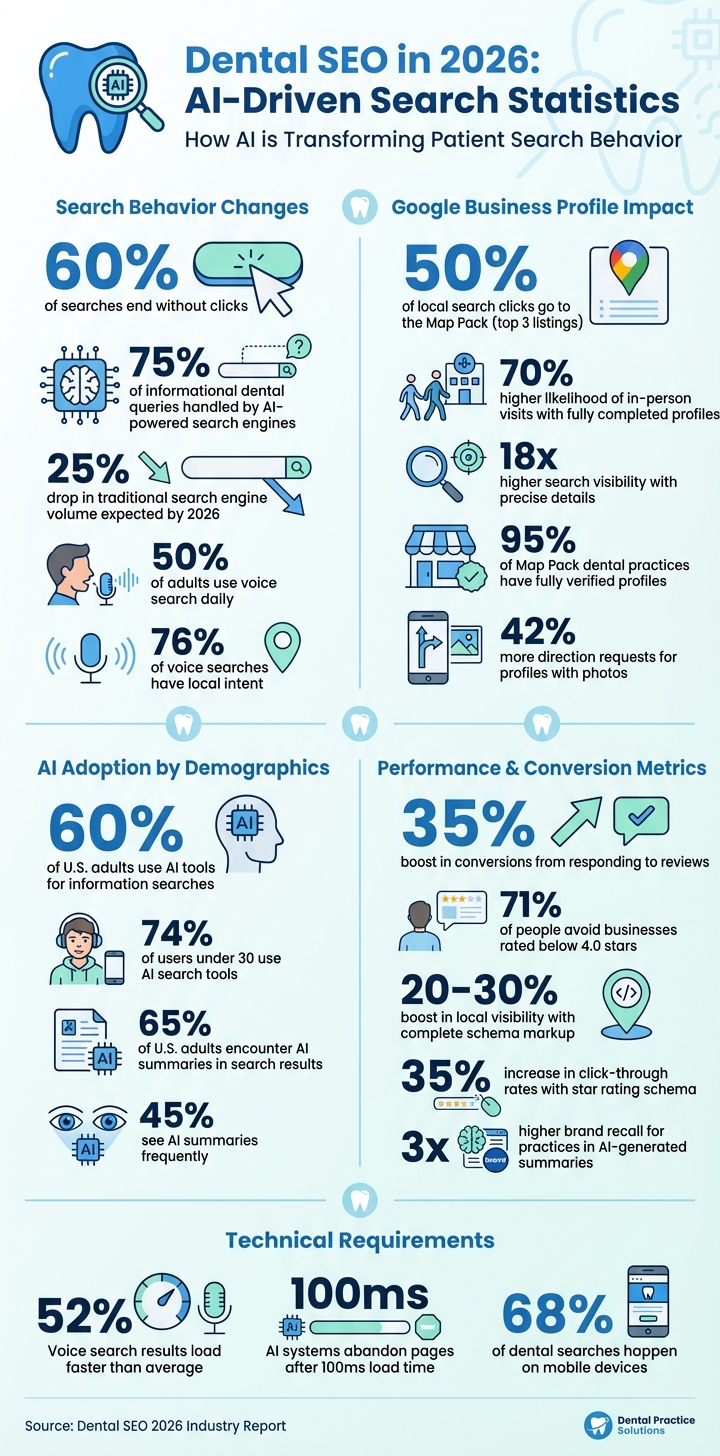
In 2026, AI is changing how patients find dentists. Search engines now prioritize direct answers over website links, with 60% of searches ending without clicks. To stay visible, dental practices must focus on becoming trusted sources for AI-generated responses. Here’s what matters most:
- Google Business Profile (GBP): Optimized GBPs dominate local searches, with the "Map Pack" grabbing 50% of clicks. Fully verified profiles with detailed service descriptions are essential.
- AI and Voice Search: AI evaluates conversational queries like “Which dentist near me accepts Delta Dental?” Voice search accounts for 25% of dental-related queries.
- Schema Markup: Structured data helps AI systems understand your services, increasing visibility in AI summaries and voice results.
- Content Strategy: Focus on answering specific patient questions in a conversational tone. Use FAQs, topic clusters, and long-tail keywords tailored for AI-driven searches.
- Site Performance: Fast-loading, mobile-friendly websites are critical, as AI systems abandon slow pages.
To succeed, dental practices must shift from traditional SEO for dentists to strategies that align with AI-driven search behavior, ensuring they remain visible and competitive in this evolving landscape.
Dental SEO Statistics 2026: AI-Driven Search Impact on Patient Acquisition
Google Brings Back the Links (in AI Search) – What It Means for Dental Practices in 2026
How to Optimize Your Google Business Profile for Local Dental Searches
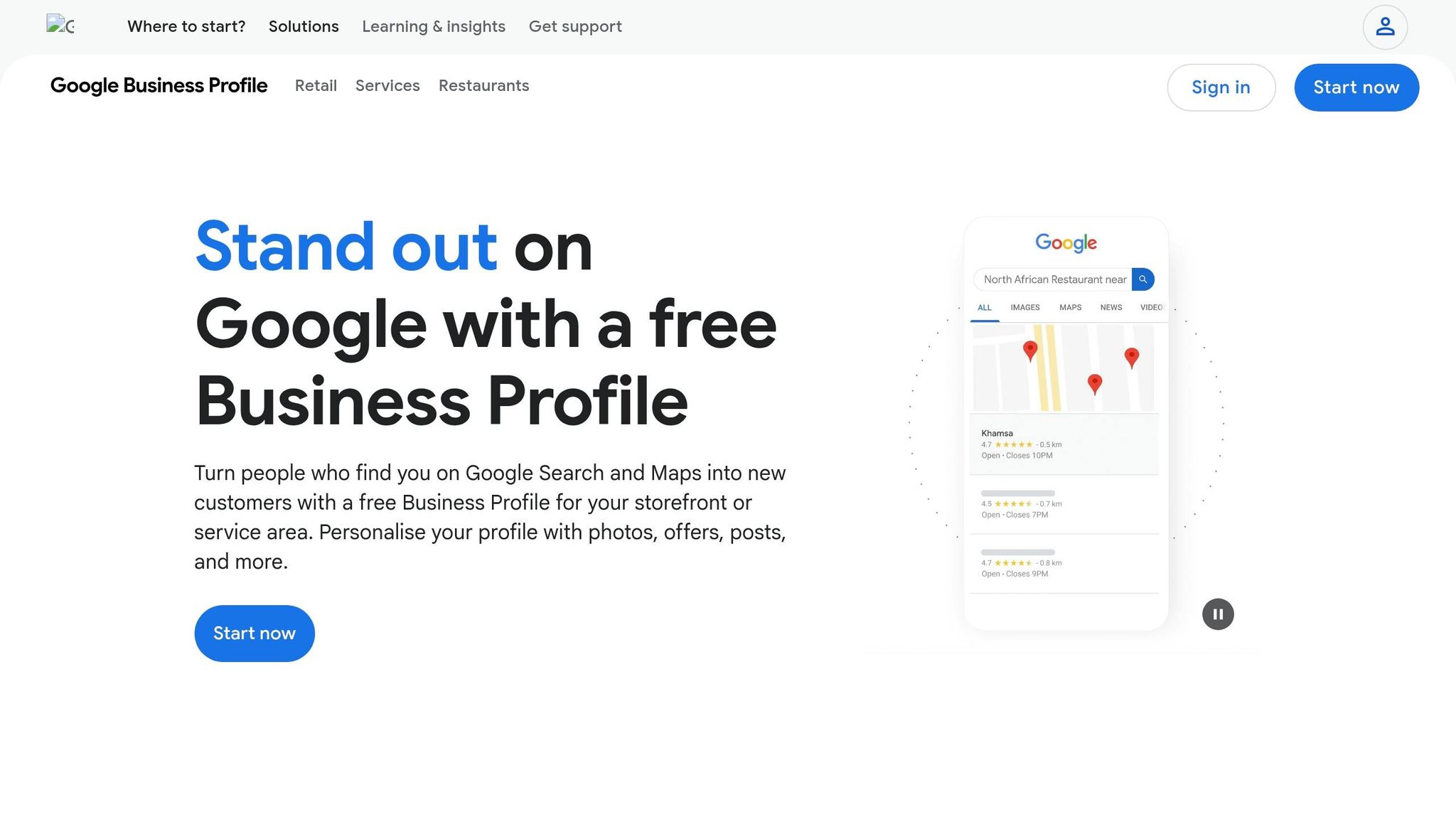
To succeed in today’s AI-driven world, it’s crucial to fine-tune your Google Business Profile (GBP) for local dental searches. Your GBP acts as the cornerstone of local dental SEO in 2026. The "Map Pack" – those three listings at the top of local search results – grabs over 50% of local search clicks. If your practice isn’t visible there, potential patients might miss you entirely. Practices with fully completed profiles are 70% more likely to attract in-person visits, and those with precise details enjoy 18x higher search visibility.
A polished GBP doesn’t just improve your visibility – it positions your practice as a trusted resource that AI algorithms prioritize. AI systems now rely on GBP data as a key source when generating responses for AI Overviews and voice searches. Every detail matters, from your office hours to service descriptions, as these elements shape AI-driven recommendations that connect patients to your practice.
How to Claim and Verify Your Google Business Profile
Start by searching for your practice on Google Maps. If your listing already exists, click "Claim this business" and follow the steps to verify it. Google typically verifies businesses by sending a postcard with a code to your address, though phone or email verification may also be available in some cases. Verification is essential – 95% of dental practices featured in the Map Pack have fully verified profiles.
Consistency is key. Make sure your Name, Address, and Phone (NAP) details match perfectly across your GBP, website, and any directories. Use your practice name exactly as it appears on your signage – avoid stuffing it with keywords like "Top Dentist in Denver." Include specifics like suite numbers and ensure your map pin is precisely placed at your office entrance for better accuracy.
Adding Dental Service Details to Your Profile
Set "Dentist" as your primary category and add secondary categories like "Pediatric Dentist", "Orthodontist", or "Emergency Dental Service" to showcase your specialties. List all treatments you offer – such as Invisalign, root canals, dental implants, or teeth whitening – and provide detailed descriptions. AI prioritizes profiles that clearly highlight specialized services.
High-quality photos can make a big difference. Upload images of your office, treatment rooms, and advanced equipment – profiles with photos get 42% more direction requests. Aim for at least 100 quality photos to improve visibility in AI-driven visual searches. For example, a clear photo of your Invisalign setup helps Google’s Vision AI categorize your services, making you more likely to appear in searches like "Invisalign dentist near me."
Stay active by posting updates weekly. Share information like emergency appointment availability, seasonal dental tips, or announcements about new technology. Enable messaging and link your profile to your online scheduling system to encourage patient engagement. Regular updates and leveraging AI-driven local SEO tactics will make your profile stand out.
Using AI-Powered Local Search Features
AI now evaluates reviews for sentiment and recurring themes, like "gentle care" or "friendly staff", and incorporates this feedback into profile summaries that influence search rankings. Responding to reviews can boost conversions by 35%, and maintaining an average rating of at least 4.0 stars is critical, as 71% of people avoid businesses rated below this threshold. Use automated SMS or email systems to ask for reviews right after appointments.
Google’s Ask Maps, powered by Gemini AI, generates instant answers by analyzing your reviews, business details, and website content. You can guide this process by adding and answering frequently asked questions in the Q&A section. Address common queries like "Do you take Delta Dental?" or "Are you open late on Thursdays?" to ensure patients get accurate information and reduce the risk of misinformation.
"If your business is not optimized for how ChatGPT, Perplexity, and Google AI Overviews surface local results, you are invisible to the customers who are already searching this way."
– Shahzad Safri, Founder, agenticplug.ai
AI-Powered Keyword Research for Dental Practices
AI is changing the game when it comes to how dental practices find and target keywords. Today’s AI tools go beyond basic keyword lists, analyzing things like semantic relationships, user intent, and query patterns to uncover opportunities that older methods might miss. Here’s a surprising stat: about 15% of daily searches are entirely new, with no prior data to reference. By diving into platforms like Reddit, patient support forums, and tools like Perplexity’s "Related Questions", AI reveals the exact concerns and questions patients are asking.
The focus has shifted from simple keywords to more complex, intent-driven queries. Patients aren’t just searching for "dentist near me" anymore – they’re asking very specific questions, like "Which dentist in Denver handles emergency calls after hours and takes Delta Dental?" AI tools now classify these queries by intent, helping practices align their content with a patient’s decision-making process. Tools like Ahrefs even predict which keywords are likely to appear in AI-generated summaries, marking the rise of Answer Engine Optimization (AEO).
Finding High-Intent Local Dental Keywords
AI doesn’t just find general keywords – it identifies those that show patients are ready to act. High-intent keywords typically combine services, locations, and urgency. Think phrases like "Invisalign near me", "emergency dentist open now in [city]", or "same-day dental crown [neighborhood]." These often include timing (e.g., "open late"), insurance (e.g., "accepts Delta Dental"), or treatment-specific details (e.g., "sedation dentist for anxious patients").
What makes AI stand out is its ability to group these keywords by meaning and intent, not just word similarity. For example, it can connect phrases like "teeth whitening cost", "professional bleaching price", and "smile brightening options." Tools like ChatGPT can generate dozens of related, long-tail queries (e.g., "Invisalign vs braces cost in [city]"), while regex filters in Google Search Console uncover hidden opportunities. A great example of this in action is Discovery Children’s Dentistry & Orthodontics in Carlsbad, California. By restructuring their service pages and adding conversational FAQs between August and November 2025, they boosted their Local Pack visibility from 33.7% to 55.6%, tripled their number-one rankings, and more than doubled their top-five rankings.
AI Tools for Dental Keyword Analysis
Once you’ve pinpointed high-intent keywords, the next step is analyzing their competitiveness and potential for conversions. AI tools like Clearscope, Surfer SEO, and Frase help fine-tune content so it’s easily picked up by AI systems, while platforms like MarketMuse and Topic use topic modeling to create detailed content strategies for entire service categories.
Newer innovations, such as Semrush Copilot and Ahrefs AI, now track how visible your content is within AI-generated summaries. This matters because 65% of U.S. adults encounter AI summaries in search results, and 45% see them frequently. Among younger users (under 30), AI tool usage is as high as 74%.
"The game has also shifted from SEO to AEO – Answer Engine Optimization. You are no longer just competing for 10 blue links. You are competing to be the cited source in ChatGPT, Perplexity, and Google AI Overviews."
– DigitalApplied
AI tools are also great for uncovering Zero Search Volume (ZSV) keywords – those long-tail queries with no historical data but significant potential. Checking "dark social" platforms like local subreddits or Facebook groups can reveal how patients naturally talk about their dental issues, giving you a chance to meet them where they are.
Optimizing for Voice Search Queries
Voice search is changing how patients find dental services, making it essential to adapt your content. About 50% of adults use voice search daily, and 76% of these searches have local intent. These searches are conversational, with queries like, "Who’s the best dentist in Salt Lake City that takes Delta Dental insurance?" Voice search results are concise – usually around 29 words.
To capture this traffic, structure content around natural, question-based phrases and include FAQ sections that answer common concerns. For example, "What should I do about a cracked tooth?" or "Which dentist in [city] handles emergency calls after hours?" Follow each question with a clear, direct answer (ideally 30–50 words) to increase your chances of being featured in AI-generated snippets. Adding FAQ and LocalBusiness schema markup also ensures AI platforms can pull key details like hours and pricing.
Voice assistants are highly accurate when processing well-structured, machine-readable content. Use conversational, long-tail phrases like "What dental clinics are open now near me?" or "How soon can I get a dental crown?" in your copy.
"Voice search results tend to load 52% faster than average search results, so speed isn’t just nice to have; it directly impacts whether you show up in voice results."
– Megan Nielsen, SEO Strategist, My Social Practice
With search engine usage expected to drop by 25% by 2026 due to the rise of AI and voice assistants, ensuring your content is optimized for voice search is critical to staying visible in the ever-changing digital landscape.
Adding Local Business Schema Markup to Your Dental Website
Schema markup is a powerful tool that helps AI-driven search engines like Google Gemini and ChatGPT understand your dental website better. By adding structured data, you make it easier for these platforms to correctly interpret and cite your practice in conversational queries and AI-generated summaries. Instead of leaving search engines to guess whether a section of your site refers to office hours, patient reviews, or specific treatments, schema clearly defines these elements.
As search shifts from traditional rankings to AI-based citations, your website needs to be machine-readable, not just user-friendly. For example, when someone asks an AI assistant, "Which dentist in Phoenix takes Delta Dental and offers same-day crowns?" structured data ensures accurate and instant results. Practices using complete schema markup see a 20-30% boost in local visibility, and those displaying star ratings through AggregateRating schema experience up to a 35% increase in click-through rates.
"AI search engines are becoming the new local directory. When someone asks ChatGPT for ‘the best Italian restaurant near me,’ your local schema determines whether you’re in that conversation."
– Seenos.ai
Schema markup also powers rich snippets, which enhance search results with star ratings, FAQs, and appointment links. These visual elements are especially effective as more users rely on AI summaries instead of clicking through to websites. Additionally, Google Business Profiles verified with schema markup are 70% more likely to drive in-person visits.
How to Add Dental Service Schema Markup
Implementing schema markup might sound technical, but it’s a straightforward process when broken into steps. The JSON-LD format is the most efficient way to add schema to your site, as it integrates seamlessly into your website’s <head> section without disrupting the HTML structure. Here’s how you can get started:
- Generate Your JSON-LD Code: Use tools like TechnicalSEO.com’s Schema Generator or Merkle’s Schema Builder to create your code. Always choose the
Dentistschema type (a subtype ofMedicalBusinessandLocalBusiness) for better clarity. - Include Key Details: Ensure your NAP (Name, Address, Phone) data matches your Google Business Profile exactly. Even small inconsistencies, like "Suite 100" versus "#100", can confuse AI systems. Add essential fields like:
- GeoCoordinates: Latitude and longitude for precise location mapping, especially in dense urban areas [22][23].
- Opening Hours: Use
openingHoursSpecificationto list regular hours, holiday variations, and emergency availability [22][23]. - Area Served: Define the neighborhoods or regions you serve to improve local SEO for medical practices and AI discovery [22][23].
- Social Profiles: Link verified accounts like Facebook and Instagram using
sameAs[21].
- Add Service and Review Schema: Use
Serviceschema to specify treatments like "Invisalign" or "Dental Implants." Pair this withAggregateRatingandReviewschema to display star ratings and testimonials directly in search results. - Implement FAQ Schema: Add
QuestionandAnswermarkup to your service pages. This creates expandable FAQ snippets in search results and provides direct answers for voice searches. - Validate Your Schema: Place the JSON-LD snippet in the
<head>section of your homepage and service pages. Use tools like Google’s Rich Results Test or Schema Markup Validator to check for errors before publishing.
Here’s an example of what dental schema markup might look like:
{ "@context": "https://schema.org", "@type": "Dentist", "name": "Smile Bright Dental", "image": "https://smilebrightdental.com/logo.png", "url": "https://smilebrightdental.com", "telephone": "(480) 555-9876", "address": { "@type": "PostalAddress", "streetAddress": "456 E Baseline Rd", "addressLocality": "Mesa", "addressRegion": "AZ", "postalCode": "85204" }, "openingHours": "Mo-Fr 08:00-17:00" } For practices with multiple locations, create unique landing pages for each office, including location-specific schema with precise NAP and GeoCoordinates.
How Schema Markup Helps AI Understand Your Services
AI doesn’t interpret websites the way humans do – it relies on structured data to extract facts. Schema markup transforms your content into a machine-readable format, enabling AI systems like Google Gemini or ChatGPT to reference your site accurately. This ensures consistency across your website, Google Business Profile, and local directories, minimizing errors that could cause AI to overlook your practice.
This shift in search behavior is significant. Around 60% of U.S. adults now use AI tools for information searches, and that number jumps to 74% for those under 30. These users expect instant, precise answers, not a list of links to sift through. When someone asks, "Which dentist in Salt Lake City handles emergency calls after hours?" AI systems rely on structured data like openingHours and Service schema to deliver the right response.
| Schema Type | How AI Uses It |
|---|---|
| Dentist | Identifies your practice as a dental provider for accurate categorization. |
| Service | Matches treatments to queries like "Invisalign near me." |
| AggregateRating | Displays star ratings to build trust in AI-generated recommendations. |
| GeoCoordinates | Ensures accurate map placement for "near me" searches. |
| FAQPage | Provides direct answers for conversational and voice search queries. |
| OpeningHours | Powers "open now" filters and emergency availability searches. |
The move from traditional SEO to Generative Engine Optimization (GEO) means your visibility now depends on AI’s ability to cite your practice in summaries. Schema markup is the foundation for this new layer of visibility, helping AI decide which practices to recommend when users ask for help.
"GEO is not an optional add-on. It is becoming essential to dental visibility in search and AI responses."
– Tyson Downs, Founder, Titan Web Agency
Even tools like Google Lens and Apple Visual Intelligence are using schema to verify physical landmarks and storefronts. For instance, if a patient photographs your office, AI will cross-check that image with your structured data to confirm details like operating hours and services.
For dental practices, implementing schema is one of the most impactful ways to improve how AI systems interpret and recommend your services. If you’re unsure where to start or need professional assistance, consider reaching out for a technical SEO audit or help with local business schema markup. This investment can ensure your practice stays competitive in the AI-driven search landscape.
Creating Content That Works with AI Search and Voice Queries
As AI reshapes the way people search, your content needs to provide answers that AI systems can easily recognize and extract. AI-driven search engines and voice assistants are designed to pull clear, direct responses from natural language queries. By 2026, 60% of U.S. adults will use AI tools to search for information, with that figure climbing to 74% among those under 30. This shift from traditional keyword-based SEO to Generative Engine Optimization (GEO) means your content must compete to be cited in AI-generated summaries and voice search results. For example, when someone asks, "Who is the best Invisalign dentist for adults near me?", AI systems prioritize content that answers conversationally and directly.
"Rankings in 2026 will favor clinics that understand what patients are saying aloud, and what they are typing into AI – not just what they used to type."
– Case Dentistry
Using everyday language not only aligns with voice search patterns but also builds trust with potential patients. Practices that succeed structure their content to reflect how people naturally speak. With traditional search engine volume expected to drop by 25% by 2026 due to the rise of AI and voice assistants, the focus should shift to three key strategies: answering questions clearly, organizing content into logical topic clusters, and writing in a conversational tone that mirrors how people phrase voice queries. The following sections break down how to create content that aligns with these AI-driven changes, similar to how specialized SEO for doctors prioritizes patient intent.
Writing Q&A Content for Common Patient Questions
Gone are the days when people searched with short phrases like "dental implants cost." Now, they ask complete questions like, "How much do dental implants cost in Phoenix?" With 50% of adults using voice search daily, it’s essential to structure FAQs for quick, clear answers. AI assistants often pull responses from the top three search results, so your content needs to deliver critical information within the first 30–50 words.
Here’s how to make your Q&A content effective:
- Use patient questions as headings and answer them upfront: Instead of generic titles like "Dental Implant Recovery", write something like, "How long does it take to recover from dental implants?" Provide the answer immediately.
- Implement FAQ schema: This helps voice assistants extract answers directly from your content.
- Simplify your language: Replace technical terms like "osseointegration" with more relatable phrases, such as "how the implant bonds with your jawbone."
For example:
"Is sedation dentistry safe for children?"
Yes, sedation dentistry is safe for children when performed by a trained pediatric dentist. The dosage is carefully adjusted based on the child’s age, weight, and medical history to ensure both comfort and safety during the procedure.
"AI optimization makes your information easier for these systems to read, interpret, and match to the questions patients typically ask."
– Tyson Downs, Founder, Titan Web Agency
Using Topic Clusters to Organize Dental Content
AI systems prioritize websites that demonstrate expertise in specific areas. To achieve this, organize your content using the pillar-cluster model. Start with a comprehensive "pillar" page for a major topic – like "Cosmetic Dentistry in [Your City]" – and create supporting "cluster" pages for individual treatments such as teeth whitening, porcelain veneers, or dental bonding. This structure signals to AI that you’re an authority in the field.
For example, instead of a broad "Restorative Dentistry" page covering crowns, bridges, implants, and root canals, break it into focused pages like "Dental Crowns in [City]" and "Dental Bridges in [City]." On each page, include patient-focused questions written in natural language, such as "Does a root canal hurt?" or "How much does a root canal cost without insurance?" This makes your content clear and easy for AI to extract.
Here’s a quick comparison of traditional SEO versus AI-driven search strategies:
| Traditional SEO | AI-Driven Search (GEO) |
|---|---|
| Focuses on keyword density and rankings | Emphasizes context, intent, and clarity |
| Built around backlinks and domain authority | Relies on structured data and machine readability |
| Optimizes for clicks to a website | Aims to be directly cited in AI-generated answers |
| Targets short-tail keywords | Targets long-tail, conversational questions |
"The future of search is conversational and context-driven. Dental practices that adapt their content strategy to match how people speak and ask questions will be better positioned to capture patient inquiries."
– Case Dentistry
Writing in a Conversational Style for Voice Search
Voice search is changing how patients find dental care. 76% of voice searches have local intent, often including phrases like "near me". To capture these queries, your content needs to sound conversational – just like how people talk. Write clear, concise answers and use structured data to ensure AI systems can easily interpret your content.
Technical SEO and Link Building for Dental Websites
AI search engines in 2026 demand faster site speeds than traditional Google SEO standards. While Google allows load times of up to 2.5 seconds, AI-driven systems like ChatGPT and Gemini might abandon loading your page if it takes longer than 100 milliseconds. This means if your site is too slow, AI may skip it altogether or, worse, generate incorrect details about your dental practice. Emily Richardson, COO and Founder of KNWN, emphasizes that AI systems stop trying to load pages after 100 milliseconds. In this AI-centric era, having a fast, mobile-friendly website is just as important as having optimized content and schema.
With 68% of dental searches happening on mobile devices, ensuring your site performs well across all screens is a must. Here are a few steps to achieve this:
- Compress high-resolution images to under 100 KB using formats like WebP.
- Upgrade to hosting optimized for performance, aiming for server response times under 200ms.
- Use a CDN (Content Delivery Network) to serve your site from servers closest to your visitors.
Regularly audit your website using Google PageSpeed Insights, aiming for a mobile score of 70+ and a desktop score of 85+. For example, in January 2026, a Manchester-based dental practice partnered with Dominate Dental to improve technical SEO and mobile performance. Over six months, their Invisalign consultations jumped from 8 to 34 per month, adding $156,000 in annual treatment revenue and reducing patient no-shows with better mobile qualification processes.
Improving Site Speed and Mobile Performance
To enhance your site’s performance, focus on Core Web Vitals: ensure LCP (Largest Contentful Paint) is under 2.5 seconds, FID (First Input Delay) is below 100ms, and CLS (Cumulative Layout Shift) stays under 0.1. Employ lazy loading so images only load when users scroll to them, and minify CSS and JavaScript files to reduce unnecessary code.
Other steps include removing outdated plugins and pop-ups that cause render-blocking scripts, eliminating redirect chains to cut down load times, and enabling browser caching for faster loading on repeat visits. Upgrading to a faster DNS provider can also reduce the initial connection time when browsers or AI systems access your site. These technical upgrades not only improve rankings but also ensure AI systems can access your practice’s information without issues.
Once your site’s performance is optimized, the next step is building authority with quality backlinks.
Getting Quality Backlinks for Your Dental Practice
Backlinks remain a critical factor in signaling trustworthiness and relevance to search engines and AI systems alike. Start by securing listings on healthcare-specific directories like Healthgrades, Zocdoc, Vitals, Doximity, and DocSpot. These platforms carry more weight than general business directories because they cater specifically to healthcare providers.
You can also build local connections by partnering with non-competing businesses like pediatricians, gyms, daycare centers, and schools. These organizations can link to your practice as a trusted provider. Additionally, create useful resources – such as oral care checklists, treatment cost comparison charts, or dental health infographics – that local blogs and community websites will want to share and link to. Use tools like Google Alerts to find mentions of your practice or dentist’s name without a link, then reach out to request they make the mention clickable.
For more structured link-building efforts, platforms like HARO (Help a Reporter Out) or Connectively can help position your dentists as expert sources for journalists. This could lead to mentions in prominent publications like Healthline or local news outlets.
"Link building for orthodontists is the process of acquiring high-quality backlinks from reputable dental blogs, local medical directories, and health publications" – SERPreach
If these strategies feel overwhelming, professional services like SearchX’s technical SEO services and link building services can help dental practices implement these techniques effectively and systematically.
Conclusion
AI-powered search engines now handle 75% of informational dental queries and end 60% of searches without a click, pushing dental practices to embrace Generative Engine Optimization (GEO) to stay relevant. The days of relying solely on traditional SEO strategies are over – adapting to these changes is essential for maintaining visibility and staying competitive.
This shift is reshaping the digital landscape for dental practices.
"The practices that adapt early will capture visibility that others miss entirely. Those that ignore this shift risk becoming invisible." – Dentree 2026 Guide
By 2026, success hinges on becoming a trusted source for AI systems like ChatGPT, Gemini, and Perplexity. To achieve this, dental practices need to focus on structured data markup, optimizing their Google Business Profile, creating conversational content that addresses real patient concerns, and building authority across multiple platforms. Practices featured in AI-generated summaries enjoy three times higher brand recall compared to those sticking to traditional rankings.
Additionally, rising Google Ad costs, driven by reduced ad inventory, make organic visibility through AI even more essential. By adopting the AI-focused strategies outlined earlier, dental practices can secure a much-needed competitive edge in this evolving search environment.
Start today by auditing your Google Business Profile, implementing dental service schema markup, optimizing for voice search, and ensuring consistent NAP (Name, Address, Phone number) information across platforms. These steps form the foundation for thriving in an AI-driven SEO world in 2026.