
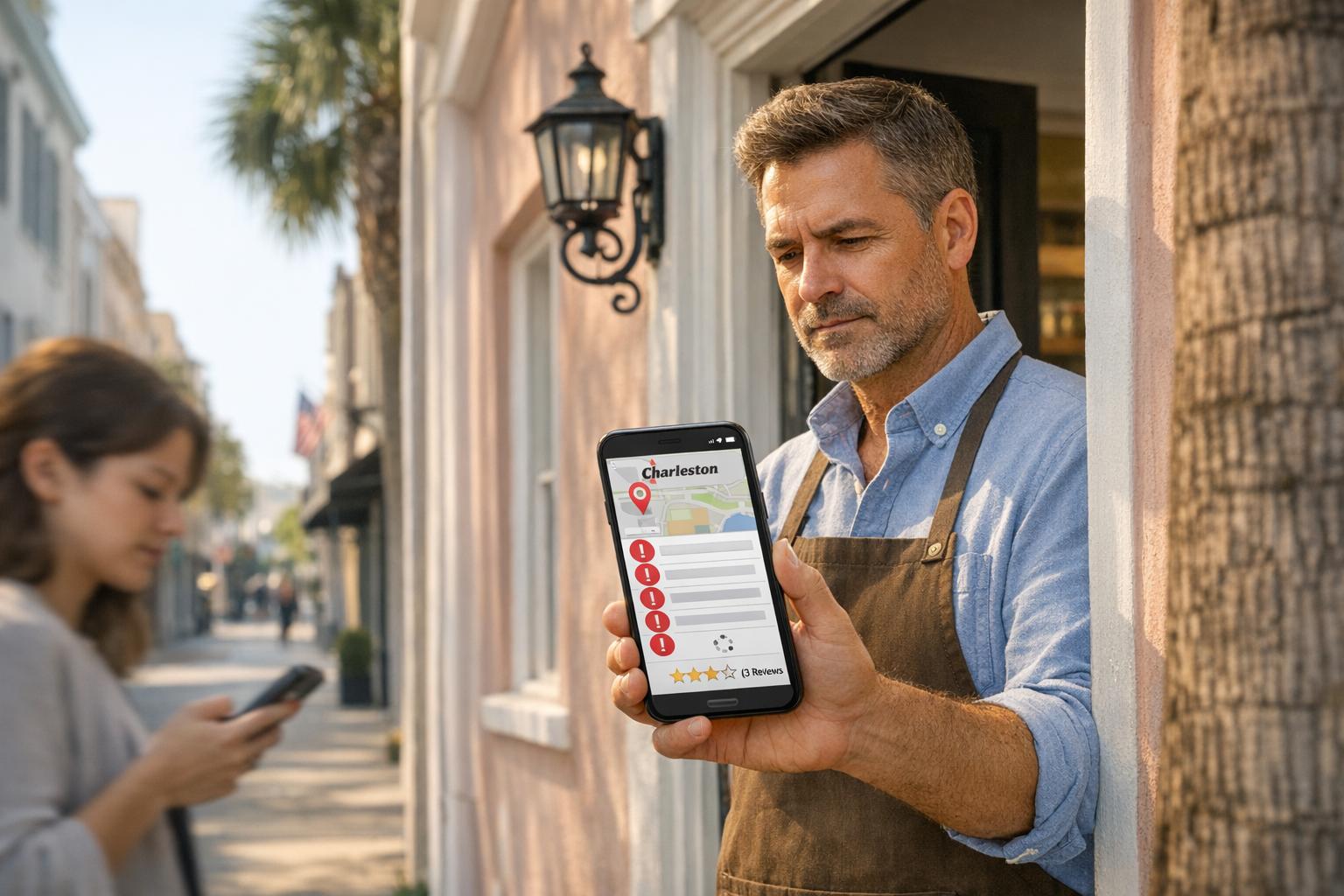
Want more customers finding your business online? Avoid these 7 common local SEO mistakes that could be driving them to your competitors.
Local SEO is critical for Charleston businesses, with nearly 46% of Google searches having local intent. If your business isn’t ranking in local search results, you’re missing out on valuable customers. Here are the top mistakes to avoid and how to fix them:
- Incomplete Google Business Profile: Only 35% of small businesses have fully optimized profiles. Missing details like hours, photos, or categories can hurt your visibility.
- Skipping Hyperlocal Keywords: Broad terms like "restaurant" won’t cut it. Use specific keywords like "best seafood in Charleston" to target local searches.
- Lack of Location-Specific Content: Mentioning local landmarks or neighborhoods on your site improves rankings and connects with your audience.
- Inconsistent NAP (Name, Address, Phone): Mismatched details across platforms confuse Google and customers, reducing trust and rankings.
- Ignoring Reviews: Reviews influence both rankings and customer trust. Responding to both positive and negative feedback is key.
- Poor Mobile Optimization: With 88% of local searches happening on mobile, a slow or clunky website can drive users away.
- No Local Business Schema Markup: Schema helps search engines understand your business details, improving visibility and engagement.
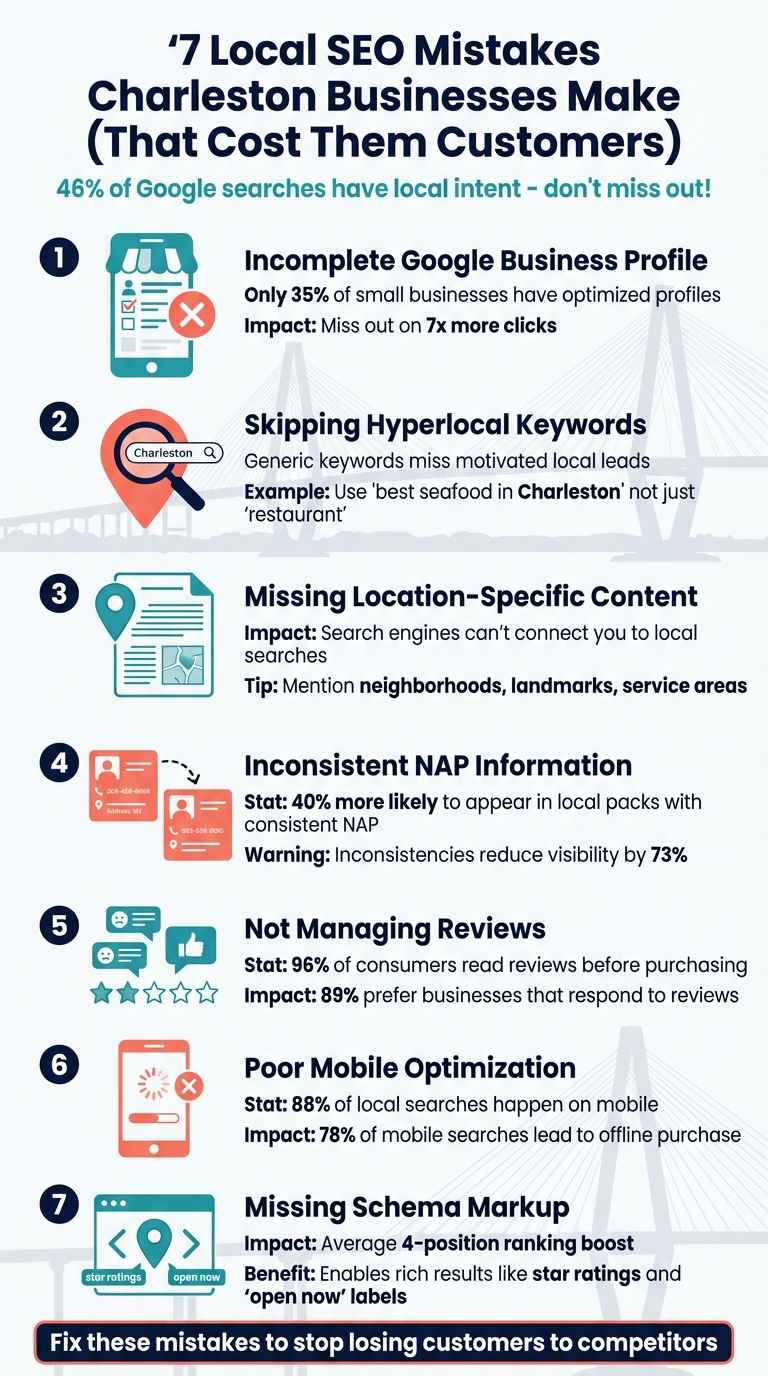
7 Local SEO Mistakes Charleston Businesses Must Avoid
7 Local SEO Mistakes That Are KILLING Small Business Owners
1. Not Optimizing Your Google Business Profile
Your Google Business Profile (GBP) is a game-changer for local visibility, yet only 35% of small-to-medium businesses actually have one. Many businesses in Charleston leave their profiles incomplete – missing photos, outdated hours, or unclear categories. This isn’t just a small oversight; it’s a major missed opportunity that can hold back your local search visibility.
Impact on Local Search Visibility
An incomplete profile can keep you out of the "Local 3-Pack" – those top three map results that dominate local searches in Charleston. For instance, if someone searches for "personal injury attorney" or "HVAC repair", Google bases much of the ranking on your primary category selection. Choosing something too broad, like "Law Firm", instead of "Personal Injury Attorney", means you’ll lose out to competitors with more specific categories.
Here’s another critical stat: over 60% of local searches now end without a website click. That means people are finding key info – like your phone number, hours, and directions – directly on your GBP. If those details are incomplete or incorrect, potential customers will simply move on to a competitor. And with 45% of consumers now using ChatGPT to find local businesses, your GBP data is becoming even more crucial for AI-powered recommendations. An incomplete profile essentially makes you invisible to these tools.
Ease of Implementation for Small Businesses
The good news? Optimizing your profile is straightforward and doesn’t require technical skills. Start by claiming and verifying your listing, then fill out every section – business description, menus, holiday hours, and any relevant attributes.
Don’t forget to upload fresh photos regularly. Profiles with photos get 42% more requests for directions than those without. If you’re a contractor, include images of your work alongside recognizable Charleston landmarks, like the Ravenel Bridge, to strengthen your local connection.
Effectiveness in Driving Local Customer Engagement
These simple updates can have a huge impact. Businesses with fully completed profiles see 7x more clicks than incomplete ones, and customers are 2.7x more likely to consider them trustworthy. Rachel Ellen, a Local Search Strategist at Croud, highlights the importance of getting your categories right:
"Correctly chosen categories help your listing show up in the right local searches. But get them wrong, or worse, leave out relevant ones, and you’re practically handing over visibility to your competitors."
Another key tip: respond to every review. A whopping 89% of consumers prefer businesses that reply to reviews, and 88% are more likely to choose those businesses. Small tweaks like these can make all the difference in standing out locally.
2. Skipping Hyperlocal Keyword Research
An optimized Google Business Profile is essential for local visibility, but hyperlocal keyword research is the key to targeting the specific needs of Charleston customers. Many businesses in the area make the mistake of focusing on broad keywords like "lawyer" or "restaurant", which often misses the mark for customers searching for services in their immediate vicinity.
Impact on Local Search Visibility
Hyperlocal keywords send a clear message to search engines that your business caters to specific needs in a defined geographical area. For example, when someone searches for "emergency plumber near King Street" or "best seafood in Charleston", Google prioritizes businesses that have optimized for these precise terms. Miriam Ellis, a Local Search Subject Matter Expert, puts it perfectly:
"The more effort you put into proper optimization, the stronger a signal you will send to both the public and search engines that the local brand you’re marketing can meet specific needs within a specific geography."
Using these keywords improves your ranking in local packs and increases visibility on platforms like Google Maps, voice search, and even AI-powered results. As customers increasingly expect hyperlocal, city-specific content, businesses that skip this step risk losing out on their most motivated leads.
Ease of Implementation for Small Businesses
The good news? Implementing hyperlocal keyword strategies is straightforward. Start by paying attention to the exact phrases your customers use. If you own an HVAC company, for instance, focus on terms like "AC repair Charleston" rather than generic industry jargon. Google’s "People Also Ask" section is another goldmine for discovering long-tail queries, such as "Thai restaurant open late night near me", offering insight into what locals are actively searching for.
Encourage your customers to include specific services or menu items in their reviews. Google uses this user-generated content to determine local rankings. A review highlighting "gluten-free options" or "emergency roof repair" can directly boost your visibility for those terms. These simple yet effective steps not only improve rankings but also foster stronger engagement with potential customers.
Effectiveness in Driving Local Customer Engagement
When used effectively, hyperlocal keywords can turn your Google Business Profile into a powerful tool for attracting customers. Incorporate these terms into your service descriptions, product listings, and menus to trigger "local justifications" – those snippets Google displays in its local pack to confirm your business’s relevance. For instance, a personal injury attorney targeting "Charleston personal injury lawyer" is far more likely to outperform competitors using vague, generic keywords.
Miriam Ellis emphasizes this point further:
"Keywords matter. But your larger goal is to become locally known for topics on which the business you’re marketing is recognized as an authority."
Instead of chasing broad, national keywords, focus on "Service + Location" combinations. For example, a West Ashley roofer optimizing for "Charleston roofer" or "emergency plumber near King Street" is far better positioned to attract qualified leads than one relying on overly general terms.
3. Missing Location-Specific Content
While hyperlocal keywords help target search queries, weaving in concrete local details strengthens your connection to the community and boosts your local authority.
Impact on Local Search Visibility
Many Charleston businesses miss a crucial ranking factor: location-specific content. When your website doesn’t include references to local neighborhoods, landmarks, or service areas, search engines struggle to associate your business with local searchers. This gap can cost you potential customers looking for services "near me" or in areas like West Ashley, Mount Pleasant, or downtown Charleston.
Amy Toman from Digital Law Marketing underscores this point:
"Concentrate on text for local optimization. As Google’s search experience refines over time, spotlighting the geographic area serviced should be a priority."
Without these specific geographic signals, even businesses located just a few blocks away from a customer may remain invisible in search results. Including such details helps search engines better connect your business to local searches, improving your chances of being found.
Ease of Implementation for Small Businesses
Adding location-specific content is both cost-effective and straightforward. Start by mentioning the neighborhoods you serve, local landmarks, and how your services address specific customer needs. For example, a roofing company could discuss solutions for Charleston’s coastal weather, while a restaurant might highlight dishes made with locally sourced ingredients.
Don’t forget to include unique details about your business that matter to the community. For instance, if your location has wheelchair accessibility, EV charging stations, or pet-friendly spaces, mention these features on your site. A downtown Charleston coffee shop could point out its proximity to Marion Square or its bike-friendly parking to attract local searchers. These small details enhance both user experience and local relevance.
Effectiveness in Driving Local Customer Engagement
Location-specific content doesn’t just help with rankings – it also creates a deeper connection with your audience. When a Charleston homeowner sees a service described as "historic home restoration in The Battery" instead of a generic "home restoration service", they immediately recognize your local expertise. This relevance builds trust and increases the likelihood they’ll choose your business.
The secret is to be genuine. Write about the Charleston neighborhoods you serve, the challenges your customers face, and how your business integrates into the local community. This strategy not only improves your visibility in search results but also resonates with customers who value businesses that understand their needs and their area.
4. Inconsistent NAP Information Across Directories
Impact on Local Search Visibility
Your business’s name, address, and phone number – commonly called NAP – serve as your online identity. When Google finds mismatched NAP details across various platforms, it creates confusion, often referred to as "identity conflict." This can hurt your rankings in the Local Pack, which is the map-based result that shows up prominently in local searches.
Businesses with consistent NAP details are 40% more likely to appear in local search packs, while inconsistencies can slash your local search visibility by up to 73%. Plus, incorrect information isn’t just bad for rankings – it’s bad for customer trust. A shocking 52% of consumers report leaving negative reviews after finding errors in online listings.
Akmal Faizan, Founder of Stech Local, sums it up perfectly:
"Local SEO is built on trust. If Google can’t match your identity across the web, nothing else you do reaches full strength."
For Charleston businesses, this issue can be especially damaging. Imagine a customer searching for "plumber near Marion Square" only to find your listing with an outdated King Street address or a disconnected phone number. That customer will likely move on to the next result, costing you both a ranking opportunity and a potential sale.
Ease of Implementation for Small Businesses
Fixing NAP inconsistencies is a key part of DIY SEO for small businesses and doesn’t have to be complicated. Start by creating a "source of truth" – a master document that includes your exact business name, a standardized address format (like using “St.” vs. “Street” consistently), and a single, reliable phone number for Charleston.
Focus on updating Tier 1 platforms first, such as:
- Google Business Profile
- Your website (header, footer, and contact page)
- Apple Business Connect
- Bing Places
- Yelp
These platforms carry the most weight and influence other directories across the web. To find outdated listings, try using Google search operators like "Your Business Name" + "Phone Number" to identify old or incorrect citations.
One thing to watch out for: dynamic call tracking numbers. While they’re helpful for tracking marketing campaigns, they can confuse Google by making your business identity appear inconsistent. Stick to a single phone number with a Charleston area code across all listings.
Once your NAP details are consistent, you’ll not only improve your rankings but also build trust with customers.
Effectiveness in Driving Local Customer Engagement
NAP consistency doesn’t just boost rankings – it directly impacts how customers interact with your business. For example, in June 2025, a Birmingham-based accounting firm standardized its address format across more than 50 directories. Within just 60 days, their visibility in "near me" searches jumped by 340%, and they saw a 45% increase in walk-in consultations. Similarly, a Milwaukee law firm corrected its NAP inconsistencies in early 2025 and experienced a 37% boost in local search visibility, climbing from #7 to #3 in the Local Pack within 90 days.
When customers see the same phone number and address across platforms like Google, Yelp, and your website, they’re more likely to trust your business. On the flip side, encountering multiple phone numbers or outdated addresses can drive away 68% of consumers who spot incorrect contact details online. Consistency is key to winning both rankings and customer confidence.
5. Not Managing Local Reviews
Impact on Local Search Visibility
Reviews play a big role in local search rankings, signaling trust and relevance to Google. When customers mention specific services or areas – like "best HVAC in Mount Pleasant" – their words act as cues that help Google connect your business to relevant searches. Just as optimizing your profile and keywords is important, staying on top of reviews is critical for maintaining visibility and tracking local search rankings. Consider this: 96% of U.S. consumers read reviews before making a purchase decision [26,27], and 50% will only consider businesses with a 4-star rating or higher. Ignoring reviews can lead to lower ratings and fewer clicks or calls, which tells Google your business might not be as active or relevant. Managing reviews ties directly into your overall local optimization strategy by building credibility.
Ease of Implementation for Small Businesses
For Charleston businesses, managing reviews doesn’t have to be complicated. Start by claiming your profiles on platforms like Google Business Profile, Yelp, and Facebook. Responding to reviews quickly is key, as customers expect timely interactions.
When dealing with negative reviews, keep your response short but meaningful: apologize, offer a solution, and provide a way to continue the conversation offline [31,32]. As Elizabeth Rule, SEO Analyst at Sterling Sky, points out:
"A reply that shows empathy and a genuine desire to make things right goes a long way. Every business gets bad reviews… What matters is how the business responds."
For positive reviews, thank customers personally and invite them to return [28,31]. Engaging with reviews not only builds trust – 89% of consumers are more likely to use a business that responds to feedback – but it can also turn things around. In fact, 63% of people will update a negative review if their issue is resolved.
Effectiveness in Driving Local Customer Engagement
Managing reviews actively can directly impact customer decisions. Nearly 97% of review readers also pay attention to how businesses respond, and 90% of consumers say a business’s response to feedback influences their decision. Thoughtful responses act as free advertising, showing professionalism without needing to sell.
It’s also much cheaper to keep an existing customer than to find a new one – retention costs can be up to 25 times lower. Plus, 62% of customers are willing to give a business another chance if their issue is resolved thoughtfully. Businesses that engage with reviews are also seen as 1.7 times more trustworthy than those that don’t.
To avoid raising red flags with spam filters, aim for a steady flow of 2–3 new reviews per week instead of sudden bursts. Train your team to ask satisfied customers for reviews via email or text (without offering incentives) and encourage them to mention specific services or locations. This helps strengthen your local relevance [26,28,29].
6. Poor Mobile Optimization for Local Searches
Impact on Local Search Visibility
These days, most Charleston customers rely on their phones to find businesses – 88% of local searches happen on mobile devices. If your website doesn’t load quickly or work smoothly on a smartphone, you’re likely losing potential customers before they even get a chance to explore what you offer.
Google’s mobile-first indexing means your site’s mobile performance directly affects its overall ranking. Danielle Birriel, Founder of D&D SEO Services, puts it plainly:
"Your business is being judged based on the mobile version of your site – not your desktop site".
A poorly performing mobile site can hurt your rankings and even knock your business out of the Local Pack. Actions like click-to-call and requesting directions are tracked by Google, and if users quickly leave your site (known as "pogo-sticking"), it sends a signal that your site may not meet quality standards. In Charleston’s competitive local market, mobile optimization is no longer optional – it’s essential.
Ease of Implementation for Small Businesses
With mobile-first indexing, speed is critical. But improving your mobile site doesn’t always mean starting from scratch. Focus on performance: aim for a load time under 2.5 seconds and a First Contentful Paint under 1.8 seconds. Simple fixes like compressing images using WebP, enabling lazy-loading, and minimizing CSS and JavaScript can significantly improve Core Web Vitals.
Make navigation easier by ensuring buttons and links are at least 48×48 pixels – perfect for thumb taps. Adding a tel: link allows users to call you with one tap. Stick with a single responsive design instead of creating a separate mobile site; it’s easier for both users and search engines to handle. For even better usability, consider moving your navigation bar to the bottom of the screen, where it’s easier to reach with one hand.
Effectiveness in Driving Local Customer Engagement
Mobile optimization directly influences sales. Seventy-eight percent of local mobile searches lead to an offline purchase, and half of mobile searchers visit a physical location within 24 hours. For Charleston businesses, this is huge – both tourists and locals exploring spots like King Street or the Historic District are using their phones to find services. They’re far more likely to choose a business with a fast, user-friendly mobile experience.
Optimizing your mobile site can also significantly increase conversions. A well-optimized mobile experience can boost conversion rates by up to 160%. For example, a local restaurant fixed small buttons and overlapping text on its site, improving mobile search visibility by 147% and tripling call volume within three months. Keep in mind, mobile users abandon slow-loading sites twice as fast as desktop users, and with over 80% of local business websites failing to meet Google’s mobile performance benchmarks, providing a seamless mobile experience is key to staying ahead.
7. Missing Local Business Schema Markup
Impact on Local Search Visibility
Schema markup acts like a translator, turning your business details into a format that search engines can easily read and interpret. Without it, search engines like Google have to do extra work to figure out basic information such as your business hours, location, or offered services. Adding schema markup can give your rankings a boost – on average, by about four positions – and unlock rich search results like star ratings and "open now" labels that make your listing pop. Even voice assistants like Siri and Alexa use schema data to answer questions like, "What time does the nearest hardware store close?". This small technical tweak pairs perfectly with other local SEO strategies, helping you get noticed while driving more engagement.
Ease of Implementation for Small Businesses
Good news: you don’t need to hire a developer to set up schema markup. Free tools and WordPress plugins like Yoast or Rank Math make the process straightforward. Once you’ve generated the code, simply paste it into your website’s <head> section. To give search engines a clearer picture of your business, opt for specific schema types like Restaurant, Dentist, or Plumber instead of the generic "LocalBusiness" tag.
Don’t forget to include your business’s exact geo-coordinates (latitude and longitude) and double-check your work using Google’s Rich Results Test to catch any errors. Also, ensure that the information in your schema matches what’s publicly visible on your website. Any inconsistencies could lead to penalties from search engines.
If you’re unsure where to start, check out our guide on How to Add Local Business Schema Markup for a step-by-step walkthrough.
Effectiveness in Driving Local Customer Engagement
Schema markup doesn’t just help with rankings – it also improves how customers interact with your business. Rich results like star ratings and operating hours build trust and encourage users to take action. For businesses in Charleston, for example, providing accurate, real-time details like "Open Now" can make all the difference when someone is deciding where to go next.
Consistency is key. Make sure your schema’s NAP (Name, Address, Phone) matches the details in your Google Business Profile to reinforce trust with search engines. By setting up schema correctly, you’re not only climbing higher in search results but also creating a smoother path for customers to choose you.
How SearchX Helps Charleston Businesses with Local SEO
SearchX focuses on a local-first strategy tailored specifically for businesses in Charleston. By analyzing local trends, customer behavior, and the competitive environment of the Holy City, they craft data-driven plans that align with each business’s goals. Addressing common issues like incomplete profiles and inconsistent NAP (Name, Address, Phone) details, SearchX ensures businesses can shine in local searches. This approach directly tackles the local SEO challenges mentioned earlier.
"Our local insight helps us build an efficient, data-driven marketing strategy and engaging content for your business." – SearchX
One of their standout offerings is a free SEO audit. This audit identifies weak spots across profiles and technical SEO, providing a clear roadmap to improve rankings on Google Search and Maps.
The results speak for themselves. In 2025, a Charleston plumbing company partnered with SearchX and tripled its monthly calls, boosting revenue within just six months. This was achieved by targeting high-intent "near me" keywords and optimizing their Google Business Profile. Another success story features a Charleston event rental company that secured the #1 local search ranking in the same timeframe, significantly increasing website traffic and bookings.
SearchX offers flexible pricing plans to meet different business needs. The Starter plan begins at $3,000/month, while the Growth plan is priced at $6,000/month, and the Enterprise plan starts at $12,000+/month for more aggressive campaigns. These plans include features like in-depth technical audits, additional content creation, and advanced tracking.
"Lorenz and his team actually listened and kept it simple. A few months in, traffic’s up and new customers are finding us." – Donovan Houston, Small Business Owner in Charleston
Conclusion
Local SEO mistakes can seriously hurt your business, especially in a place like Charleston where 46% of all Google searches have local intent. If you’re guilty of any of the seven mistakes outlined earlier, you might be driving potential customers straight to your competitors.
The good news? These issues are fixable. Start by optimizing your Google Business Profile with complete details and high-quality photos. Businesses that do this see 7x more clicks. Next, focus on hyperlocal keywords – use the terms Charleston residents are actually searching for. Ensure your NAP (Name, Address, Phone number) information is consistent across all directories. Don’t forget to respond to reviews, make your site mobile-friendly, create content tailored to your location, and use local business schema markup. These steps are the foundation for improving your local SEO presence.
Need help? Check out our DIY Local SEO guides and schema markup tutorials. Or, take advantage of SearchX’s free SEO audit to uncover areas that need attention.
Act now to fix these mistakes and keep customers from turning to your competitors.
FAQs
Which local SEO fix will bring results fastest?
Optimizing your Google Business Profile is the fastest way to improve your local SEO. Start by making sure all your business details – like name, address, phone number, and hours – are accurate and up-to-date. Upload high-quality photos that showcase your business, as visuals can grab attention and leave a strong first impression.
Don’t overlook reviews! Actively manage them by responding to both positive and negative feedback. Engaging with reviews shows potential customers that you care, while also signaling trustworthiness to Google. These simple steps can directly increase your visibility and bring in more local customers.
How can I find the best Charleston “near me” keywords?
To discover the most effective Charleston "near me" keywords, start by exploring local search terms with tools like Google Autocomplete or Keyword Planner. Look for phrases that people in your area are likely searching for, such as "plumber in Charleston" or "best bakery near me."
You can also get more specific by including hyper-local keywords that mention neighborhoods or detailed services. For example, instead of just "Charleston bakery", try targeting terms like "artisan bakery in West Ashley" or "emergency plumber in Mount Pleasant." These details help you connect with high-intent local searches and stand out in your community.
What schema markup should my business use?
Your business can benefit from using LocalBusiness schema markup to highlight essential details such as your physical address, operating hours, and contact information. This not only boosts your visibility in local search results but also ensures search engines present accurate and reliable information about your business to potential customers.
Related Blog Posts
- Is Your Charleston Website Ready for Local SEO? Use This 10-Point Checklist
- Charleston Google Business Profile Hacks for Local Visibility
- Local SEO South Carolina Checklist: 10 Steps to Higher Rankings
- Charleston SC SEO in 2025: Why 47% of Local Businesses Are Switching Strategies (And You Should Too)