

AI-driven search is changing the game. Search engines no longer prioritize simple keyword matches; instead, they focus on user intent and authoritative content. To stay competitive, your website must power AI-generated answers by combining structured data and technical SEO. Here’s why this matters:
- Structured Data: Helps AI systems understand your content by labeling entities (like products, people, or organizations) using formats like JSON-LD and schemas like FAQPage or Product. Websites using structured data see up to a 43% boost in AI visibility.
- Technical SEO: Ensures your site is fast, crawlable, and mobile-friendly. Core Web Vitals (e.g., LCP ≤ 2.5s, INP ≤ 200ms) and proper robots.txt or XML sitemaps are critical for AI crawlers.
- AI Visibility Metrics: Success is now measured by how often AI cites your content, not just traditional rankings. Pages cited by AI enjoy higher engagement and conversion rates.
Structured Data: Helping AI Understand Your Content
What Is Structured Data?
Structured data, often implemented with JSON‑LD and Schema.org vocabulary, labels content like articles, authors, and prices in a way that AI systems can easily interpret. While traditional search engines used schema as static metadata for rich snippets, modern AI platforms like ChatGPT and Gemini take it further. They analyze semantic relationships and build knowledge graphs to identify entities such as people, places, and products.
"In the AI era, visibility is no longer about ranking #1. It’s about becoming the citable, authoritative source that AI systems trust and reference".
The results are clear: websites using comprehensive schema markup see a 43% boost in visibility within AI-driven responses compared to those that don’t. Still, only 30% of websites currently take advantage of structured data. This labeling not only makes your content more accessible to AI but also sets the stage for advanced SEO strategies.
Schema Types That Improve AI Visibility
Certain schema types are particularly useful for increasing AI visibility. These include Organization, Article, BreadcrumbList, FAQPage, HowTo, Product, and LocalBusiness schemas.
Schemas like FAQPage and HowTo are designed for conversational queries, making them perfect for AI-generated answers. Product schema, which includes details like variants and shipping, is essential for AI shopping recommendations. For businesses targeting local audiences, LocalBusiness schema delivers location-specific data directly to AI platforms.
| Schema Type | AI & GEO Benefit |
|---|---|
| Organization | Defines the brand as a key entity; forms the foundation of the entity graph |
| Person | Highlights experts as entities; provides clear E-E-A-T signals |
| Article | Links authors and publishers; aids in AI citations |
| FAQPage | Structures Q&A for direct AI extraction into summaries |
| Product | Details price, availability, and reviews for AI shopping suggestions |
| LocalBusiness | Supplies location data for AI-driven local search results |
Real-world examples show the effectiveness of structured data. Nestlé saw an 82% higher click-through rate (CTR) for pages with rich results compared to those without. Rotten Tomatoes achieved a 25% CTR boost by adding structured data to 100,000 pages, and The Food Network increased visits by 35% after applying search features to 80% of its content. These schema types work together to enhance your site’s credibility and lay a strong foundation for technical SEO.
How to Implement Structured Data Correctly
To optimize for AI-driven search, your structured data needs to be both thorough and accurate. JSON‑LD is the recommended format due to its simplicity. Use canonical @id URLs (e.g., https://example.com/#org) to prevent entity fragmentation.
Include all recommended properties, not just the required ones, to give AI systems the depth they need for precise retrieval and citation. Ensure that you only mark up visible content to avoid spam penalties.
Validation is key. Use tools like Google’s Rich Results Test and the Schema.org Validator to confirm your structured data is accurate and eligible for rich results. Since many AI crawlers struggle with JavaScript, make sure your structured data is rendered server-side or through dynamic rendering tools. Additionally, the sameAs property can link your Organization or Person entities to trusted profiles like Wikipedia or LinkedIn, helping AI systems build a unified trust graph.
Case studies highlight the impact of proper implementation. A local HVAC company increased leads by 420% and generated $180,000 in revenue using LocalBusiness and Service schemas. Similarly, a law firm that adopted Attorney and LegalService schemas saw a 312% rise in case inquiries over 18 months, resulting in $420,000 in new case value.
Technical SEO: Core Elements for AI Rankings
Site Speed and Core Web Vitals
AI crawlers like GPTBot and ClaudeBot are quick to abandon pages that load slowly or throw up 404 errors, often skipping over them entirely during indexing. Fast-loading pages not only make a better impression on these crawlers but also signal reliability and quality, which directly influence how AI platforms evaluate your content.
"AI crawlers are often less patient than Googlebot. They’ll bail if your page loads slowly or triggers 404s." – Alicia Sandino, Linkflow.ai
Core Web Vitals have shifted from being "nice-to-have" to absolutely necessary for AI visibility. Between 2022 and 2025, top-ranking pages upped their performance scores by 20%, even as their page sizes grew by 43%. Responsiveness metrics saw an even bigger leap, improving by 50% over the same period. In 2025, Interaction to Next Paint (INP) replaced First Input Delay (FID) as the go-to metric for measuring responsiveness, making it essential to focus on overall page interactivity.
Here’s what to aim for:
- LCP (Largest Contentful Paint): under 2.5 seconds
- INP (Interaction to Next Paint): under 200 milliseconds
- CLS (Cumulative Layout Shift): below 0.1
Switching to modern image formats like WebP or AVIF can shrink file sizes by 40–80%. For websites heavy on JavaScript, consider Server-Side Rendering (SSR) or prerendering tools to deliver fully rendered HTML. Also, defer non-critical JavaScript to avoid blocking the main thread. To reduce latency, optimize Time to First Byte (TTFB) with fast hosting or a Content Delivery Network (CDN) – a must for AI bots with tight time constraints.
| Metric | Target Threshold | Impact on AI Search |
|---|---|---|
| LCP (Largest Contentful Paint) | < 2.5 seconds | Ensures content is visible before crawler timeouts |
| INP (Interaction to Next Paint) | < 200 milliseconds | Reflects a smooth and responsive user experience |
| CLS (Cumulative Layout Shift) | < 0.1 | Prevents layout shifts that can signal poor quality |
| TTFB (Time to First Byte) | Minimal latency | Critical for AI bots with strict time limits |
Once speed and interactivity are in check, focus on ensuring AI crawlers can easily navigate your site.
Crawlability: Robots.txt and XML Sitemaps
The robots.txt file acts as a gatekeeper, deciding which parts of your site AI crawlers can access. Without proper crawl budget management, valuable server resources could be wasted on unimportant pages, leaving high-priority content overlooked. For perspective, OpenAI’s GPTBot alone generates about 569 million monthly requests, with Anthropic’s ClaudeBot following at 370 million.
XML sitemaps are equally vital, providing structured metadata that AI systems rely on to prioritize and understand your content. They clarify your site’s architecture and topic relationships, which is especially important for Retrieval-Augmented Generation (RAG). Always include accurate <lastmod> timestamps and <changefreq> tags (e.g., "daily" or "weekly") for high-value pages. To avoid confusion, only list canonical URLs, and keep each sitemap under 50,000 URLs. For larger sites, splitting sitemaps by category can help.
With crawlability sorted, the next step is to refine your mobile experience.
Mobile Optimization and Mobile-First Indexing
Google’s shift to mobile-first indexing is now effectively mobile-only. Websites that fail to deliver a strong mobile experience face steep ranking penalties. With over 60% of web searches happening on mobile devices – and AI platforms like ChatGPT and Google’s Gemini driving 78% of AI search traffic – getting mobile optimization right is non-negotiable.
To ensure AI crawlers can extract meaningful information, use semantic markup with clear H1-H6 hierarchies, lists, and tables. This is especially important since most AI bots retrieve HTML snapshots without executing client-side JavaScript.
Steps to optimize for mobile include:
- Making all clickable elements and navigation targets at least 44×44 px
- Using a minimum font size of 16 px for body text
- Applying fluid CSS and proper viewport settings to eliminate horizontal scrolling
- Avoiding intrusive pop-ups or interstitials that block main content, as these can lead to ranking penalties
Speed and clarity are key values for AI, and an optimized mobile experience ensures your site performs consistently across all devices.
SearchX offers technical SEO services to help fine-tune these critical elements, ensuring your site meets AI crawler requirements while delivering a seamless mobile experience.
How Structured Data and Technical SEO Work Together
Entity Recognition and Content Relationships
When technical SEO meets structured data, it creates a powerful combination that enhances both discovery and semantic clarity – two things AI search algorithms thrive on. Think of technical SEO as the foundation: it ensures AI crawlers can access your site. Structured data, on the other hand, acts like a translator, turning your content into a format that machines can easily interpret. Together, they make your site both accessible and understandable.
Structured data organizes chaotic HTML into clear, machine-readable facts, giving AI systems the tools they need to identify entities – like people, places, products, or organizations – and understand their relationships within a Knowledge Graph. This structured approach helps AI shift its focus from isolated keywords to a deeper understanding of entities and their connections.
"Technical SEO factors… function more as prerequisites than ranking drivers… they create the conditions that make content easier for AI systems to retrieve, interpret, and cite." – Nitin Manchanda, Founder, Botpresso
This shift is significant. For example, large language models (LLMs) that rely on structured data and Knowledge Graphs can be up to 300% faster and more accurate than those using unstructured text. A real-world example? In late 2025, Brightview Senior Living used Schema App’s External Entity Linking feature to connect their content to authoritative knowledge bases. The result? A 25% increase in clicks for non-branded queries related to the "assisted living" entity.
| Feature | Technical SEO Role | Structured Data Role |
|---|---|---|
| Discovery | Ensures robots.txt and sitemaps allow AI bot access | Identifies content type (e.g., FAQ, HowTo) |
| Understanding | Provides clean HTML and clear site hierarchy | Defines entities (e.g., Organization, Product, Person) |
| Rich Results | Optimizes page speed for better rendering | Activates rich results |
| AI Citable Signals | Ensures mobile-friendliness and fast loading | Provides context for AI-generated summaries |
This collaboration between technical SEO and structured data lays the groundwork for optimizing AI-specific search features.
Optimizing for AI-Driven Search Features
Building on this foundation, websites cited by Google AI Mode often show higher use of schema types like Organization (34%), Article (26%), and Breadcrumb (20%). Pairing schema with fast-loading pages, mobile-first designs, and clear URLs significantly increases the chances of being cited by AI systems.
With mobile traffic accounting for 81% of Google AI citations, mobile optimization and schema markup have never been more critical. Even small details like URL structure matter – URLs with slug lengths of 17–40 characters tend to perform best in AI citations. Open Graph markup also plays a role, appearing on 60% of pages cited by Google AI Mode and 40% of those cited by ChatGPT.
Over half of AI-cited sources rank in the top 10 search results, emphasizing the importance of a solid technical foundation. Pages with fast load times, mobile-friendly designs, descriptive URLs, and clear schema markup consistently gain favor with AI platforms. For structured data, JSON-LD is the recommended format since it’s Google’s preferred method and easily understood by large language models.
"Structured data is not just about SEO anymore – it’s about building the semantic layer that enables AI." – Martha van Berkel, CEO and Co-founder, Schema App
To make the most of these strategies, tools like SearchX can help you audit and refine both your technical SEO and structured data. By identifying and addressing gaps, these tools ensure your site is ready to maximize its visibility in AI-driven search results.
Boost Your SEO with Structured Data: Beginner’s Guide to Schema Markup
Measuring Results: ROI from Structured Data and Technical SEO
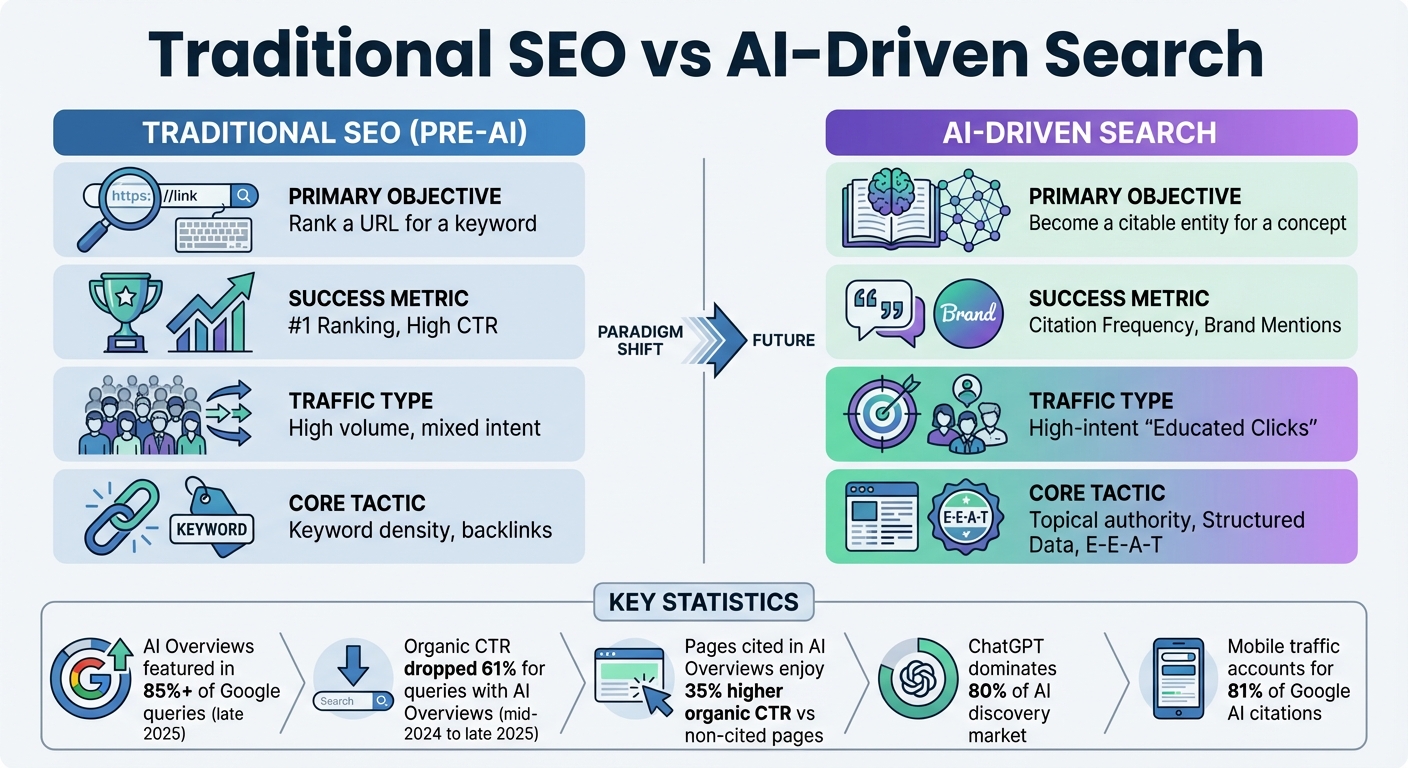
Traditional SEO vs AI-Driven Search: Key Metrics and Goals Comparison
Key Metrics for AI Visibility
In today’s search landscape, success depends on how often AI platforms cite your brand as a trusted source. By late 2025, AI Overviews were featured in over 85% of Google queries, significantly shifting the importance of traditional click-through rates (CTR). Organic CTR for queries with AI Overviews dropped by 61% between mid-2024 and late 2025.
However, pages cited in AI Overviews enjoy a 35% higher organic CTR compared to non-cited pages on the same search results page. This has given rise to a new metric called "educated clicks" – visitors who come to your site already informed by AI about your brand. These users often exhibit higher engagement, lower bounce rates, and quicker conversions. To measure this, track these visitors separately in your analytics and compare their conversion rates to those of traditional organic traffic.
Other crucial metrics include AI crawl frequency, which can be monitored by analyzing log files to see how often bots like OAI-SearchBot visit your site and which pages they prioritize. Additionally, pay attention to entity recognition – whether Google’s Knowledge Graph identifies your brand as a distinct entity rather than just a keyword. Finally, maintaining strong Core Web Vitals (LCP ≤ 2.5s, INP ≤ 200ms, CLS ≤ 0.1) is essential, as these metrics act as trust signals for AI systems. Even if organic clicks are low, monitoring impressions in Search Console can reveal if your content is contributing to AI summaries.
| Metric | Traditional SEO Goal (Pre-AI) | AI-Driven Search Goal |
|---|---|---|
| Primary Objective | Rank a URL for a keyword | Become a citable entity for a concept |
| Success Metric | #1 Ranking, High CTR | Citation Frequency, Brand Mentions |
| Traffic Type | High volume, mixed intent | High-intent "Educated Clicks" |
| Core Tactic | Keyword density, backlinks | Topical authority, Structured Data, E-E-A-T |
These metrics pave the way for understanding the measurable returns of combining structured data with technical SEO.
Before and After: Comparing Optimization Results
Case studies reveal how targeted schema updates and technical improvements lead to measurable returns, validating earlier strategies. For instance, a local HVAC company achieved a 420% ROI over 12 months by implementing LocalBusiness and Service schema alongside content clusters focused on "emergency AC repair." This effort resulted in a 285% boost in organic traffic and $180,000 in new revenue.
Similarly, a law firm saw a 312% ROI over 18 months by deploying Attorney and LegalService schema and enhancing E-E-A-T signals with detailed author bios. This approach led to a 312% increase in case inquiries, generating an estimated $420,000 in new case value. Even more striking, an online retailer achieved a 2,300% ROI by adding Product and Review schema across its catalog. This resulted in an 1,850% surge in organic traffic and rich results for over 80% of its products.
"Visibility is no longer about ranking #1. It’s about becoming the citable, authoritative source that AI systems trust and reference." – Travis Wilkie, Founder, Phoenix SEO Geek
When assessing your own results, compare organic traffic, lead volume, and revenue before and after implementing schema updates. Tracking branded search growth can also be revealing – brands frequently cited by AI often see their branded queries double. Additionally, technical improvements such as faster server response times (which improved by 32% for top-ranking pages between 2022 and 2025) can indirectly boost ROI by increasing your likelihood of being cited.
Using SearchX Tools for SEO Tracking and Audits
Real-time monitoring of these metrics ensures your SEO strategy stays in sync with AI-driven search trends. SearchX offers a range of tools to help you track and optimize structured data and technical SEO performance. The Free Website Audit Tool provides an instant breakdown of technical and content performance, highlighting gaps in schema implementation, Core Web Vitals, and crawlability that could hinder AI platforms from citing your content.
For ongoing optimization, SearchX’s Technical SEO Services include regular audits of robots.txt files, XML sitemaps, and mobile performance – key factors for AI visibility. The platform also allows you to track SEO metrics specific to AI-driven search, such as citation frequency across major platforms like ChatGPT (which dominates with 80% of the AI/LLM discovery market), Perplexity (11%), and Microsoft Copilot (5%).
For businesses focusing on local schema, the Local Business Schema Markup guide provides step-by-step instructions. Additionally, the SEO ROI measurement tools help quantify the financial impact of structured data investments. Enterprise clients on the $12,000+/month plan gain access to dedicated AI visibility tracking dashboards, enabling real-time measurement and optimization of citation frequency.
This detailed analysis connects your strategy implementation to the next steps in preparing for AI-driven search.
Conclusion: Preparing for AI-Driven Search
This guide has highlighted how structured data and technical SEO can position your website for success in the era of AI-driven search. The evolution from traditional keyword rankings to AI-based citations marks a significant shift in how search engines operate. Technical SEO lays the groundwork, ensuring AI crawlers can effectively access, render, and interpret your site’s content. Meanwhile, structured data adds a semantic layer that helps AI systems recognize your brand as a credible source.
The focus has shifted. Instead of obsessing over ranking #1 for keywords, the goal is to become the go-to source that AI platforms cite when responding to user queries. This means prioritizing key schema types – like Organization, Article, and BreadcrumbList – while ensuring your site meets Core Web Vitals benchmarks (e.g., LCP ≤ 2.5 seconds, INP ≤ 200 milliseconds). Structuring content in an answer-first format also makes it easier for AI models to extract and use your information effectively. These technical elements are essential for redefining success in AI-driven search.
Success metrics are evolving, too. With organic click-through rates dropping by 61% for queries featuring AI Overviews, traditional traffic metrics are no longer enough. Instead, businesses should monitor how often their content is cited across platforms like ChatGPT, which dominates about 80% of the AI discovery market. Additionally, tracking "educated clicks" – users who engage with your site after being informed by AI summaries – provides a clearer picture of your impact.
To stay ahead, tools like SearchX’s Technical SEO Services and Free Website Audit Tool can help identify areas for improvement, from schema implementation to crawlability and mobile performance. For those ready to take it a step further, the Enterprise plan includes real-time dashboards to track citation frequency across major AI platforms.
Ultimately, businesses that excel in AI-powered search are those trusted by AI systems. By auditing your technical SEO, implementing essential schema types, and structuring content for easy AI extraction, you can build a solid foundation for visibility. As Tomasz Rudzki, SEO researcher, puts it:
"The higher you rank in Google’s top 10, the more likely you are to appear in AI search results across platforms".
Lay this groundwork to ensure your business thrives in the AI-driven search landscape.
FAQs
How does structured data help improve visibility in AI-powered search results?
Structured data acts as a clear, machine-readable summary of your webpage’s content, outlining key entities and their relationships. This allows search engines to better interpret your content, making it eligible for features like AI Overviews and citations, which can boost its visibility in search results.
Using tools like schema markup, structured data helps search engines identify and highlight important details on your page. This can improve your chances of being featured prominently in AI-powered search results, enhancing your content’s reach and impact.
What are the most important technical SEO factors for improving AI search rankings?
Technical SEO is crucial for ensuring that AI search engines can effectively understand and trust your website. Unlike traditional search engines that rely heavily on keywords, AI-driven platforms prioritize clear, machine-readable signals. This makes a solid technical foundation key to achieving better rankings in AI-generated search results.
Here are some essential elements to focus on:
- Crawlability and Indexation: Make sure your site is easy for AI crawlers to navigate. This includes maintaining a clean
robots.txtfile, using accurate canonical tags, and keeping your XML sitemaps up to date. - Site Speed and Structure: Fast load times, minimal redirects, and a straightforward URL structure not only improve user experience but also make your site easier for AI systems to process.
- Mobile Optimization: With mobile-first indexing becoming the standard, a responsive design and mobile-friendly features are non-negotiable.
- Structured Data: Implement schema markup, such as Organization or Article schema, to provide clear, machine-readable descriptions of your content.
- Error-Free Technical Health: Fix broken links, address duplicate content issues, and ensure your site uses HTTPS for secure browsing. These steps help establish trust with AI platforms.
By addressing these technical aspects, businesses can enhance their online visibility and increase the chances of their content being featured in AI-powered search results.
Why is mobile optimization important for AI-driven search rankings?
Mobile optimization is a game-changer when it comes to boosting your website’s visibility in AI-driven search results. Why? Because AI-powered search engines give priority to pages that load fast, are easy to navigate, and deliver a smooth experience on mobile devices. If your site performs well on smartphones, it sends a signal of reliability and trust, increasing your chances of being featured in AI-generated answers.
With the majority of users now searching on their phones, mobile-friendly websites get the edge. AI algorithms are designed to favor sites that offer fast, accurate, and user-friendly experiences. In today’s AI-driven search world, a well-optimized mobile experience isn’t just a nice-to-have – it’s the baseline for ranking higher.