
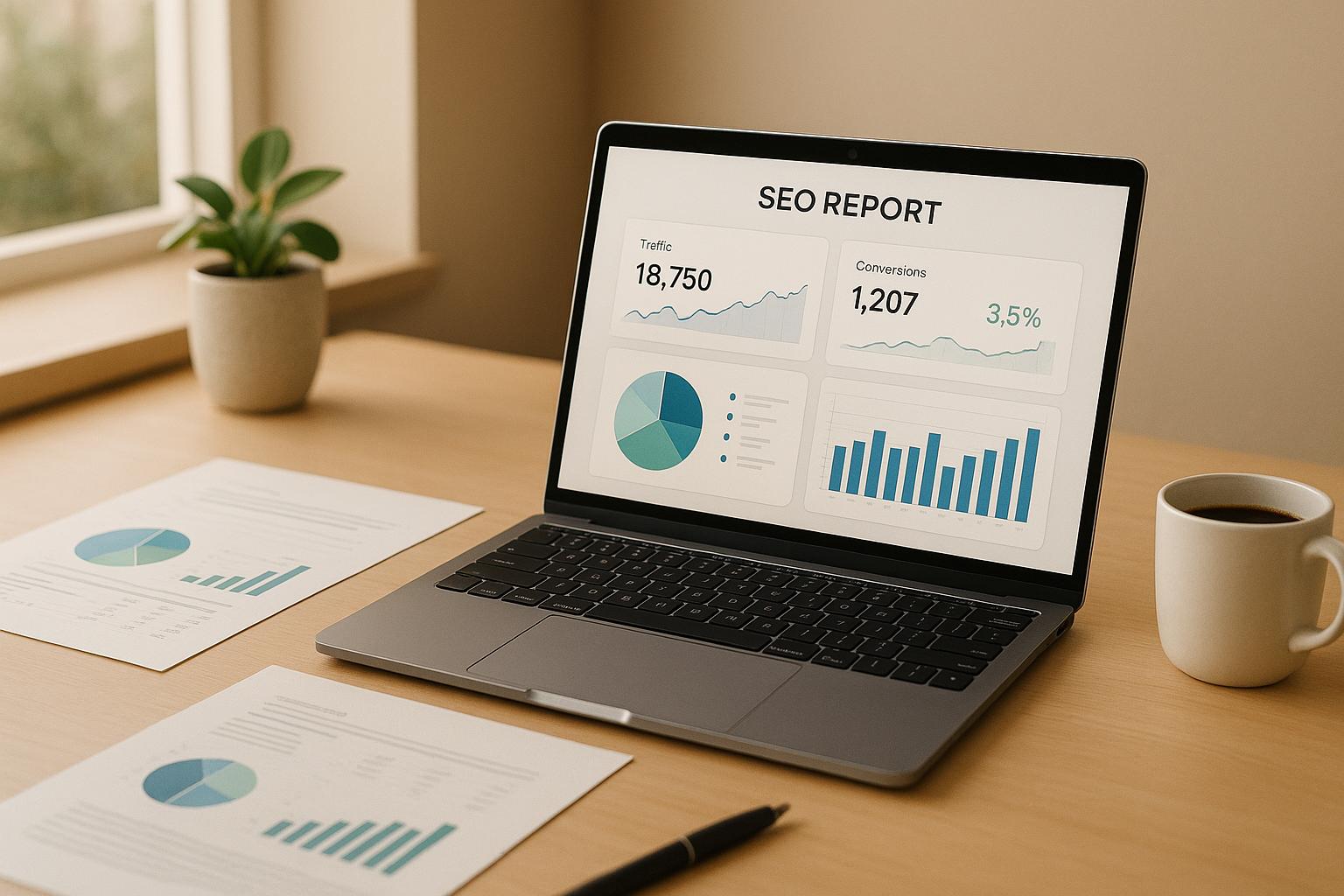
SEO reports for executives should focus on what matters most: revenue, leads, and market share. Executives don’t need technical jargon or vanity metrics – they need clear, actionable insights that show how SEO impacts the bottom line.
Here’s the key to crafting effective SEO reports:
- Prioritize business outcomes: Highlight metrics like organic revenue, conversions, and ROI.
- Keep it concise: Use an executive summary and visuals to deliver insights in under five minutes.
- Tie metrics to goals: Show how SEO drives growth, reduces costs, and outperforms competitors.
- Actionable next steps: End with clear priorities that align with business objectives.
Focus on presenting data in a clean, structured format that executives can quickly understand and act on.

4-Step Process for Building Executive SEO Reports That Drive Results
Steal Our SEO Report Dashboard (Structure & Outline)
Set Clear Objectives and KPIs
Before diving into data, define what success looks like. Clear objectives serve as the bridge between raw SEO data and the strategic insights that decision-makers in the boardroom care about. Executives are focused on outcomes like revenue growth, customer acquisition, lead generation, and market share expansion – not the nitty-gritty of technical SEO details. Your KPIs should directly answer whether organic search efforts are driving these key business outcomes.
Each metric you report should tie back to a tangible business result. For example, you might report that organic sessions contributed to 25% of total revenue, comparing performance on a quarterly and yearly basis. For customer acquisition, track SQLs (Sales Qualified Leads) and MQLs (Marketing Qualified Leads) generated through SEO content. A sample metric could be: "A 20% increase in leads from top-performing content assets". While B2B companies might focus on metrics like revenue, SQLs, MQLs, and visitor growth, B2C organizations typically emphasize revenue, conversions, visitor numbers, and market share.
Stay away from vanity metrics, like raw keyword rankings, unless you can connect them to a meaningful outcome. For instance, instead of simply reporting improved rankings for "buy widgets online", frame it as: "Improved rankings for ‘buy widgets online’ drove a 15% increase in traffic, resulting in $50,000 in sales". Highlight non-branded traffic contributions as well – such as "40% of total traffic came from non-branded searches" – to underscore SEO’s role in reaching new audiences.
Connect SEO Metrics to Business Goals
Show how SEO efforts directly impact the business by illustrating the conversion funnel – from organic sessions to visitors, conversions, and ultimately revenue. Use specific numbers and visual aids, like charts, to make the progression clear. For example, you might report: SEO-driven revenue reached $200,000 (a 30% year-over-year increase), organic sessions hit 75,000 (a 15% quarter-over-quarter growth), and SEO ROI stands at 5:1 – every $1 invested delivers $5 in revenue. These kinds of metrics resonate with executives because they translate SEO performance into dollars, growth percentages, and return on investment.
Build a KPI Comparison Table
A KPI comparison table can make performance tracking straightforward and visually impactful. Include columns for Metric, Current Value, Target Value, and Variance, and use color coding – green for hitting targets, red for falling short. Here’s an example:
| Metric | Current Value | Target Value | Variance |
|---|---|---|---|
| Organic Revenue | $120,000 | $150,000 | -20% |
| Organic Sessions | 50,000 | 60,000 | -17% |
| Conversions | 2,500 | 3,000 | -17% |
| SEO ROI | 4.2:1 | 5:1 | -16% |
Keep your table concise, focusing on 5–8 core KPIs that align with business goals. Pull current data from tools like Google Analytics, set realistic targets based on historical trends (e.g., aiming for 20% year-over-year growth), and calculate the variance as (Current - Target) / Target × 100. To make the table even more actionable, add visual indicators like arrows to show trends and include a brief summary when applicable, such as "Revenue target exceeded by 10%".
With these KPIs in place, you’ll have a solid foundation for gathering and verifying data in the next steps. These metrics ensure your efforts stay aligned with measurable business outcomes, making your SEO strategy both effective and easily understood.
Collect and Organize Your Data
Once you’ve set your KPIs, the next step is gathering the right data. The trick here is to rely on a few trusted sources and present the information in a way that makes trends easy to understand for executives. Most SEO reports pull data from three main platforms: Google Analytics 4 (GA4) for on-site behavior and conversions, Google Search Console (GSC) for search performance, and an SEO tool like Ahrefs or Semrush for backlink insights and competitor analysis.
Primary Data Sources
Start with GA4 to track metrics like organic sessions, user engagement, conversions, and revenue attribution. Then, use Google Search Console to extract data on impressions, clicks, click-through rates (CTR), and average keyword positions. GSC is especially useful for identifying the keywords driving visibility and spotting your top-performing landing pages. Finally, layer in data from an SEO platform such as Ahrefs or Semrush to monitor keyword rankings, backlink growth, domain authority, and how your brand stacks up against competitors. For instance, your report might include:
"Acquired 150 new links from 50 domains, boosting DR by 5 points".
To keep your reporting consistent, establish a fixed schedule – monthly or quarterly – with standardized filters, segments, and MM/DD/YYYY date ranges. Always include comparison periods (month-over-month, quarter-over-quarter, and year-over-year) to highlight trends. If managing GA4, GSC, and SEO platforms feels overwhelming for your team, consider partnering with an agency like SearchX. They can build automated dashboards, define KPIs, and maintain consistent reporting templates.
Once your data is organized, shift focus to the metrics that align with executive goals.
Choose Metrics That Matter to Executives
Executives care about business outcomes, so focus on metrics that tie directly to revenue, leads, or other tangible results. Highlight trends in organic traffic, top keyword rankings, conversion rates, backlink growth, and revenue attribution. Instead of just listing traffic numbers, frame the data in terms of impact. For example:
"Organic traffic from product pages increased 20%, driving an estimated additional $45,000 in revenue this month".
Avoid vanity metrics like impressions alone. Instead, emphasize metrics that show the value of non-branded traffic, qualified lead generation (SQLs/MQLs), and market share growth.
Structure your data into sections that resonate with executives:
- Performance summary: Organic revenue, leads, and cost per acquisition
- Organic traffic and conversions
- Keyword visibility: Focus on high-value keywords and ranking changes
- Content performance: Highlight top landing pages by revenue or sign-ups
- Backlinks and authority
- Technical health: Address only critical issues
Use line charts to show trends over time, and limit tables to essential data like top-performing pages or keywords. Employ consistent color coding – use green for improvements and red for declines – to make changes clear. Keep the report concise, aiming for 5–7 pages, and move detailed data to an appendix. This ensures executives can get a quick, five-minute overview without getting bogged down in unnecessary details.
Format the Report for Easy Reading
When designing your report, aim for a layout that allows executives to quickly grasp the key takeaways. Clean formatting, clear visuals, and a logical structure make it easier to highlight performance trends without overwhelming readers with dense data.
Create a Title Card and Executive Summary
Start with a professional title card that includes the report title, reporting period (MM/DD/YYYY – MM/DD/YYYY), your company or agency logo, and website URL. Follow this with a concise, one-page executive summary. This summary should:
- Highlight your top two or three wins in straightforward language.
- Show key KPI changes compared to last month and the previous year.
- List three to five completed actions during the reporting period.
- Outline three to five prioritized next steps, tied to their potential business impact.
Use bullet points and short sentences to keep the content digestible. Avoid SEO-specific jargon – this summary should be understandable at a glance. Many executives treat this page as both the starting and ending point of the report, often making decisions within seconds.
Once your summary is in place, focus on structuring the rest of the report to deliver insights clearly and effectively.
Use Charts and Tables for Key Data
Visuals are your best friend when presenting data. Use annotated line charts to show six- to twelve-month trends for key metrics. These charts help reinforce the strategic insights tied to your objectives.
For keyword ranking updates, include a small bar chart showing the count of keywords in the Top 3, Top 10, and Top 20 compared to the previous period. Alternatively, create a table listing five to ten priority keywords, including their current rank, movement, and estimated traffic value.
When showcasing top landing pages, use a table with the following columns:
- Page URL/Title
- Organic Sessions
- Conversions
- Conversion Rate
- Revenue (formatted as $X,XXX.XX)
Focus on the top five to ten pages, keeping the data relevant and concise. Use consistent visuals across the report – green for improvements, red for declines, and gray for unchanged values. Add a short caption to each chart or table explaining the data and its relevance to business goals.
Organize Into Core Performance Sections
Structure your report into clear sections, such as:
- Organic Traffic: Include a trend chart comparing month-over-month and year-over-year data, along with a brief analysis.
- Keyword Rankings: Highlight the visibility index, top movers, and keywords driving revenue.
- Top Landing Pages: Feature a table of the most impactful pages, with notes on any new or optimized content.
- Link-Building Progress: Present a chart of new referring domains and backlink growth.
Each section should begin with an at-a-glance visual and two to three bullet points summarizing the key insights. Keep the section order consistent across all reports so executives know exactly where to look for the information they value most.
Finally, include a Prioritized Actions section to outline next steps and their expected business impact. For agencies like SearchX, this modular approach ensures consistency across multiple client reports while allowing for customization based on individual business goals.
Identify Opportunities and Next Steps
Once your data is organized and metrics are clearly defined, it’s time to turn those numbers into meaningful actions. A well-crafted SEO report doesn’t just recap performance – it lays out actionable steps that tie SEO efforts to tangible results like revenue growth, lead generation, and market share gains.
Find Growth Opportunities
Start by pinpointing areas where you can make the biggest impact. Focus on:
- Keywords currently ranking in positions 11–20.
- Pages with high impressions but low click-through rates (CTR).
- Competitors’ content gaps.
For example, improving titles and meta descriptions can significantly boost CTR. Conduct a content gap analysis to compare your keyword strategy with top competitors. This can reveal valuable opportunities. Let’s say you find a topic like "executive SEO reporting" with 10,000 monthly searches, where competitors rank but you don’t – it’s a clear chance to make a move:
"Competitor ranks #1 – we could gain 5,000+ monthly visitors by creating authoritative content here."
Don’t overlook technical issues that may be holding back high-value pages. For instance, slow load times on product pages or mobile usability errors on lead-generation forms can directly impact performance. Frame these issues with potential outcomes:
"Fixing core web vitals could boost rankings by 10-20% for 50 keywords."
Create a Prioritized Action Plan
Once you’ve identified opportunities, organize them into a clear, actionable plan. Use a simple table with columns for Priority (High/Medium/Low), Task, Owner, Due Date (MM/DD/YYYY), and Expected Impact.
Focus on five to ten key priorities that align with business goals. Separate tasks into quick wins (0–30 days) and longer-term initiatives (90+ days). This approach shows how you can deliver immediate results while setting the stage for sustained growth.
For businesses that need extra support – whether it’s local SEO, franchise SEO, or Shopify SEO – agencies like SearchX can step in. They can help identify content gaps, perform technical audits, and create measurable action plans, especially when internal resources are stretched thin.
Conclusion
Creating SEO reports that resonate with executives isn’t about overwhelming them with data – it’s about presenting a clear, actionable narrative. By linking SEO metrics to business outcomes like revenue, lead generation, and conversions, you shift reports from being mere performance summaries to strategic tools that drive growth.
The process is straightforward: define clear objectives, focus on actionable metrics, present data in an easily digestible format, and wrap up with prioritized next steps. Keep in mind, most executives will only read the executive summary and glance at a few charts. That means every element of your report should answer three critical questions: What happened? Why does it matter? What needs to happen next?
As one expert from SearchX puts it:
"When it comes to SEO, numbers don’t lie. We focus on tangible, revenue-boosting outcomes rather than vanity metrics. No fluff – just strategies that move the needle on your bottom line." – SearchX Pro
A well-designed report builds trust by highlighting successes, addressing risks, and pointing out clear next steps. Use visuals like charts and tables to make patterns and trends instantly clear. And remember, brevity is key – stick to 5–7 pages for maximum impact.
For businesses looking to take their efforts further, expert support can make a big difference. Agencies like SearchX specialize in technical audits, content gap analysis, and tailored strategies to turn SEO work into measurable results. The goal? To transform your SEO efforts into qualified traffic, better conversions, and real revenue growth that decision-makers can act on immediately.
FAQs
Which SEO metrics matter most to executives?
Executives should prioritize SEO metrics that directly connect to business objectives and offer actionable insights. Here are some key ones to keep an eye on:
- Organic traffic: This measures the number of visitors arriving from search engines, giving a clear picture of your site’s visibility in search results.
- Keyword rankings: Tracks the performance of specific targeted keywords in search engine results, helping gauge the success of your optimization efforts.
- Conversion rates: Evaluates how well your website traffic is turning into leads, sales, or other meaningful actions that drive business results.
- Bounce rate: Indicates user engagement by showing the percentage of visitors who leave after viewing just one page, signaling potential issues with content or user experience.
- Return on investment (ROI): Assesses the financial returns of your SEO initiatives by comparing the costs of your efforts to the measurable outcomes.
By keeping these metrics in focus, executives can gain a clearer understanding of how SEO strategies are performing and make smarter decisions to drive growth.
How can I present SEO data to executives in a way that’s easy to understand?
To present SEO data effectively to executives, zero in on key metrics that matter to business outcomes – like website traffic, conversions, and ROI. These figures directly connect SEO efforts to the company’s bottom line, making them more relatable and impactful.
Use clear visuals like charts, graphs, or dashboards to simplify complex data. Visuals not only make the information easier to understand but also keep the presentation engaging.
Steer clear of technical jargon. Instead, focus on delivering straightforward insights that spotlight trends and opportunities. Keep your presentation short and to the point, prioritizing only the information that aligns with their goals. This approach ensures they can quickly see how SEO contributes to the company’s success.
What should an executive-level SEO report include?
An executive-level SEO report should deliver clear and concise insights that directly tie into the company’s goals. Start by presenting a summary of key metrics – things like organic traffic growth, keyword rankings, and conversion rates – to show the tangible impact of your SEO efforts. It’s also helpful to spotlight high-performing content while identifying areas that need improvement, such as pages with low performance, and suggest specific actions like updating content or tweaking keyword strategies.
Don’t forget to include a snapshot of technical SEO health. This could cover aspects like site speed, mobile usability, and progress in backlink growth or domain authority. To make your report more digestible, incorporate visuals like charts and graphs, ensuring the data is easy to follow. Most importantly, connect these insights to the company’s overall ROI to underline the value SEO brings to the table.