
When potential clients search online for legal help, your law firm’s website needs to be easily found. On-page SEO ensures your site ranks higher in search results by optimizing content, structure, and keywords. Here’s what you need to focus on:
- Keyword Research: Target high-intent, location-specific, and long-tail keywords like "personal injury lawyer in Miami" or "child custody attorney near me."
- Search Intent: Align content with user intent – whether informational, navigational, or transactional – to match what clients are looking for.
- Content Optimization: Use plain language, address client questions, and build trust by showcasing expertise through detailed guides, attorney bios, and updated legal information.
- Title Tags & Meta Descriptions: Write unique, keyword-rich titles and descriptions for each page to improve click-through rates.
- Headers & URLs: Structure content with clear headers (H1, H2, etc.) and use clean, keyword-focused URLs.
- Local SEO: Optimize for local searches by standardizing contact details (NAP), creating geo-targeted pages, and embedding maps.
- Schema Markup: Use structured data (e.g., LegalService schema) to help search engines understand your services and improve visibility in local search results.
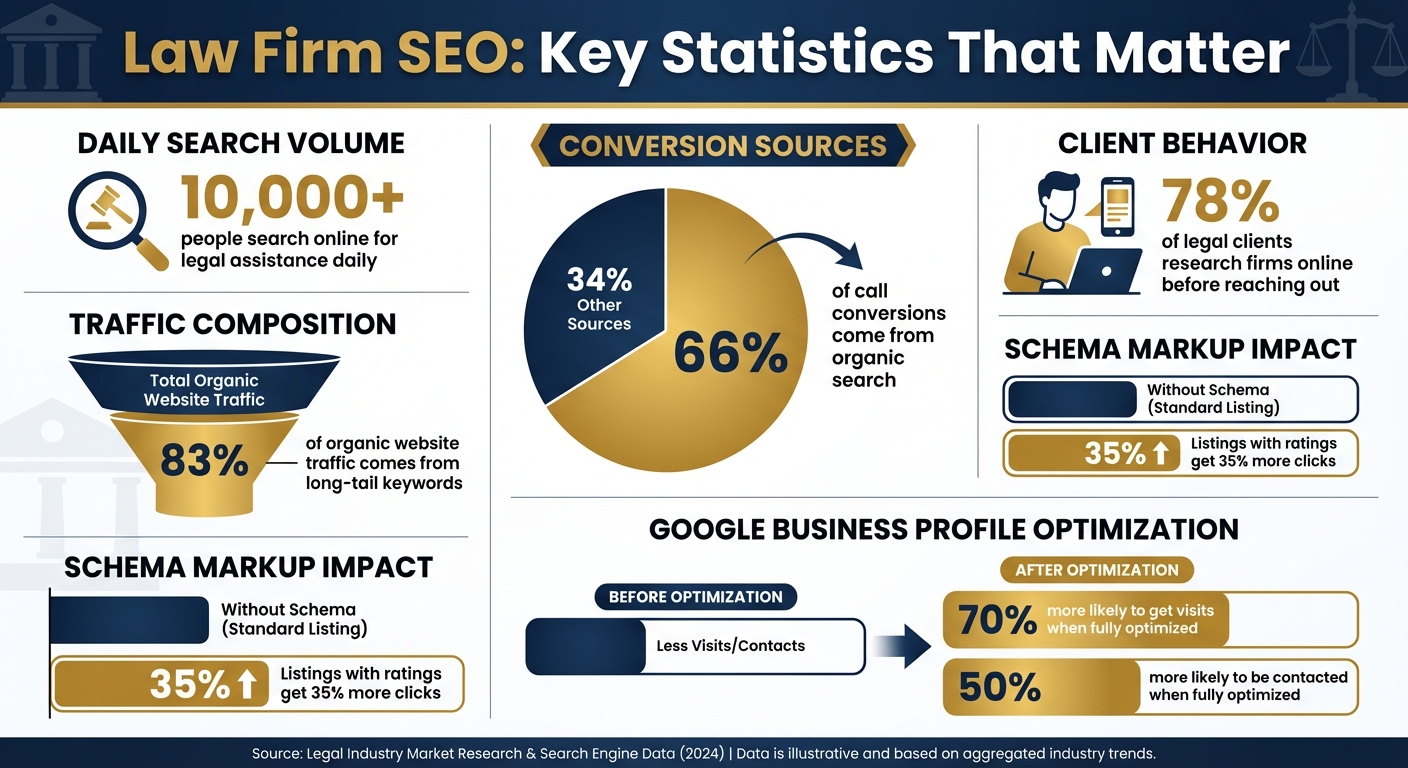
Law Firm SEO Statistics and Performance Metrics
Local SEO For Lawyers: My Proven Strategy
How to Research and Target Legal Keywords
Keyword research is more than just identifying popular search terms; it’s about understanding how potential clients seek legal help. Every day, over 10,000 people search online for legal assistance, and the language they use reveals exactly what they need. When your content aligns with these search patterns, you position yourself to connect with clients at the moment they’re looking for your services.
The type of keywords people use often reflects how close they are to making a decision. With up to 66% of call conversions for law firms coming from organic search, it’s crucial to target terms that match where potential clients are in their decision-making process.
Start by thinking about the language your clients actually use. While legal professionals might use terms like "litigation" or "tort", potential clients are more likely to search for phrases like "car accident lawyer" or "help with a lawsuit." To get a better sense of this, ask your clients what words they used when searching for legal help.
Adding geographic terms to your keywords – like city names, neighborhoods, or "near me" – is another way to attract local clients. For instance, searches like "DUI lawyer near downtown Atlanta", "immigration lawyers in Queens", or "family law attorney 90210" often have less competition than broader, national keywords.
Pay special attention to long-tail keywords, which make up about 83% of organic website traffic. These are longer, more specific phrases that often indicate a stronger intent to hire. Instead of targeting just "divorce lawyer", you might focus on more detailed searches like "uncontested divorce lawyer in Miami" or "child custody attorney Broward County." Next, let’s explore how understanding search intent can refine your keyword strategy.
Types of Search Intent for Legal Services
Search intent is all about understanding what people are looking for when they type in a query. Google’s RankBrain AI uses keywords and user behavior to identify intent, and tailoring your content to match that intent can make a big difference. Here are the main types of search intent and how they apply to legal services:
- Informational Intent:
These searches are for learning or understanding. Queries like "what is a criminal law attorney" or "how much is my car accident case worth" suggest the user is in the early stages of gathering information. - Navigational Intent:
When people search for phrases like "personal injury lawyer near me" or "immigration lawyers near me", they’re looking for specific local services. Optimizing your location pages and keeping your Google Business Profile updated can help you capture these high-conversion searches. - Commercial/Investigational Intent:
Searches such as "best law firm for divorce" or "workers’ compensation lawyer in Atlanta, Georgia" suggest the user is comparing their options. Content like client testimonials, case studies, and comparison guides can help position your firm as the best choice. - Transactional Intent:
Queries like "experienced DUI defense attorney – free consultation" or "fast legal representation for personal injury" indicate that the user is ready to take action. Pages targeting these searches should include clear calls-to-action, easy-to-find contact details, and options to schedule consultations quickly.
Want to know how to identify intent? Try searching for the keywords you’re targeting. If the top results are educational articles, the intent is likely informational. If you see local map results, it’s navigational. And if service pages with pricing dominate, the intent is probably transactional.
Finding the Right Keywords for Your Practice
Once you understand search intent, analyzing your competition can help you find valuable keyword opportunities. Search your target terms and review the Google Local Pack results. Look at which firms appear, the keywords they use in their titles and meta descriptions, and how they structure their service pages. This can reveal gaps you can fill with your own content.
When building your keyword list, combine practice areas with location-specific terms. Go beyond the main city to include suburbs, neighborhoods, ZIP codes, and nearby communities. For example, if you handle personal injury cases in Dallas, your list might include terms like "personal injury lawyer Dallas", "Dallas car accident attorney", "truck accident lawyer Dallas County", or "slip and fall attorney near Dallas". Hyperlocal searches like "criminal defense lawyer in Buckhead" often face less competition while targeting specific client needs.
It’s also important to balance your keyword strategy. Short-tail keywords like "DUI lawyer" may have high search volumes but are highly competitive and often lead to lower conversion rates. Body keywords, such as "DUI lawyer Los Angeles", add more context and have medium search volumes. Long-tail keywords, like "first-time DUI lawyer downtown Los Angeles free consultation", have lower search volumes but tend to convert better because they’re so specific.
Finally, remember to review and update your keyword strategy regularly. Search trends change, new competitors emerge, and the language your clients use evolves. Staying on top of these shifts ensures your approach continues to drive calls and consultations to your firm.
How to Optimize Key On-Page Elements
Once you’ve nailed down effective keyword research, the next step is to fine-tune your on-page elements. This not only helps your law firm rank higher but also ensures your pages are structured to convert visitors into clients. On-page optimization is more than just sprinkling keywords throughout your content – it’s about showing expertise, organizing information for both users and search engines, and establishing credibility. Since Google holds legal content to stricter standards under its YMYL (Your Money or Your Life) guidelines, law firms must pay close attention to how they present their information.
Elements like title tags, headers, and URLs play a major role in how search engines classify your pages and how users navigate your site. A well-optimized page makes it easier for potential clients to find answers while reinforcing the authority and relevance of your content. Let’s break down how these elements – from content to URL structure – can boost both rankings and conversions.
Writing Content That Builds Trust and Authority
Google evaluates legal content using E-E-A-T: Experience, Expertise, Authoritativeness, and Trustworthiness. For law firms, this means your content should clearly show that it’s written or reviewed by licensed attorneys. Including attorney bios with qualifications, bar admissions, and case experience on service pages or blog posts can go a long way in building trust.
A smart strategy is to compile a list of 50–100 common client questions and create pages that thoroughly answer each one. Instead of generic pages like "What is probate?", consider more specific topics such as "What Happens If You Die Without a Will in Texas?" or "How Long Does Probate Take in Cook County?" This type of targeted content appeals to users who are closer to making a decision.
Creating in-depth resource centers can also enhance your authority in specific legal areas. For instance, a detailed guide like "The Complete Guide to Chapter 7 Bankruptcy" or "Understanding Custody Evaluations in Divorce" (2,500–3,500 words) can establish your expertise while linking to shorter, related articles. Additionally, tailoring content to specific jurisdictions – like "Filing Divorce in Harris County Circuit Court" or "DUI Penalties Under California Vehicle Code Section 23152" – can attract highly qualified local leads. Always cite reputable sources like statutes or court decisions to show your content is well-researched, and have a licensed attorney review everything before it goes live.
Use plain language to explain legal terms and avoid overwhelming readers with jargon. Break up text with clear headings, subheadings, and bullet points to improve readability. Adding multimedia elements like images, graphics, or videos can also keep users engaged. Including client testimonials and case studies helps build social proof, while regularly updating content to reflect changes in laws or case decisions signals to search engines that your site remains up-to-date and reliable.
Writing Effective Title Tags and Meta Descriptions
Title tags are crucial for signaling a page’s relevance to search queries and directly impact click-through rates from search results. Every page should have a unique title tag that incorporates the primary keyword, location, and a clear benefit. For example, instead of using a generic title like "Divorce Services", try something more specific like "Chicago Divorce Lawyer | Free Consultation | Smith Family Law" to highlight what you offer and where you practice.
Keep title tags concise – ideally between 50–60 characters – so they don’t get cut off in search results. Place the most important keywords near the beginning and include your location for local SEO. While meta descriptions don’t directly affect rankings, they play a big role in encouraging users to click on your link. Write meta descriptions that complement your title tag, include a call-to-action, and entice users to take the next step. For example: "Facing DUI charges in Atlanta? Our experienced defense attorneys have helped over 500 clients reduce or dismiss charges. Call (404) 555-0100 for a free case review." Aim for 150–160 characters and make sure every page has a unique description.
Organizing Headers and URLs
Headers (H1–H6) and URLs are essential for structuring your site in a way that’s clear to both users and search engines. Use a single H1 tag per page as your main title, making it descriptive and keyword-rich. For example, "Houston Personal Injury Attorney | Car Accident & Slip-and-Fall Cases" clearly identifies the page’s focus and location.
Use H2 tags for main sections and H3 tags for subsections. Avoid skipping header levels (like jumping from H2 to H4) as this can confuse search engines and disrupt the content hierarchy. For example, a Probate Administration page might use an H1 for the main title, H2 headers like "Understanding Probate Administration", and H3 subsections such as "What Is Probate?" and "Role of the Probate Administrator." Another H2, like "Benefits of Professional Probate Assistance", could include its own H3 subsections.
When it comes to URLs, keep them short, keyword-focused, and easy to read. Use hyphens to separate words and avoid unnecessary fillers like "of", "and", or "the." For example, instead of using a URL like "yourfirm.com/page123?id=456", opt for something cleaner like "yourfirm.com/family-law/child-custody/." A logical directory structure helps search engines understand how pages are related and makes navigation easier for users. If your firm serves multiple cities or counties, create location-specific landing pages with geo-targeted URLs like "yourwebsite.com/dallas-family-law-attorney" or "yourwebsite.com/orange-county-estate-planning." This approach also supports internal linking and simplifies tracking performance by location or practice area.
Adding Local SEO and Schema Markup
Local SEO is a must-have for law firms. Why? Because clients often search for attorneys within specific areas, making it essential to clearly showcase your location and the regions you serve. Since attorneys are licensed to practice in particular states or jurisdictions, your website needs to communicate this information clearly. Strong local SEO ensures your firm appears in Google’s Local Pack (those map results for searches like "divorce lawyer near me" or "personal injury attorney in Miami") and boosts your visibility for location-specific searches. Pairing this with structured data markup makes it easier for search engines to understand your services and display detailed, rich search results. To strengthen these local signals, focus on standardizing your NAP (Name, Address, Phone) details and embedding relevant maps.
Strengthening Local SEO Signals
Start by ensuring your NAP information is consistent across your website, Google Business Profile, and all online directories. Use standard U.S. formatting for addresses and phone numbers. For example, "123 Main Street, Suite 200, Austin, TX 78701" and "(512) 555-0100." Display your NAP prominently in your website footer so it appears on every page. You should also include it on your contact page and any location-specific landing pages.
Adding a Google Map to your contact page or location pages enhances local relevance. It gives visitors a quick way to locate your office and get directions. If your firm operates in multiple locations, create separate pages for each office. Include unique NAP details, embedded maps, and content tailored to the specific area.
Mentioning local landmarks, neighborhoods, or courthouses can also help. For example, you might say, "Our office is two blocks from the Harris County Civil Courthouse" or "We serve clients throughout the Greater Phoenix area, including Scottsdale, Tempe, and Mesa." This not only helps search engines but also reassures potential clients about your familiarity with the area. For firms serving multiple counties or cities, consider creating dedicated landing pages with geo-targeted URLs like "yourfirm.com/orange-county-dui-attorney" and content that addresses local laws, court systems, or community-specific concerns.
Once you’ve nailed your local SEO signals, you can take things further by integrating schema markup.
Implementing Legal Service Schema Markup
Schema markup is a type of structured data added to your website’s HTML that helps search engines understand your content better. For law firms, LegalService and LocalBusiness schema types are especially important. The LegalService schema highlights the specific legal services you offer – whether that’s family law, criminal defense, or estate planning – ensuring search engines recognize your expertise in these areas. Meanwhile, LocalBusiness schema emphasizes your physical location, contact details, and office hours, helping search engines associate your firm with a specific region.
Schema markup can significantly boost your visibility. Listings with ratings, for instance, get 35% more clicks, and 78% of legal clients research firms online before reaching out. Including schema with details like your address, phone number, office hours (formatted as "Monday–Friday, 9:00 AM–5:00 PM"), service areas, and even location coordinates (latitude and longitude) can lead to rich snippets – those enhanced search results showcasing reviews, services, and contact information directly on the search page.
You can add schema markup manually by editing your site’s HTML or use plugins if you’re on platforms like WordPress. Tools like Google’s Structured Data Markup Helper can guide you step-by-step. For firms with multiple offices, make sure to apply LocalBusiness schema to each location-specific page, reflecting the unique details of that office. If you’re unsure where to start, resources like how to add local business schema markup can provide a clear roadmap. Once you’ve implemented the markup, test it with Google’s Rich Results Test to ensure everything is error-free and ready for enhanced search displays.
Measuring and Improving On-Page SEO Performance
Once you’ve made on-page SEO updates, the next step is measuring their impact and refining your approach. Tools like Google Analytics 4 (GA4) and Google Search Console (GSC) are essential for connecting your SEO efforts to measurable outcomes. GA4 tracks key user interactions – like form submissions, phone calls, and live chats – that often lead to signed cases. Meanwhile, GSC provides valuable insights into how Google views your site and how users interact with your search listings. Together, these tools help you fine-tune your on-page SEO strategy based on actual performance data.
Key Metrics to Track for Law Firm Websites
Here are some of the most important metrics to monitor:
- Organic traffic: The number of visitors reaching your site through search engines.
- Keyword rankings: The performance of your pages for specific legal search terms.
- Click-through rate (CTR): The percentage of users clicking on your search listings, as shown in GSC. A low CTR might indicate that your title tags or meta descriptions need improvement.
- Leads and conversions: Actions like filling out contact forms, making phone calls, or requesting consultations – indicators of qualified traffic.
- Bounce rate and time on page: These metrics show whether your content aligns with visitor expectations.
Using Data to Refine Your On-Page Strategy
Use GSC to spot opportunities, like keywords ranking just beyond the first page or pages with low CTR. Revise title tags and meta descriptions to make them more compelling. In GA4, analyze pages with high bounce rates or short time spent on the page. For instance, if a page about car accident claims has a high bounce rate, consider tightening the content and addressing common client concerns more directly.
Conclusion
On-page SEO plays a crucial role in helping law firms connect with potential clients. By focusing on geo-specific keywords and fine-tuning elements like title tags, meta descriptions, headers, and URLs, you make it easier for search engines to pair your firm with relevant searches.
But it doesn’t stop there. Local SEO efforts, such as optimizing your Google Business Profile, maintaining consistent directory listings, and encouraging client reviews, are equally important. These strategies ensure your firm appears in searches like "[your city] personal injury lawyer" or "business attorney near me." In fact, law firms with a fully optimized Google Business Profile are 70% more likely to get visits and 50% more likely to be contacted. That’s not just improved visibility – it’s a direct path to client inquiries.
Once these strategies are in place, use tools like GA4 and GSC to monitor your performance. This will help you quickly identify underperforming pages or low click-through rates, so you can make adjustments and keep your SEO efforts on track.
FAQs
How can law firms use long-tail keywords to boost their SEO performance?
Law firms can boost their SEO efforts by zeroing in on long-tail keywords – those specific, detailed search phrases that potential clients are likely to use. Unlike broader terms, these keywords often face less competition, making it easier for your website to climb the search rankings.
Take this example: instead of going after a broad keyword like "divorce lawyer", a firm could target a more precise phrase like "affordable divorce lawyer in Atlanta." This strategy doesn’t just help you rank higher; it also brings in more qualified leads – people who are actively searching for exactly what you offer. By weaving these targeted phrases into your content, meta descriptions, and headings, you can improve your online visibility and turn more visitors into clients.
How does schema markup improve local SEO for law firms?
Schema markup plays a key role in helping search engines grasp the details of your website’s content, making it simpler for them to present the most relevant information in search results. For law firms, adding local business schema can showcase crucial details like your address, phone number, business hours, and even client reviews.
By providing this extra layer of information, you can enhance your visibility in local search results, making it easier for potential clients to discover your services. Plus, it helps build trust and credibility for your firm online.
Why is understanding search intent important for a law firm’s SEO strategy?
Understanding search intent is a critical part of any law firm’s SEO strategy. It helps ensure your website content aligns with what potential clients are actually searching for. Whether they’re looking for legal advice, exploring specific legal services, or ready to hire an attorney, tailoring your pages to match their intent can make all the difference.
By doing this, your site becomes more relevant in search results, which not only improves visibility but also boosts the likelihood of turning visitors into clients. Aligning with search intent builds trust and shows potential clients that your law firm is the right choice when they need it most.