
High-authority backlinks are essential for legal websites to rank higher on search engines and attract qualified traffic. These links signal credibility and expertise, especially in a competitive field like law, where search engines prioritize trust, relevance, and quality. Here’s what you need to know:
- Why Backlinks Matter: Backlinks act as endorsements, directly impacting rankings. Sites with strong backlink profiles outperform competitors, especially after Google’s 2024 focus on expertise and trust (E-E-A-T).
- What Makes a Good Backlink: Links from reputable, law-related sources (e.g., bar associations, legal journals) carry more weight than unrelated or low-quality links. Factors like domain authority, topical relevance, and natural anchor text are key.
- How to Build Them: Focus on ethical methods like creating valuable legal content, leveraging directories like Avvo and Justia, forming partnerships, and earning links through media coverage or academic collaborations.
- Avoid Pitfalls: Steer clear of paid link schemes or manipulative tactics that violate Google’s guidelines. Regularly audit your backlink profile to remove harmful or irrelevant links.
Building a strong backlink profile requires a mix of strategy, quality content, and ethical practices. The payoff? Better rankings, increased traffic, and a stronger online presence for your law firm.
3 Link Building Strategies for Lawyers
What Makes a Quality Legal Backlink
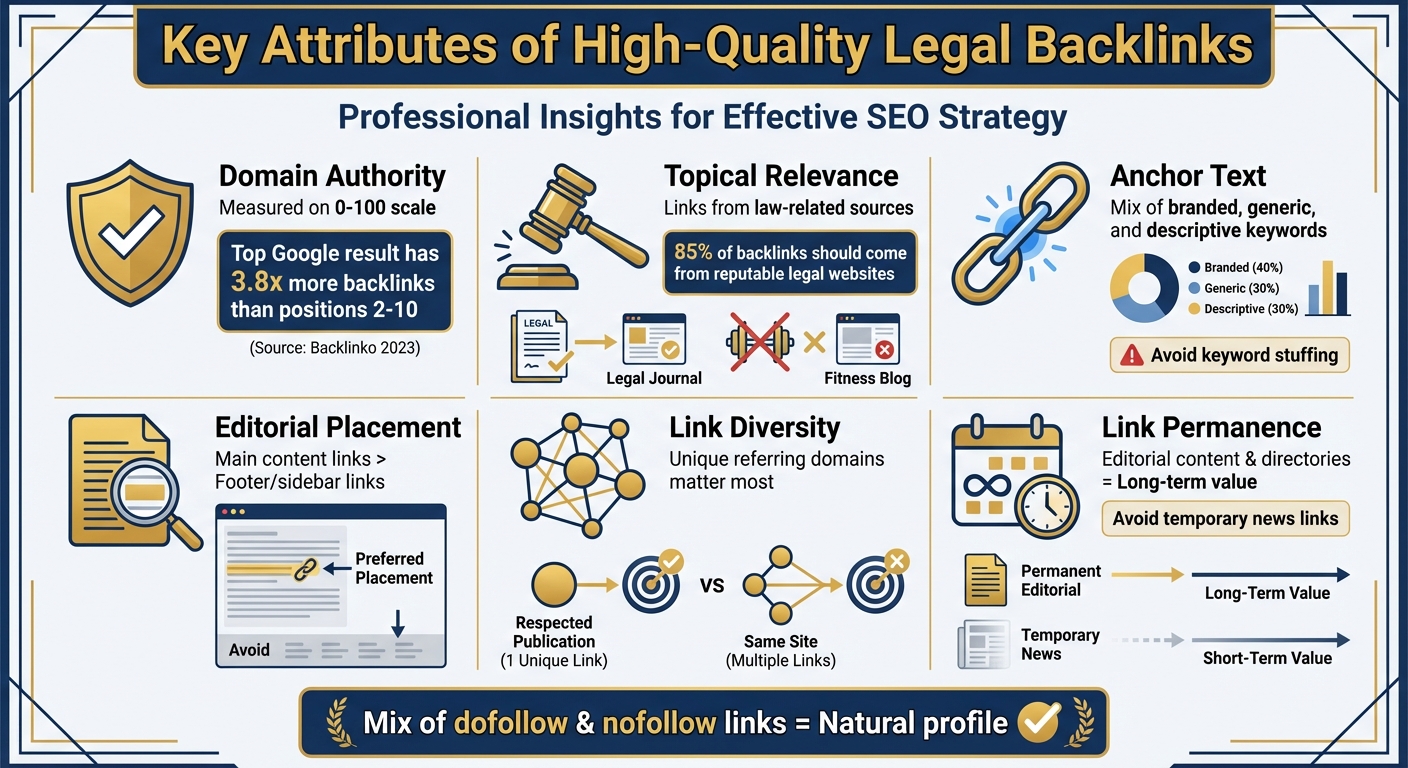
Key Attributes of High-Quality Legal Backlinks
Not all backlinks are created equal. A link from a state bar association, for example, carries far more weight than one from an unrelated blog. Understanding what distinguishes a strong backlink from a weak one is key to focusing your efforts where they’ll have the most impact.
Domain authority is a critical factor. Websites with high domain authority – measured on a 0 to 100 scale – have earned credibility with search engines through strong backlink profiles. A 2023 study by Backlinko revealed that the top-ranking result in Google has, on average, 3.8 times more backlinks than pages ranked in positions 2 through 10. While domain authority is important, it’s only part of the equation.
Topical relevance is equally essential. Search engines prioritize backlinks from sources that align with your area of expertise. For a law firm, a link from a legal journal is far more valuable than one from a fitness blog. To compete for highly sought-after keywords, 85% of your legal backlinks should come from reputable, law-related websites. This also aligns with Google’s E-E-A-T framework, which evaluates your experience, expertise, authoritativeness, and trustworthiness in the legal field.
Anchor text plays a pivotal role in signaling your page’s content to search engines.
Neil Patel explains, "A quality backlink is a link that comes from a high domain authority website that is well-trusted by search engines and searchers alike. In other words, not only do the robots trust the website, but actual people also trust the website".
Using descriptive anchor text like "personal injury attorney software" helps search engines understand your content, boosting its ranking for relevant keywords. However, it’s important to maintain a natural anchor text profile by mixing branded terms, generic phrases, and descriptive keywords. Overusing keyword-heavy anchors can raise red flags.
Editorial placement is another factor to consider. Links embedded within the main content of a page carry more weight than those buried in footers or sidebars. Links positioned higher on a page tend to receive better click-through rates and pass more SEO value. Additionally, backlinks from sites with consistent organic traffic and growing keyword rankings are more valuable. It’s also important to ensure the linking site maintains a clean backlink profile, avoiding excessive or irrelevant links that could signal participation in link-selling schemes.
Key Attributes of Quality Backlinks
To build a strong backlink profile, consider these technical elements. While "dofollow" links directly impact SEO, a natural profile includes a mix of "dofollow" and "nofollow" links. Since 2019, Google has treated "nofollow" links as a "hint", meaning they can still help with discovery and indexing.
Google’s John Mueller has noted, "We try to understand what is relevant for a website, how much we should weigh these individual links, and their total number doesn’t matter at all. Because you could go off and create millions of connections across millions of websites if you wanted to, and we could just ignore them all".
Unique referring domains are more valuable than accumulating multiple links from the same site. For example, a single link from a respected legal publication carries more weight than several links from the same source. Diversify your backlinks by targeting reputable legal sites, bar associations, and industry publications for better results.
The permanence of backlinks is also crucial. Links embedded in editorial content, guest posts, or legal directories tend to stay live for years, offering long-term benefits. By contrast, temporary links from news articles or time-sensitive content may disappear over time. Additionally, backlinks from sites with stable organic traffic patterns hold more authority than those from sites with inconsistent or declining traffic.
Be mindful of the outbound linking habits of sites linking to you. Trustworthy sites link sparingly and only to reputable, relevant sources. Sites that link excessively to unrelated websites may be involved in link schemes, which can harm your rankings.
Ethical Guidelines and Compliance Rules
Beyond technical considerations, ethical practices are vital for sustainable legal SEO. Law firms must adhere to strict advertising rules set by the American Bar Association (ABA) and state bar associations, which prohibit misleading claims, false statements, and deceptive tactics.
Avoid paid link schemes entirely. Buying links or participating in link exchanges violates Google’s guidelines and can result in severe penalties, including removal from search results. Google’s algorithms are increasingly adept at detecting unnatural link patterns, so links that appear manipulative or lack genuine value can harm your SEO efforts.
Nancy Lippincott from Best Lawyers highlights, "Ethical, relevant backlinks remain vital for law firm SEO and long-term visibility".
If you use sponsored content or paid placements, transparency is key. Mark these links with the sponsored attribute to comply with Google’s spam policies. While such links don’t carry the same ranking value as editorial backlinks, they can still boost brand awareness and generate leads when disclosed properly. Similarly, links from user-generated content, such as comments or forums, should use the UGC attribute.
The best approach is to earn backlinks naturally by creating high-quality content and building genuine relationships. Develop resources like legal guides, case studies, and educational materials that other professionals and organizations will want to reference. Collaborate with industry influencers and publications to secure authentic backlinks from respected platforms. This strategy not only ensures compliance with ethical guidelines but also builds lasting SEO value that can withstand algorithm updates.
Regularly monitor your backlink profile to identify and address harmful links. If you find spammy or irrelevant links pointing to your site, take steps to remove or disavow them to protect your rankings. Proactive monitoring helps maintain your firm’s reputation and ensures your backlink profile stays clean and compliant with both search engine guidelines and legal ethics rules.
How to Build High-Authority Backlinks for Legal Websites
Creating high-authority backlinks for legal websites involves strategic outreach and producing content that resonates with trusted sources. The focus here is on earning links from directories, demonstrating expertise through valuable content, and building meaningful partnerships. These approaches align with ethical SEO practices and the principles of quality backlinking.
Using Legal Directories and Bar Associations
Legal directories and bar associations are excellent sources for backlinks that not only boost SEO but also drive relevant traffic. Start with well-established directories like Avvo, Justia, and Martindale-Hubbell. According to an ABA survey, 33% of law firms already use Avvo, showcasing its importance in the legal industry. These platforms help enhance your domain authority while adhering to legal advertising rules.
Don’t overlook state and local bar associations. Many of these organizations provide member directories featuring profile pages with backlinks, attorney spotlights, and committee or event pages that link back to your site. To maximize local SEO benefits, ensure your Name, Address, and Phone number (NAP) are consistent across all listings.
Creating Legal Content That Earns Links
Producing valuable legal content is a powerful way to attract backlinks while showcasing your expertise. Comprehensive guides on topics like probate laws, family law, or property transactions can draw links from local blogs and websites, bolstering your authority. This aligns with the E-E-A-T (Experience, Expertise, Authority, and Trustworthiness) standards.
Original research and data are particularly effective for earning links. For example, publishing studies on local legal trends, analyzing court cases, or conducting client surveys can create resources that journalists and content creators will want to reference.
Location-specific content is another winning strategy. For instance, anonymized case studies based on local legal cases or articles explaining local ordinances can attract backlinks from government websites and news outlets. Additionally, creating state-by-state legal comparisons on issues relevant to your practice and regularly updating them can make your site a go-to resource. According to industry data, 29% of law firms have acquired clients directly through blog posts, proving that well-crafted content can drive both traffic and business.
To expand the reach of your content, consider repurposing it. Turn detailed blog posts into infographics, create downloadable ebooks from comprehensive guides, or produce videos simplifying complex legal concepts. These formats can attract links from a broader audience.
Forming Partnerships for Natural Links
Building partnerships with complementary professionals and organizations is an effective way to gain natural backlinks while enhancing your firm’s reputation. These collaborations align with ethical SEO practices and help establish your domain authority.
Local business partnerships are particularly effective. For example, a real estate attorney could team up with real estate agents or mortgage brokers to host seminars on first-time homebuying, while an estate planning attorney might collaborate with financial advisors on retirement planning. These efforts often result in cross-promotion and backlinks as both parties share the content online.
Non-profit collaborations are another valuable avenue. Providing pro bono legal services to local charities or sponsoring community events can lead to backlinks from event pages or acknowledgments on the organizations’ websites.
Academic partnerships can also yield high-quality backlinks, especially from .edu domains. Contributing to law reviews, participating in research projects, or offering resources to clinical programs can result in citations and links from educational institutions. Guest lecturing at law schools is another way to enhance your backlink profile.
Media connections can open doors to authoritative backlinks as well. By offering expert commentary to journalists or sending press releases about newsworthy activities – like hosting a legal clinic or winning a community award – you can secure coverage that includes links to your website.
Lastly, appearing on podcasts or participating in expert roundups can provide additional backlink opportunities. Podcasts often include links to guest websites in their show notes, and expert roundups position you alongside other respected professionals, offering long-term link value.
Auditing and Monitoring Your Backlink Profile
Building quality backlinks is just one piece of the SEO puzzle; keeping an eye on your backlink profile is equally important to maintain the health of your legal website’s SEO. Regular audits not only safeguard your site’s reputation but also help you avoid penalties that could harm your search rankings. For legal websites, classified by Google as "Your Money or Your Life" (YMYL) sites, this process is especially critical.
How to Conduct a Backlink Audit
Start with Google Search Console to gather basic backlink data. It’s free and provides valuable insights, but it does have limitations, especially for larger websites that exceed its thresholds for domains, pages, or anchor text. For a more detailed analysis, tools like Ahrefs (starting at $29/month) or Semrush are excellent options. Both offer features to evaluate link quality, sources, and placements. If you’re just starting out, Moz Link Explorer is another option, and its free version is great for beginners.
When conducting your audit, focus on identifying harmful links that could result in penalties. Pay attention to patterns like links from irrelevant industries, suspicious domains, or pages overloaded with outbound links. Ensure your backlinks come from credible, authoritative sources rather than low-quality link farms. Also, check that all links are functioning – broken links leading to non-existent pages can negatively affect your rankings.
Once you’ve flagged any problematic links, the next step is to implement a plan for continuous monitoring.
Tracking and Maintaining Your Backlinks
After completing your audit, regular monitoring helps you stay ahead of potential issues. Aim to review your backlink profile monthly to catch problems early. Use Google Search Console alerts to stay informed about sudden drops in link counts, spammy links, or broken links. Keep track of both new and lost links so you can adjust your strategy as needed.
If you find toxic links, Google Search Console’s disavow tool can help protect your site from penalties. Additionally, reach out to website owners to fix broken links or turn unlinked brand mentions into active backlinks.
Monitoring backlinks isn’t just about avoiding penalties – it’s also about improving performance. Tie your efforts to metrics like website traffic, lead generation, and client inquiries. A 2023 Backlinko study found that the #1 result on Google typically has 3.8 times more backlinks than the page in the #2 position, highlighting the importance of a strong backlink profile. Focus on acquiring high-quality, relevant backlinks from trusted legal sources rather than chasing sheer numbers.
Conclusion: Building a Long-Term Backlink Strategy for Legal Websites
Investing in high-quality backlinks for your legal website is a smart, long-term move to boost your firm’s digital credibility and authority. This approach aligns with the strategies discussed in this guide and promotes steady SEO growth. Why does it work? Because it focuses on quality over quantity and sticks to ethical practices instead of shortcuts. A single backlink from a well-respected legal resource can have far more impact than dozens of low-quality links.
Backlinks remain one of the most influential ranking factors. In fact, top-ranking pages typically have far more backlinks than those lower on the results page. Additionally, a strong backlink profile can help your site maintain its rankings, even when search engine algorithms change. That makes it one of the most reliable SEO strategies for law firms.
To succeed, stick to three key principles. First, always prioritize ethics. Avoid buying links, engaging in link schemes, or using tactics that violate Google’s rules or state bar advertising guidelines. Second, focus on creating content that’s genuinely useful – think state-specific legal guides, in-depth case studies, or data-driven reports that others in the legal industry or media will naturally want to reference. Third, treat link building as a networking opportunity. Build authentic relationships with legal professionals, journalists, and organizations, which can lead to natural backlinks over time. Together, these principles lay the groundwork for ethical and sustainable SEO success in the legal sector.
In practice, diversify your efforts. Maintain profiles on reputable legal directories, contribute guest articles to trusted publications, and keep an eye on your backlink profile to ensure quality. By combining ethical practices, valuable content, and meaningful relationships, your firm can strengthen its online presence while safeguarding its reputation.
FAQs
What are the best ways to identify high-quality backlinks for my legal website?
When it comes to backlinks, the best ones come from reliable and respected websites that have a strong connection to the legal field. Think of sources like prominent legal associations, trade groups, law schools, reputable legal publications, or even government websites.
As you assess potential backlinks, pay attention to three key factors: the site’s domain authority, its relevance to your legal niche, and its reputation for offering trustworthy information. Links from sources that match your practice area and target audience can do more than just improve your search rankings – they can also enhance your credibility in the eyes of potential clients.
What are the risks of using paid link schemes for improving SEO rankings?
Using paid link schemes to improve your SEO rankings might seem tempting, but it comes with serious risks. Search engines like Google have clear rules against these practices, and breaking them can lead to harsh consequences. Your site could face penalties like lower search rankings or, in the worst-case scenario, being completely removed from search results.
On top of that, paid links often don’t provide real value or relevance, which can damage your site’s reputation with both users and search engines. A better approach? Stick to ethical methods. Focus on creating quality content, building connections with trustworthy organizations, and using respected legal directories to grow your backlink profile in a way that’s natural and sustainable.
How often should I review my backlink profile to ensure strong SEO performance?
To keep your SEO efforts on track, you should review your backlink profile at least every three months. These regular check-ins are crucial for spotting and dealing with harmful or low-quality backlinks that might harm your site’s domain authority or search rankings.
For websites actively building links or seeing big shifts in traffic, it’s wise to take a closer look more often – monthly audits can be a good idea. Use reliable tools to monitor your backlinks, and prioritize keeping links that are high-quality, relevant, and in line with ethical SEO standards.