

A fast website isn’t just nice – it’s necessary for law firms wanting to rank higher on Google and convert visitors into clients.
Here’s why speed matters:
- Google prioritizes fast websites in its rankings because they improve user experience and make crawling more efficient.
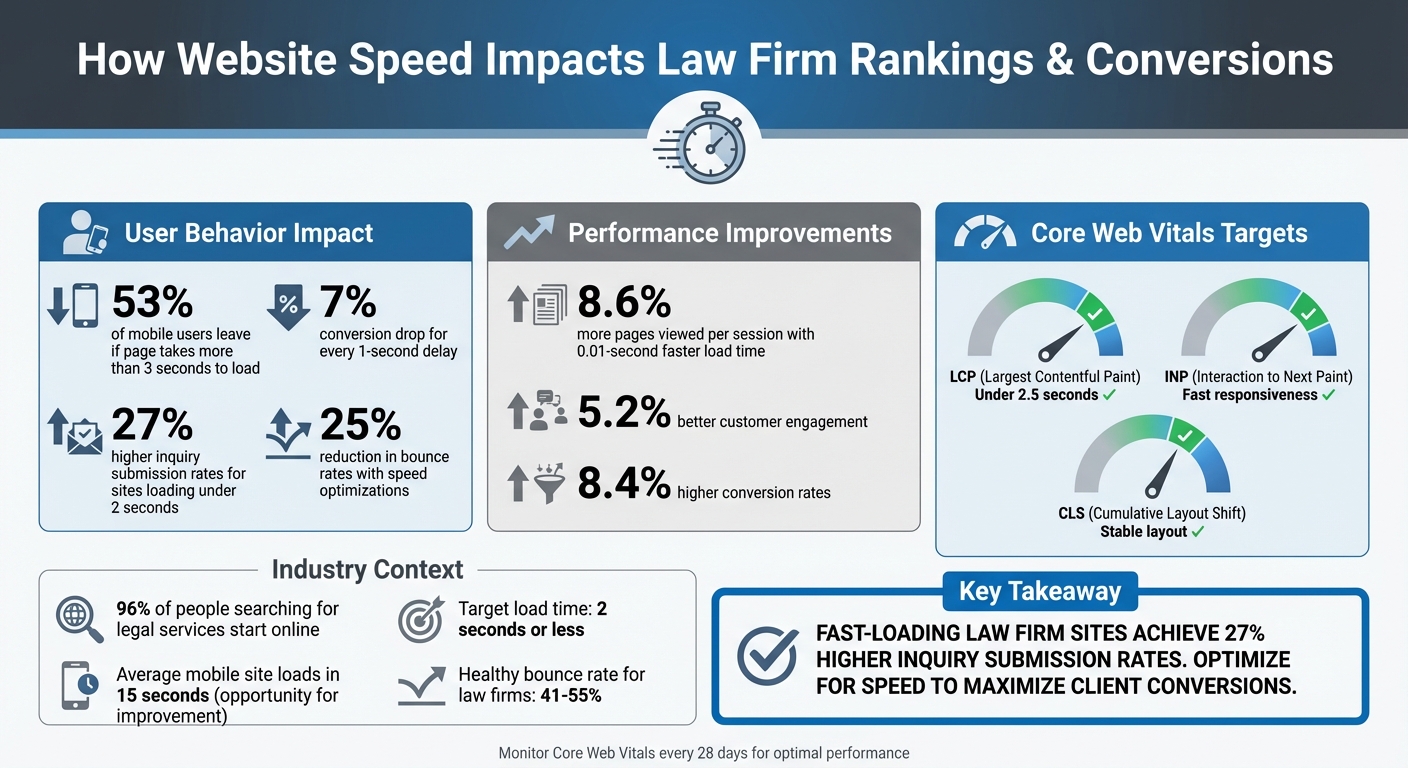
- Slow websites lose visitors – 53% of mobile users leave if a page takes more than 3 seconds to load.
- Speed impacts conversions – law firms with load times under 2 seconds see 27% more inquiry submissions.
- Core Web Vitals are key – metrics like Largest Contentful Paint (LCP) and Cumulative Layout Shift (CLS) directly affect rankings.
Improving speed involves optimizing images, using caching, leveraging CDNs, and upgrading hosting. Tools like Google PageSpeed Insights can help monitor progress. A faster website means better rankings, more leads, and a stronger online presence.
How Website Speed Impacts Law Firm Rankings and Conversions
Does PageSpeed Actually Impact SEO? [New Experiment]
How Website Speed Affects SEO Rankings
Google includes website speed as part of its Page Experience signals, which directly influence search rankings. For law firms, fast loading times are essential – especially in competitive local markets where potential clients are comparing multiple attorneys online.
Website speed not only improves SEO but also enhances user engagement, signaling to Google that your site delivers quality. Let’s break down the key metrics and user behaviors that highlight why speed matters.
Core Web Vitals: What Law Firms Need to Know
Google evaluates user experience using three Core Web Vitals metrics, which play a major role in determining your rankings:
- Largest Contentful Paint (LCP): This measures how quickly the largest visible content on your page – like practice areas, attorney photos, or contact details – loads. Aim for under 2.5 seconds.
- Interaction to Next Paint (INP): Tracks how responsive your site is when users interact, such as clicking a button or submitting a form.
- Cumulative Layout Shift (CLS): Ensures that elements on your page remain stable during loading, preventing frustrating shifts when users are trying to read or tap on something – like your phone number on a mobile device.
These metrics form the foundation of how Google assesses your site’s performance. A law firm with strong Core Web Vitals scores is more likely to rank higher than competitors with similar content but slower loading speeds. Now, let’s look at how speed influences user behavior and reduces bounce rates.
Speed and User Behavior: Reducing Bounce Rates
Did you know that 53% of mobile visitors leave a website if it takes more than 3 seconds to load? Even a one-second delay can cut conversions by 7%. On the flip side, law firms with page load times under 2 seconds often see 27% higher inquiry submission rates compared to slower sites.
First impressions matter – especially in legal services. When potential clients search for an attorney, they’re often dealing with urgent issues like a car accident, divorce, or criminal charge. If your website loads slowly, it can give the impression that your firm is outdated or unreliable, eroding the trust needed to turn visitors into clients. Mobile users, in particular, expect quick access to information, given the time-sensitive nature of their legal needs.
Faster websites also encourage visitors to stay longer and explore more pages. This increased engagement sends a strong signal to search engines that your content is valuable, improving your search visibility. Speed optimizations can even lead to a 25% reduction in bounce rates, making it easier to convert visitors into clients.
How to Improve Website Speed for Law Firms
Now that we’ve covered why speed is so important, let’s dive into some practical ways to make your law firm’s website faster. Legal websites often feature high-resolution images, detailed attorney profiles, and other elements that can slow things down. Here’s how to tackle these challenges head-on.
Image Optimization Techniques
Images like attorney headshots and office photos are essential for law firm websites, but they can significantly drag down loading times. A review of 54 law firm websites revealed that large image sizes were a major factor affecting performance and user experience.
To address this, start by compressing your images using tools designed for this purpose. You can also convert images to modern formats like WebP, which typically offers better compression than older formats like JPEG or PNG. For photographs, stick with JPEG; for logos or graphics that need transparency, use PNG. Additionally, enable lazy loading so images only appear when they’re needed, and define height and width attributes to avoid layout shifts during loading.
Caching and Content Delivery Networks (CDNs)
Once your images are optimized, focus on improving how your site delivers content. Caching is a great way to speed things up – it stores copies of your website’s files (like images, CSS, and JavaScript) on nearby servers, reducing the need to fetch them from your main server every time someone visits.
Using a Content Delivery Network (CDN) takes this a step further. CDNs distribute your website’s content across servers worldwide, so a visitor in Dallas, for instance, could load your site from a nearby server instead of one located across the country. This reduces latency and speeds up loading times. CDNs often come with added security features like DDoS protection and SSL encryption, making them a win-win. You can also set up browser caching (via your .htaccess file, for example) to make return visits even faster.
Upgrading Hosting Solutions
Your hosting provider plays a massive role in your website’s speed. A slow server can lead to higher bounce rates and erode trust with potential clients. For law firm websites, it’s worth investing in hosting solutions with 99.99% uptime, fast Time to First Byte (TTFB), and built-in SSL security. If you’re currently using shared hosting, consider upgrading to managed hosting. Managed hosting offers dedicated resources and better scalability, which can handle traffic spikes – whether from a marketing campaign or a feature in local news. It’s a step that ensures your site runs smoothly no matter the circumstances.
How to Measure and Monitor Website Speed
After making changes to your website, you’ll want to ensure they’re actually working. Checking your website’s speed isn’t just a one-and-done task – it’s an ongoing process. Regular monitoring helps you catch issues early and track your progress over time. Thankfully, there are plenty of free tools to make this easier.
How to Use Diagnostic Tools
Start with Google PageSpeed Insights. This tool analyzes your website’s performance and pinpoints which resources are slowing it down. It also measures your Core Web Vitals – key metrics Google uses for rankings – and gives you a score out of 100. Other useful (and free) tools include Google Chrome’s Lighthouse, WebPageTest, and Google Web Vitals. For more in-depth analysis, GTmetrix offers additional insights, including the option to test your site from different server locations.
To get a reliable picture of your site’s speed, run three tests at different times and average the results. If your business serves clients across multiple states or regions, make sure to test your website from various geographic locations. Test both desktop and mobile performance on different network types, keeping in mind Google’s mobile-first indexing approach. Google suggests aiming for page load speeds of two seconds or less, but the average mobile site takes about 15 seconds to load. That means there’s often significant room for improvement.
Once you’ve gathered diagnostic data, document your current metrics. This will serve as your baseline for tracking future improvements.
Setting a Performance Baseline
Before you can measure progress, you need to know where you stand. Record key metrics such as Core Web Vitals, overall page load time, bounce rate, and mobile performance. Ideally, aim for an average load speed of three seconds or less. For law firms, a healthy bounce rate typically falls between 41-55%, while rates above 70% could indicate potential issues.
Check your Core Web Vitals every 28 days to monitor trends and assess whether your updates are making a difference. Comparing current metrics to previous periods – especially year-over-year – can help account for seasonal changes and provide a clearer view of your progress. Even small improvements can have a big impact: a 0.01-second faster load time could result in 8.6% more pages viewed per session, 5.2% better customer engagement, and 8.4% higher conversion rates. Every fraction of a second counts!
Conclusion
Website speed plays a crucial role in your law firm’s online success. Quick-loading pages not only influence how Google ranks your site but also shape the experience potential clients have when they visit – and that directly affects how many inquiries turn into cases. With 96% of people searching for legal services starting their journey online, every moment matters.
The numbers tell the story: law firms with page load times under two seconds enjoy 27% higher inquiry submission rates. Even a tiny improvement – just 0.01 seconds – can boost pages viewed per session by 8.6% and increase conversions by 8.4%. On the flip side, slow-loading sites risk losing up to 53% of mobile users if pages take longer than three seconds to load. The cost of a sluggish site is undeniable.
Keeping your site optimized and aligned with Google’s evolving standards is vital – not just for rankings but also for building trust with potential clients. As Google’s John Mueller explains:
…Core Web Vitals is more than a random ranking factor, it’s also something that affects your site’s usability after it ranks (when people actually visit).
The path forward is clear: start by assessing your site’s current performance, apply the optimization strategies that suit your firm, and regularly monitor Core Web Vitals – ideally every 28 days. Whether you handle this internally or work with SEO professionals, investing in website speed pays off. It leads to stronger rankings, more engaged visitors, and a steady flow of qualified leads. A fast-loading site reflects the professionalism and dependability your firm stands for, turning every second saved into new opportunities.
FAQs
What are the best ways for law firms to speed up their websites?
Law firms can boost their website speed by focusing on a few practical strategies. Start with image optimization – reducing file sizes while maintaining quality ensures faster loading times. Implement lazy loading, which delays the loading of images and videos until they’re actually needed, saving valuable resources. Choosing a fast, reliable hosting provider is another key step to ensure your server responds quickly.
Other effective techniques include enabling browser caching, which stores website data locally for returning visitors, and trimming down unnecessary JavaScript to simplify the loading process. Using a Content Delivery Network (CDN) is also a smart move, as it distributes your content across multiple servers, making pages load faster for users regardless of their location. These improvements not only create a smoother experience for visitors but can also positively impact your site’s search engine performance.
What are Core Web Vitals, and why do they matter for law firm websites?
Core Web Vitals are a set of performance metrics that Google uses to gauge how user-friendly a website is. These metrics include:
- Largest Contentful Paint (LCP): Measures how quickly the main content of a page loads.
- First Input Delay (FID): Tracks how quickly a site responds to a user’s first interaction.
- Cumulative Layout Shift (CLS): Evaluates how stable the visual elements on a page are during loading.
For law firm websites, getting these metrics right is essential. Google considers them when determining search rankings, meaning a website that’s fast, responsive, and visually stable can rank higher. Beyond rankings, a well-optimized site creates a better experience for visitors, keeps them from leaving too soon, and increases the chances they’ll reach out to your firm. Focusing on these metrics can help your website stand out in both local and organic search results.
How does a fast-loading website improve client conversions for law firms?
A fast-loading website is essential for law firms looking to boost client conversions. It creates an immediate positive impression and ensures a smooth experience for visitors. When your site loads quickly, potential clients are more inclined to stay, explore your services, and engage with your content – ultimately increasing the likelihood that they’ll reach out for legal assistance.
In contrast, a slow-loading website can drive users away, leading to higher bounce rates and lost opportunities. By improving your site’s speed, you not only make the experience more enjoyable for visitors but also build a sense of trust. This trust encourages potential clients to take action, whether it’s completing a contact form or picking up the phone to call your office.