
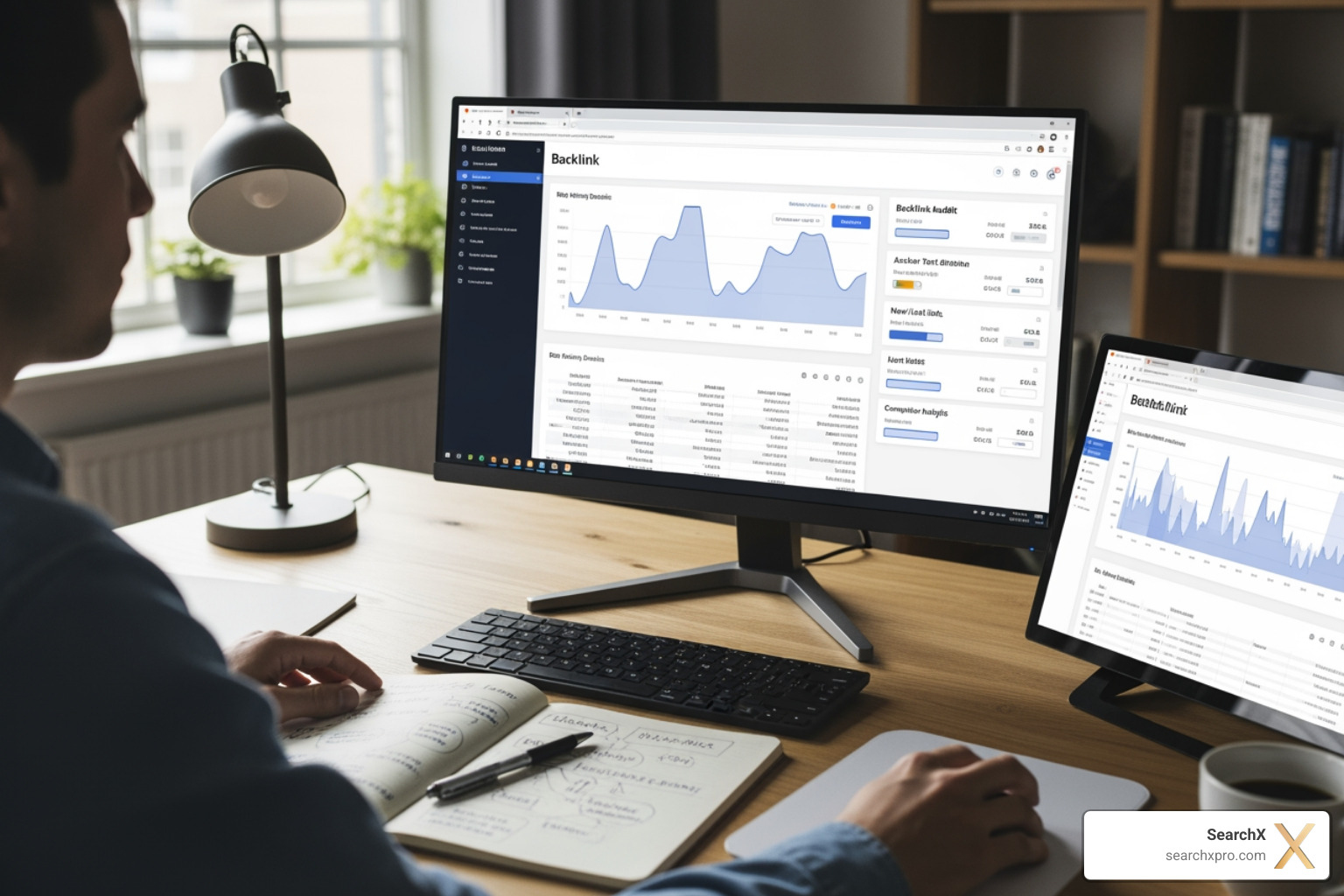
Why Monitoring Your Backlinks is Critical for SEO Health
Protecting your website’s search rankings requires more than just acquiring backlinks—it demands constant vigilance. This monitor backlinks tutorial provides a clear process for safeguarding your SEO health.
How to Monitor Backlinks:
- Gather Data: Export your backlink list from Google Search Console.
- Track Links: Use a dedicated tool to organize and monitor your links.
- Check Status & Quality: Regularly verify that links are live and evaluate their authority and relevance.
- Take Action: Disavow toxic links, reclaim lost ones, and track changes monthly.
Acquiring backlinks is only half the battle. Since backlinks are a top 3 ranking factor, your profile’s health is paramount. But it can change overnight without your knowledge. High-quality links can disappear, get ‘nofollowed’, or worse, toxic links can accumulate and trigger a Google penalty that tanks your rankings.
Losing just a few high-quality backlinks can hurt your rankings and cost thousands in lost traffic. This guide will walk you through the exact process we use at SearchX to protect our clients’ SEO investments and prevent these disasters.
Why Backlink Monitoring is Non-Negotiable for SEO Success
Without monitoring, valuable backlinks can disappear, or toxic links can accumulate, causing your rankings to tank before you even know there’s a problem. Continuous backlink monitoring is as essential to SEO as the links themselves.

Here’s why regular monitoring is critical:
- Protect Your Rankings: When high-quality links vanish, Google notices. Broken backlinks stop the flow of authority and signal that your site is poorly maintained. Monitoring helps you fix these issues before they hurt your traffic.
- Avoid Google Penalties: Low-quality or spammy links actively harm your rankings. Google’s algorithms look for suspicious patterns, and links from PBNs or irrelevant sites can trigger penalties. Regular monitoring lets you spot and remove these toxic links early.
- Protect Your Investment: Every backlink represents an investment of time or money. When links are removed or changed to “nofollow” without your knowledge, that investment is wasted. Reclaiming lost links can save thousands in link building costs.
- Find Competitor Opportunities: Analyzing where your competitors get links reveals new strategies, publications, and content ideas. You can even claim valuable links they’ve lost.
- Guard Against Negative SEO: Some competitors may point spammy links at your site to trigger a penalty. Proactive monitoring catches these attacks quickly, allowing you to take defensive action.
To see how professional monitoring amplifies these benefits, check out our guide on How Backlink Monitoring Tools Improve SEO.
Understanding Key Backlink Metrics
To monitor effectively, you need to understand these core metrics:
- Referring Domains: The number of unique websites linking to you. More unique, relevant domains are better than many links from one site.
- Domain Authority (DA) / Domain Rating (DR): Scores from Moz (DA) and Ahrefs (DR) that estimate a website’s backlink strength. They are useful benchmarks for quality.
- Spam Score: A metric from tools like Moz that estimates the likelihood a site is spam. Low scores are ideal.
- Anchor Text Distribution: The clickable text used in your backlinks. A natural profile has a mix of branded, partial-match, and generic anchors. Over-optimized, exact-match anchor text is a red flag.
- Dofollow vs. Nofollow: Dofollow links pass SEO value (“link equity”), while nofollow links do not. A natural profile contains both.
- Link Relevance: How closely related the linking site’s topic is to yours. A relevant link from your industry carries more weight.
For a comprehensive breakdown of evaluating link quality, read our detailed guide on How to Assess Backlink Quality in 2025.
A Step-by-Step Monitor Backlinks Tutorial
This monitor backlinks tutorial provides the practical steps for setting up an effective early warning system to protect your SEO investment.
Step 1: Gather Your Backlink Data with Free Tools
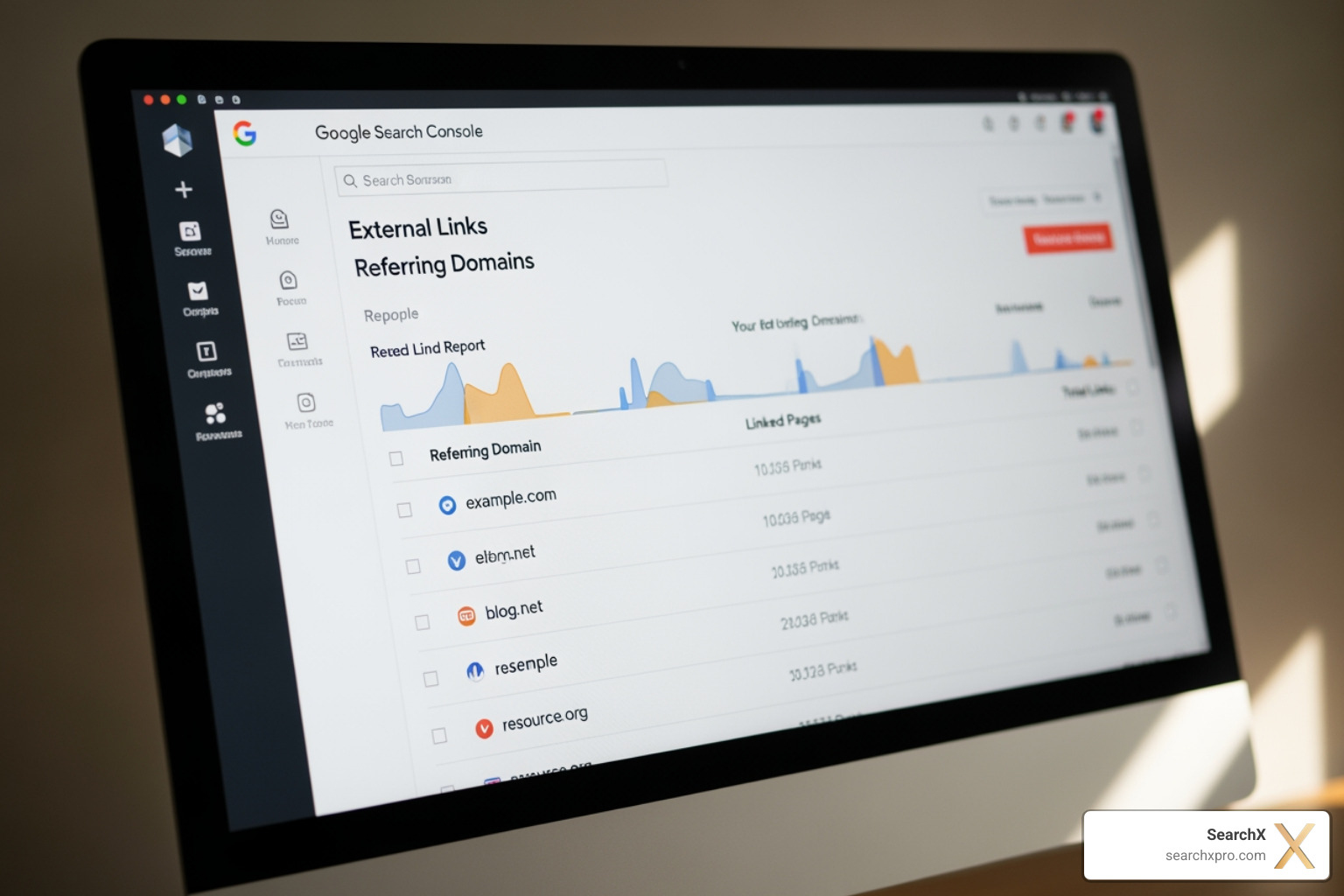
Start by collecting your existing backlink data. Google Search Console (GSC) is the best free starting point, as the data comes directly from Google.
- Log into your GSC account and steer to the “Links” section.
- Review the top linking sites (who links to you) and top linked pages (your most popular content).
- Export your link data. This file is the foundation for your monitoring system.
While GSC is essential, it has limitations. It doesn’t offer real-time alerts or provide quality metrics like spam scores, making it an incomplete solution for comprehensive monitoring.
Step 2: Set Up a Monitoring System
With your data exported, you need a system to track changes. While a manual spreadsheet is possible for very small sites, it’s time-consuming and prone to error.
We recommend choosing a dedicated backlink monitoring toolkit. A good tool automates the process and provides critical features:
- Real-time alerts for new, lost, or changed links.
- Competitor analysis capabilities.
- Detailed link quality metrics (DA, spam score, etc.).
- An integrated disavow tool and link categorization.
The right tool transforms monitoring from a chore into an automated system that alerts you when action is needed.
Step 3: How to Manually Check and Evaluate Your Backlinks
Automated tools are great, but manual review is irreplaceable for understanding your profile’s health. When reviewing a link, ask these questions:
- Site Quality & Relevance: Visit the linking page. Is the site reputable and relevant to your niche? A link from a local food blog to your Naples bakery is gold; a link from a random tech forum is not.
- Link Placement & Context: Is the link placed editorially within the main content, or is it hidden in a footer with dozens of other links? Editorial links carry far more weight.
- Anchor Text: Does the clickable text look natural? A healthy profile includes your brand name, partial matches, and generic phrases. Too many exact-match keywords look manipulative and are a red flag.
For a deeper dive into what makes a backlink truly valuable, check out our guide on How to Evaluate Backlink Relevance. It covers the nuances of assessing topical relevance and editorial placement.
Managing Your Backlink Profile: Pruning and Recovery
Monitoring is just the first step. The real work is taking action by pruning harmful links and recovering valuable ones.
How to Identify and Handle Toxic Backlinks
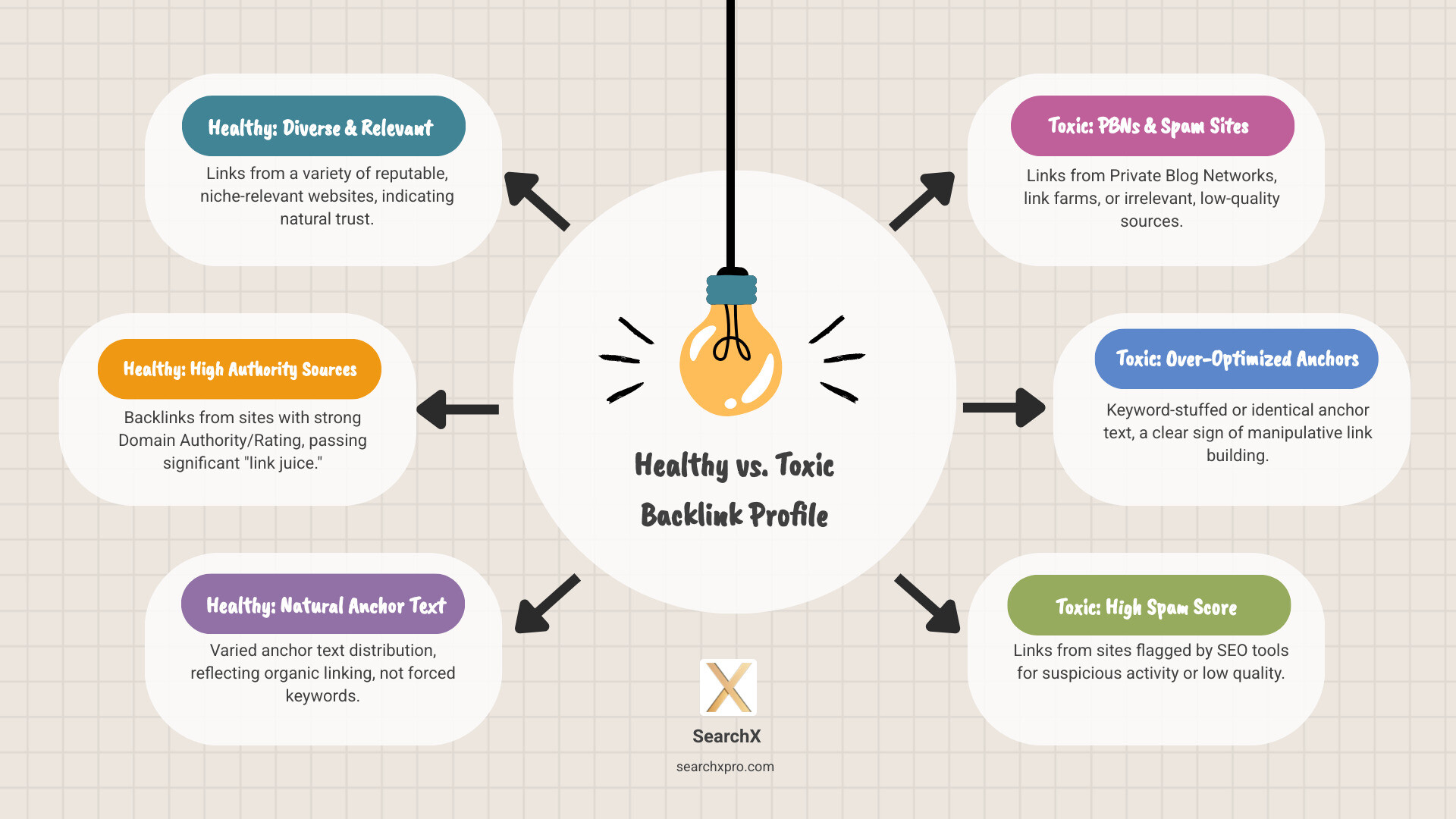
Bad links can poison your SEO strategy. A backlink is toxic if it comes from:
- PBNs (Private Blog Networks): Websites created solely to manipulate search rankings.
- Irrelevant Niches: Links from completely unrelated, low-quality sites (e.g., a gambling site linking to a local business).
- Sites with High Spam Scores: Tools can identify domains with characteristics of spam sites.
- Pages with Over-Optimized Anchor Text: When too many links use the exact same keyword, it looks unnatural to Google.
To handle these, start the link pruning process by emailing the webmaster and politely requesting removal. Document every attempt. If they don’t respond, you may need to disavow the link. For more on spotting these, see our guide on What are Toxic Backlinks?.
When and How to Use the Google Disavow Tool
The Google Disavow Tool tells Google to ignore specific links. Treat it as a last resort, to be used only after manual removal requests have failed. Google’s algorithms can ignore most spammy links, but the tool is necessary if you have a manual penalty or are cleaning up a history of bad link building.
- Create a disavow file: A plain text (.txt) file listing the URLs or domains to ignore. Use
domain:spammy-site.comto disavow an entire domain. - Submit to Google: Upload the file via Google Search Console.
- Document your efforts: Keep records of your outreach and disavowed links. This is crucial if you ever need to file a reconsideration request.
For exact steps, follow the steps in Google’s documentation here.
Reclaiming Lost High-Quality Backlinks
Losing a valuable backlink hurts, but you can often recover it with quick action.
- Identify Lost Links: A monitoring tool will alert you as soon as a link disappears.
- Find the Reason: Was the page removed? Did your URL change, creating a broken link? The fix depends on the cause.
- Contact the Webmaster: Send a polite, personalized email. If the link broke because your page moved, provide the updated URL. If their content changed, suggest a new, relevant resource from your site.
This helpful approach builds relationships and dramatically increases your success rate. For tips on effective outreach, see our guide on How to Write Outreach Emails for Backlinks.
Gaining a Competitive Edge with Competitor Backlink Analysis
Your competitors have already done some of the heavy lifting by identifying valuable websites and creating link-worthy content. Analyzing their backlink profiles gives you a roadmap to their success and helps you find opportunities they missed.
A Simple Monitor Backlinks Tutorial for Competitors
Monitoring competitors isn’t about copying them; it’s about understanding the landscape to find your own path.
- Identify Your Top SEO Competitors: Your true SEO competitors are the websites that consistently rank for your target keywords, not necessarily your direct business rivals.
- Analyze Their Backlink Profiles: Use SEO tools to examine their referring domains, the authority of those sites, and the types of links they’re getting (e.g., editorial mentions, guest posts).
- Find Their Top-Linked Content: Identify their “link magnets”—the content that attracts the most backlinks. This gives you a blueprint for creating something even better.
- Check Their Link Velocity: See how quickly they are acquiring new links. A steady stream signals a consistent strategy, while a sudden spike could indicate a new campaign.
For a full breakdown, see our guide on How to Identify Competitor Backlinks.
Finding Actionable Opportunities
Turn your research into results by looking for these opportunities:
- Find Link Gaps: Identify high-quality sites that link to your competitors but not to you. These are prime outreach targets.
- Broken Link Building: Find broken links pointing to a competitor’s site. Reach out to the webmaster, report the broken link, and suggest your content as a replacement.
- Uncover Guest Post Sites: See where your competitors are publishing guest posts. These sites are likely open to contributions from others in your niche.
- Replicate Successful Tactics: If a competitor is earning links from resource pages or podcast appearances, explore those same channels for your own business.
For more strategies on turning these insights into backlinks, explore our resource on Backlink Opportunity Finder for Growth.
Frequently Asked Questions about Backlink Monitoring
Here are answers to common questions we hear from clients about monitoring backlinks.
What makes a backlink “toxic” or “spammy”?
A backlink is toxic if it’s designed to manipulate search engines rather than provide genuine value. Key red flags include links from low-quality or irrelevant websites, paid link schemes, private blog networks (PBNs), and pages with over-optimized anchor text. Tools that measure a “spam score” can also help identify potentially harmful domains. For a deeper look, see our guide on What are Toxic Backlinks?.
How often should I monitor my backlinks?
It depends on your activity level and industry:
- Monthly: This is sufficient for most established websites.
- Weekly: Recommended if you are running an active link building campaign or are in a highly competitive niche.
- Immediately: You should always audit your backlinks after a significant, unexpected drop in rankings.
What should I do if I find a broken backlink to my site?
Finding a broken backlink is an opportunity. These links hurt user experience and waste SEO value.
- Identify the cause: Did you move or delete a page on your site? If so, the fix is on your end.
- Fix your side: Set up a 301 redirect from the old URL to the most relevant live page. This preserves most of the link’s value.
- Contact the webmaster: Send a friendly email informing them of the broken link and provide the correct URL. They will usually appreciate the heads-up.
Conclusion
This monitor backlinks tutorial shows that backlink monitoring is not a one-time task but a continuous process essential for SEO health. Regular monitoring protects your rankings from disappearing links, helps you avoid Google penalties, saves your link building investment, and uncovers competitor strategies.
Your backlink profile is constantly changing. Without monitoring, you’re vulnerable to lost links, negative SEO, and other issues that can harm your rankings.
At SearchX, we turn clicks into customers by managing every aspect of SEO, including proactive backlink monitoring. We understand this can be overwhelming while you’re running a business. Our expert services are designed to protect your investment and drive measurable revenue growth.
We build custom strategies for businesses in Charleston, Austin, New York, Miami, Naples, Stockholm, Malmö, and across the United Kingdom, Poland, Scandinavia, Switzerland, and the Nordic Countries.
Don’t let your hard-earned backlinks slip away. Take control of your profile and give your website the protection it deserves. Get professional help with your Link Building Services and let’s build an SEO strategy that lasts.