
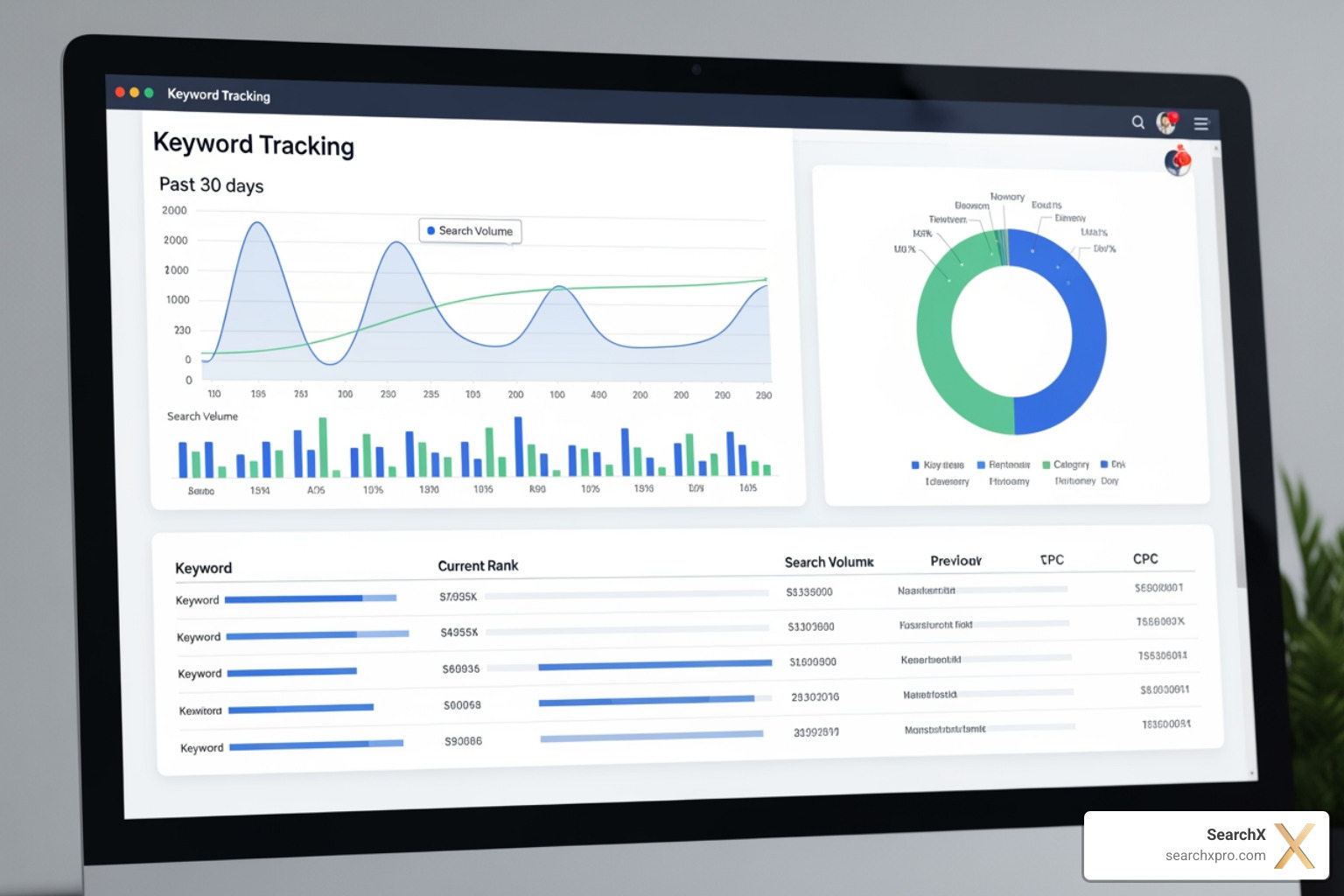
Why Every Business Owner Needs to Track Website Keywords
Track website keywords and you open up the most direct path between your website and revenue growth. Here’s what you need to know:
To effectively track website keywords:
- Choose high-intent keywords that align with your business goals.
- Select a tracking method – use Google Search Console for free basic tracking, or dedicated keyword tracking tools for detailed insights.
- Set up your project with device targeting, location settings, and competitor monitoring.
- Monitor key metrics like ranking position, visibility, SERP features, and estimated traffic.
- Act on the data by optimizing content, fixing ranking drops, and building on wins.
The stakes are high. A single position drop for a key product keyword can mean thousands of lost visits and significant revenue loss. For example, one retailer lost an estimated 31,300 organic visits from just one position slip for a popular product. Another saw a one-position drop for a high-value keyword cost them an estimated $3,096 in potential revenue in a single day.
In 2025, search results change faster than ever. AI Overviews push organic listings down, and competitors optimize daily. Without tracking, you’re flying blind, missing the movements that actually impact your bottom line.
I’m Lorenz Esposito, founder of SearchX, and I’ve helped businesses track website keywords to identify revenue opportunities and protect against costly ranking drops. The framework I’m sharing combines proven fundamentals with modern strategies that account for AI search and evolving SERP dynamics.

How to Effectively Track Website Keywords: A Step-by-Step Guide
When you track website keywords systematically, you’re not just collecting data—you’re building a roadmap that shows exactly how customers find you and where you’re leaving money on the table. Let me walk you through how we set up keyword tracking projects that move the needle.
Choosing the Right Keywords to Track for Your Website
Don’t track every keyword; you’ll drown in useless data. Instead, focus on terms that align with your business goals and drive revenue.
Prioritize these keyword types:
- High-intent keywords: Phrases people use when they’re ready to act (e.g., “SEO services Charleston SC” vs. “what is SEO”).
- Conversion-focused terms: Keywords that lead directly to a sale or lead, like “buy [product name]” or “[service] near me.”
- Branded and non-branded keywords: Track your company name to see how easily existing customers find you, and non-branded terms to gauge your competitive position.
- Long-tail keywords: Longer, specific phrases (e.g., “affordable local SEO for small retail stores”) often have lower volume but higher conversion rates and less competition.
Before tracking new terms, review your Google Search Console data to find keywords you already rank for. You may find quick wins on page two. Also, analyze competitor keyword gaps—what they rank for that you don’t—to find new content opportunities. The right number of keywords depends on your site; a local business might track 50-100, while a large e-commerce site could track thousands. The key is to prioritize by business value.
For a deeper look at how we build keyword strategies, check out our SEO solutions.
Selecting Your Tracking Method: Free vs. Dedicated Tools
You have two main options: free tools or dedicated platforms.
Google Search Console is the free starting point, offering data directly from Google on queries, impressions, clicks, and average position. You can learn the basics from Google’s official guide.
However, GSC shows average positions, which can hide critical issues like poor mobile rankings. It also lacks competitor tracking and has limited historical data (16 months).
For serious SEO, dedicated rank trackers provide the necessary precision. They offer daily updates, location-specific accuracy (down to the city or ZIP code), and competitor tracking. You also get SERP feature analysis (to see if you’re in featured snippets, AI Overviews, etc.) and years of historical data to measure long-term impact.
Here’s a quick comparison:
| Feature | Google Search Console | Dedicated Tracking Tools |
|---|---|---|
| Cost | Free | Paid subscription (typically $30-$50/month for basic plans) |
| Data Source | Direct from Google | Proprietary crawling, often third-party verified |
| Update Frequency | Daily (with reporting delays) | Daily, weekly, or real-time updates |
| Ranking Granularity | Average position across all appearances | Exact position per keyword, per device, per location (city/ZIP code) |
| Competitor Tracking | No | Yes, monitor multiple competitors |
| SERP Feature Analysis | Limited | Comprehensive (featured snippets, AI Overviews, image packs, etc.) |
| Historical Data | Up to 16 months | Multiple years of trend data |
| Alerts & Reporting | Basic email notifications | Customizable alerts, detailed reports, analytics integrations |
While GSC is useful for a quick overview, dedicated tools provide the competitive intelligence needed to win in tough markets.
Setting Up and Managing Your Tracking Project
Setting up a tracking project is quick if you get the details right.
Start by entering your domain, then specify your search engine, device (track desktop and mobile separately), and location. For local businesses, tracking at the city or ZIP code level is crucial, as rankings vary dramatically within metro areas like Charleston, Austin, or Stockholm.
Next, add your keyword list. Use tags to organize them by funnel stage (awareness, conversion), page type (blog, product), or business priority. This allows you to filter data and focus on what matters.
Add 3-5 top competitors to monitor their movements alongside yours, revealing opportunities to outrank them. Then, set up automated alerts for significant ranking changes (e.g., drops of 3+ positions). This lets you respond quickly to critical shifts.
Managing your project is an ongoing process. Review reports weekly, update your keyword list as your business evolves, and adjust tags as your strategy shifts. This keeps your tracking aligned with your business priorities. We also use various free SEO tools to complement data from dedicated trackers.
When you track website keywords with this precision, you build an intelligence system that guides your optimization efforts.
From Data to Decisions: Using Tracking Insights to Drive SEO Strategy
The real power of keyword tracking isn’t in the numbers themselves—it’s in what you do with them. When we track website keywords at SearchX, we’re building a roadmap that tells us exactly where to focus our efforts for maximum business impact.

Key Metrics to Monitor and What They Mean
Several interconnected metrics paint a complete picture of your search performance:
- Ranking position: Your exact spot in the search results. Studies show the top position gets over 27% of clicks, which drops significantly for each subsequent position. Every drop means lost potential customers.
- Visibility score: An estimate of your overall presence across all tracked keywords, calculated by most dedicated tools. It’s a great high-level view of your search real estate.
- Search volume: The monthly search demand for a keyword. This helps prioritize which ranking improvements will have the biggest business impact.
- SERP features owned: Shows if you appear in featured snippets, “People Also Ask” boxes, or AI Overviews. Owning these features can drive more traffic than a higher organic rank alone.
- Estimated traffic: A calculation of how many visitors you likely get from a keyword based on its position and search volume. This connects rankings to tangible traffic.
- Average position: A useful overview, but be cautious. It can mask problems on specific devices or locations, so always dig deeper.
Together, these metrics reveal the full performance story and drive smart decisions.
Informing Content Strategy and Uncovering Competitor Secrets
Your tracking data shows you exactly what to do next.
Keywords ranking on page two or three are prime opportunities for content optimization. This signals your content is relevant but needs strengthening with more depth, better structure, or fresh information. If a high-value keyword drops, investigate whether competitors improved their content or if technical issues are at play.
Identifying content gaps is another key benefit. By comparing your rankings to competitors, you can find valuable keywords they rank for that you don’t. Each gap is a chance to create new content and capture traffic they currently own.
Competitive tracking also reveals which of their pages perform best, what keywords drive their traffic, and their overall market share. This isn’t about copying; it’s about understanding the landscape to find angles they’ve missed and identify potential backlink opportunities.
The goal is proving ROI. We connect ranking improvements to business outcomes, showing how a jump in position for a key term translated into more visitors, leads, and revenue. This is the power of connecting SEO to your bottom line.
Common Mistakes to Avoid When You Track Website Keywords
Avoid these common pitfalls to get the most from your tracking efforts:
- Tracking too many keywords: This dilutes focus. Prioritize keywords that align with business goals and conversion potential.
- Ignoring search intent: A high ranking won’t convert if your page doesn’t match what the user wants (e.g., an informational blog post for a transactional query).
- Not segmenting by priority: Use tags to separate high-value keywords from others. This helps you spot critical drops immediately.
- Overreacting to daily fluctuations: Rankings bounce around. Focus on consistent trends over weeks, not daily jitters.
- Forgetting new targets: Your keyword list should evolve. Regularly add emerging terms and retire those that are no longer relevant.
- Only watching average position: This can hide critical problems on mobile or in specific locations. Always analyze device and location-specific data.
Advanced Keyword Tracking for a Competitive Edge
The world of search is constantly evolving. To maintain a competitive edge, we need to look beyond traditional rankings and adopt advanced tracking strategies.
Navigating AI Overviews and Their Impact on Your Rankings
The rise of Google’s AI Overviews is changing the search landscape, often pushing organic results down. In 2025, tracking is more important than ever to steer these shifts.
At SearchX, we practice Generative Engine Optimization (GEO). This involves:
- Tracking Visibility in AI: Advanced tools can now track your brand’s appearance in AI Overviews and other AI search platforms. We monitor this to understand your presence.
- Optimizing for AI Citations: We structure content with clear, concise answers and authoritative information to make it easily citeable by AI models.
- Understanding Impact on Organic Listings: We track keywords affected by AI Overviews to measure the impact on clicks to traditional organic results and adapt our strategy.
- Enhancing Content Authority: AI prioritizes clear, factual content. We focus on content depth and ensuring pages directly answer user queries, making them prime candidates for AI inclusion.
This proactive approach ensures your business remains visible in both traditional and intelligent search experiences.
Identifying and Fixing Keyword Cannibalization
Keyword cannibalization occurs when multiple pages on your site compete for the same keyword. This confuses search engines, dilutes your authority, and causes unstable rankings.
Here’s how we identify and fix it:
- Identifying Competing Pages: Many dedicated tools offer reports to spot these overlaps. We also manually review tracking data to see if different URLs appear for the same keyword over time.
- How to Fix Cannibalization:
- 301 Redirects: Redirect the weaker page to the stronger one to consolidate authority.
- Content Consolidation: Combine similar pages into one comprehensive resource.
- Refocusing Content: Redefine the target keywords for each page so they don’t directly compete.
- Internal Linking: Use internal links to signal which page is the most authoritative for a topic.
Resolving cannibalization ensures each page has a clear purpose and the best chance to rank.
Frequently Asked Questions about Tracking Website Keywords
We hear the same questions come up again and again when business owners start to track website keywords. These are the ones that matter most, along with the honest answers we give our clients.
How many keywords should I track?
The right number depends on your business size and goals. There’s no magic number.
A small local site (e.g., a coffee shop in Charleston) might start with 50 to 100 keywords covering branded terms and local service phrases. Larger e-commerce or content sites may need to track hundreds or thousands across different categories.
The most important rule is to prioritize by business value. It’s better to track 50 keywords that directly tie to revenue than 500 that don’t move the needle. Focus on impact, not volume.
How often should I check my keyword rankings?
We recommend checking your rankings at least once per week. This is frequent enough to spot meaningful trends without getting lost in normal daily volatility.
Rankings fluctuate. A keyword might drop and rebound within a few days. We focus on consistent movement over time. A steady decline over two weeks is a signal to investigate.
For your most critical, revenue-driving keywords, set up automated alerts in your tracking tool. You’ll be notified of important drops immediately, so you only need to act when it’s necessary.
Can I track keyword rankings for local SEO?
Yes, and for any business serving specific geographic areas like Charleston, Miami, or Stockholm, it’s essential. Local rankings can be dramatically different from national ones.
Modern rank trackers let us track down to the city or even ZIP code level. This precision is crucial for local businesses, allowing us to see how you perform for hyper-local searches (e.g., “emergency dentist 29401”).
Mobile tracking is also critical, as most local searches happen on phones. We track both desktop and mobile to get a complete picture of your local visibility. This data connects directly to your Google Business Profile performance and your appearance in the local map pack, which is often the most valuable real estate in local search.
Conclusion: Turn Your Keyword Data into Tangible Results
Keyword tracking is only valuable when it leads to real business results. It’s an ongoing conversation with your customers, revealing what they’re searching for and how well you’re meeting their needs.
Consistent tracking helps you uncover opportunities, understand competitors, and catch problems before they cost you money. It’s the difference between data-driven decisions and guesswork. Knowing which keywords drive traffic and which pages need work allows you to invest your budget wisely, turning visits into revenue.
Search engines and customer behavior are always evolving. The businesses that thrive are committed to continuous improvement—tracking performance, learning from data, and adapting their strategies.
At SearchX, we turn keyword data into actionable strategies that move the needle. Our approach combines SEO fundamentals with advanced techniques like Generative Engine Optimization to keep you visible in both traditional and AI-driven search. Whether you’re a local business in Naples or a growing company in Miami, the principles are the same: track the right keywords, understand the data, and take action.
Ready to see what’s really happening with your website’s search performance? Get a free website audit from SearchX today. We’ll show you where you stand, where the opportunities are, and how to turn rankings into real business results.